By Global Media & Commerce Correspondent
Published in partnership with ADWEEK House: Advertising HQ
Executive Overview
In the modern media and advertising landscape, audience engagement is no longer confined to traditional living room setups or static second-screen experiences. As linear television networks face fierce competition from streaming platforms and digital creators, live sports and associated ecosystems—most notably fantasy sports—remain the undisputed gold standard for capturing real-time consumer attention.
During the latest iteration of the highly anticipated ESPN Fantasy Football Marathon, sports broadcasting history was rewritten at 35,000 feet. In an unprecedented high-altitude activation, ESPN teamed up with United Airlines to execute a marquee fantasy football draft mid-flight, leveraging cutting-edge Starlink in-flight Wi-Fi to seamlessly connect an airborne analyst to the live broadcast desk.
This high-flying stunt represents far more than a momentary novelty; it is a masterclass in modern experiential marketing, strategic brand partnerships, and technical infrastructure utilization. For ESPN, the activation underscores the meteoric, record-breaking growth of its digital fantasy platform, which recently surpassed 14 million participants. For United Airlines, the stunt serves as a high-visibility demonstration of its robust, lightning-fast connectivity capabilities, proving that commercial airliners are no longer dead zones for high-bandwidth data consumption.
As the advertising industry prepares to converge at ADWEEK House: Advertising HQ in Midtown from October 5–8 to discuss the future of commerce, media, and unscripted brand connections, the ESPN-United collaboration stands out as a prime case study. It illustrates how brands can cross-pollinate audiences, leverage advanced technology, and turn routine consumer touchpoints into unforgettable live spectacles.
Detailed Chronology: The Anatomy of a Mid-Air Draft
The execution of a live, televised sports draft from a commercial aircraft requires meticulous planning, absolute technical reliability, and split-second timing. The operational timeline of this milestone event reveals the complex machinery powering modern sports media activations.
Phase 1: Pre-Flight Engineering and Network Stress-Testing (T-Minus 72 Hours)
Weeks before the aircraft ever pushed back from the gate, engineering teams from ESPN and United Airlines engaged in rigorous technical rehearsals. The primary variable was connectivity. Historically, in-flight Wi-Fi was notoriously unreliable, plagued by high latency, bandwidth throttling, and frequent dropouts—factors that are entirely incompatible with a live television broadcast requiring high-definition video feeds and real-time audio synchronization.
To overcome this, United’s integration teams utilized newly deployed Starlink satellite-backed Wi-Fi architecture. Engineers conducted multiple test flights to measure packet loss, upload speeds, and downlink stability at cruising altitudes. The system passed with flying colors, consistently delivering the low-latency parameters required to support a live broadcast feed traversing multiple cellular and satellite handoffs while hurtling through the stratosphere at 500 miles per hour.
Phase 2: Boarding, Cabin Transformation, and Operational Prep (Tuesday Morning)
On the morning of the ESPN Fantasy Football Marathon, the designated United Airlines aircraft was prepped not just for passenger transport, but as a fully functioning mobile television studio.
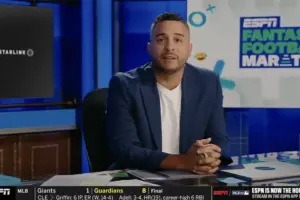
ESPN host and prominent fantasy football expert Tyler Fulghum boarded the flight alongside a lean production crew equipped with compact broadcast-grade cameras, mobile encoding units, and redundant audio gear. While standard passengers stowed their carry-ons and settled into their seats, Fulghum established a mobile command center in a mid-cabin row, transforming the tray table into a high-tech draft board.
Phase 3: Going Live at 35,000 Feet (The Broadcast Window)
As the aircraft reached its cruising altitude of 35,000 feet somewhere over the continental United States, the red light on the mobile camera blinked on.
Back at ESPN’s primary studios, anchors threw to the airborne segment. Viewers across the country watched in real-time as Tyler Fulghum appeared on screen, crystal-clear and free of latency artifacts, reporting live from the cabin. Utilizing the aircraft’s Starlink connection, Fulghum accessed his draft dashboard, analyzed player values, and made his selections in real time.
The picks were transmitted instantly to the ESPN draft war room, processed through the network’s fantasy backend, and reflected globally on millions of user screens within milliseconds. The segment concluded without a single technical hiccup, proving that high-speed digital engagement is no longer bound by terrestrial infrastructure.
Supporting Context & Metrics: The Exponential Rise of Fantasy Football
To understand the strategic value of United Airlines’ sponsorship and participation in this broadcast stunt, one must examine the staggering macroeconomic and demographic metrics underpinning the fantasy sports industry.
ESPN’s Record-Breaking Growth Trajectory
Fantasy football has evolved from a niche hobby played among office coworkers using pen and paper into a multi-billion-dollar cultural juggernaut that dictates NFL viewership habits, merchandise sales, and digital media consumption.
According to official network data from the most recent NFL season, ESPN Fantasy Football registered an astonishing 14 million participants. This milestone is even more impressive when viewed through a longitudinal lens: it marks the third consecutive year that ESPN’s fantasy ecosystem has grown by over 1 million active players annually.
| Metric / Year | Active Participants | YoY Growth | Primary Driver |
|---|---|---|---|
| Previous Season -2 | ~12.0 Million | +1.0M+ | Mobile App Redesign & UX Optimization |
| Previous Season -1 | ~13.0 Million | +1.0M+ | Expanded Betting Integrations & Social Leagues |
| Most Recent Season | 14.0 Million | +1.0M+ | Cross-Platform Synergy & Experiential Stunts |
This continuous compounding of users creates an enviable monetization engine for ESPN. High user density attracts premier advertisers, drives traffic to owned-and-operated digital properties, and feeds linear television ratings as fans tune in to monitor their fantasy matchups on Sundays, Mondays, and Thursdays.
The United Airlines Playbook: Capturing the Modern Business and Leisure Traveler
For United Airlines, aligning with a property boasting 14 million highly engaged, tech-savvy, and predominantly affluent participants is a masterstroke in brand positioning.
Modern air travelers—particularly frequent flyers, business executives, and millennial/Gen Z consumers—demand seamless connectivity. The traditional pain point of air travel has always been the "offline penalty"—the period of enforced isolation where emails go unanswered, streaming buffers indefinitely, and live events become inaccessible.
By powering ESPN’s high-altitude draft through Starlink, United is aggressively marketing its primary value proposition: connectivity without compromise. The airline is actively shifting consumer perception, transforming the airplane cabin from a disconnected tube into a high-productivity, high-entertainment extension of the modern living room or corporate office.
Official Statements and Industry Insights
While corporate partnerships of this scale require months of legal, logistical, and creative coordination, the payoff lies in the cultural resonance and public-facing narrative.
Industry analysts tracking the intersection of sports media and travel hospitality have lauded the activation as a benchmark for future brand integrations.
"We are witnessing the absolute erasure of traditional boundaries between where we are physically located and how we consume media," noted a leading media strategist specializing in sports entertainment ecosystems. "When a fantasy football expert can execute a live draft from a commercial airliner cruising at 35,000 feet with zero latency, it fundamentally alters consumer expectations. ESPN wins by pushing the boundaries of live television production, and United wins by proving that their technological infrastructure is light-years ahead of legacy in-flight Wi-Fi providers."
From the perspective of event organizers and commerce leaders gathering at ADWEEK House: Advertising HQ, stunts of this caliber represent the pinnacle of modern marketing. In an era dominated by ad-skipping, banner blindness, and fragmented media consumption, brands can no longer rely on passive impressions. They must manufacture unscripted, high-stakes moments that organically merge entertainment, utility, and brand messaging.
Future Outlook: The Next Frontier of Media, Travel, and Commerce
As we look toward the remainder of the NFL season and anticipate the broader conversations taking place at industry summits like ADWEEK House in Midtown this October, several key takeaways emerge from the ESPN-United partnership that will shape the future of advertising and commerce:
1. The Normalization of Ubiquitous High-Speed Connectivity
The success of the mid-air draft signals the death knell for poor in-flight connectivity. As Starlink and competing low-earth orbit (LEO) satellite constellations achieve mass deployment across commercial aviation fleets, consumers will come to expect fiber-optic speeds at 35,000 feet. This shift will unlock massive opportunities for brands targeting captive, high-intent audiences through programmatic advertising, interactive commerce, and live-streaming integrations.
2. The Gamification of Everyday Consumer Touchpoints
Fantasy sports and gamified engagement models are bleeding into non-traditional verticals. Just as ESPN has gamified football fandom for 14 million users, travel, hospitality, financial services, and retail brands are increasingly adopting gaming mechanics to drive customer retention. Expect to see future travel loyalty programs tied directly to real-time fantasy leagues, predictive commerce simulations, and immersive in-flight entertainment experiences.
3. Experiential Media as the Ultimate Antidote to Ad Fatigue
As audiences become increasingly adept at bypassing traditional commercial breaks, brands must invest in experiential storytelling where the product is the experience. Whether it is a fantasy draft conducted thousands of feet in the air or immersive activations on the ground at Advertising HQ, the future belongs to brands that orchestrate unforgettable, real-time spectacles.
Join the pioneers shaping the future of advertising, commerce, and media at ADWEEK House: Advertising HQ, taking place in Midtown from October 5–8. Engage in unscripted conversations, build after-hours connections, and explore the strategies driving tomorrow’s breakout campaigns. Secure your place today.