Executive Overview
In the high-stakes, hyper-scrutinized world of modern computer-animated feature films, visual fidelity is often treated as the ultimate metric of studio success. From the microscopic strands of hair rendered in Pixar productions to the complex light-bouncing algorithms of Walt Disney Animation Studios, millions of dollars and countless man-hours are funneled into ensuring that every frame looks pristine, believable, and utterly polished. Yet, the animation pipeline—a sprawling, multi-tiered gauntlet of modeling, rigging, simulation, and rendering—is inherently prone to catastrophic, surreal, and downright terrifying technical glitches.
When a bug occurs mid-render, it usually results in the digital equivalent of a digital horror movie: characters losing their skin, eyes detaching from sockets, limbs stretching into infinity, or textures disappearing entirely. Traditionally, these digital artifacts are quietly excised from existence, quarantined in secret folders labeled with profanities, and hidden far away from the prying eyes of the public.
However, Walt Disney Animation Studios’ upcoming magical feature Hexed is rewriting the rules of pipeline error management. Facing its fair share of online discourse—ranging from accusations of "same-face syndrome" to wild fan conspiracy theories regarding its vertical framing and stylistic comparisons to The Owl House—the film has managed to flip the script on technical blunders. Rather than burying a severe rendering artifact, the creative team decided to deliberately leave it in the final movie.
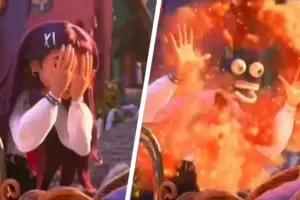
According to Disney Animation rendering engineer Yining Karl Li, a notorious bug that caused teenage witch protagonist Billie Doe’s skin to vanish entirely was embraced as an intentional feature. Thanks to the film’s magical setting of Hexe, a glitch that would normally spell disaster for a technical director instead became an organic, universe-appropriate visual gag. This rare peek behind the corporate curtain not only highlights the unpredictable nature of the animation pipeline but also offers a refreshing dose of self-awareness from one of the industry’s most conservative studios as it prepares for its November 25 theatrical rollout.
Detailed Chronology: The Making and Monitoring of Hexed
To understand how a rendering error managed to find its way into a premier Disney feature film, one must examine the turbulent and evolving production timeline of Hexed.
From Boy Wizard to Teenage Witch
The genesis of Hexed dates back several years within the secretive halls of Disney Animation. Early in development, the project was conceptualized around a male protagonist—a young boy wizard navigating a complex magical institution. However, as the story evolved and creative leadership re-evaluated the narrative trajectory, a pivotal shift occurred: the main character was completely overhauled, transforming from a boy into a teenage girl named Billie Doe.
While studio officials framed this as a creative choice driven by character dynamics and emotional resonance, industry observers and animation forums quickly drew parallels to external market pressures. Chief among these speculations was the timing of HBO’s massive, multi-season Harry Potter television reboot. By pivoting Billie to a female lead, Disney likely sought to sidestep direct thematic and demographic comparisons to the behemoth wizarding franchise, carving out a distinct visual and narrative identity for Hexed.
The D23 Reveal and Online Firestorms
As production pressed forward, Disney began teasing the project at major industry events, culminating in a series of character and trailer reveals at the D23 Expo. Almost immediately, Hexed found itself trapped in the crosshairs of internet fandom scrutiny.
- Same-Face Syndrome Allegations: Social media platforms erupted with side-by-side comparisons of Billie Doe and heroines from recent Disney outings like Frozen, Moana, and Wish, arguing that contemporary 3D character design at the studio has grown increasingly homogenized.
- The Vertical Framing Conspiracy: A bizarre, elaborate online subculture sprouted around the film’s trailer framing, with users concocting conspiracy theories about aspect ratios and hidden messaging.
- The Owl House Comparisons: Character designs for the film’s coven of witches drew immediate comparisons to Disney Channel’s beloved, creator-owned series The Owl House, sparking fierce debates over originality and executive inspiration.
It was against this backdrop of relentless online analysis that the creative team prepared the final cuts of the film, unknowingly sitting on a ticking time bomb of a rendering error that would eventually become one of the movie’s most endearing talking points.
Supporting Context & Metrics: Inside the Animation Pipeline
To truly appreciate the audacity of keeping a broken render in a major motion picture, one must understand the labyrinthine journey of a modern 3D animated film. The animation pipeline is a massive logistical and computational machine, moving data through departments that rarely interact directly with one another.
The Anatomy of a Render Bug
In a standard studio pipeline, assets flow from modeling and texturing to rigging, animation, layout, effects (FX), lighting, and finally, rendering. Each department adds layers of data.
- Rigging & Visibility Flags: Characters are given digital skeletons (rigs) and control mechanisms. Visibility flags tell the rendering software whether a specific mesh or layer should be visible in a given frame.
- Skinning & Texturing: Maps are applied to the character geometry to give them color, texture, and tactile realism (such as skin, cloth, and hair).
- The Glitch: Occasionally, pipeline communication fails. An export script might misplace a texture map, a visibility flag might break due to a software update, or an asset reference might drop out entirely. When this happens during the rendering phase—where computers calculate light, shadow, and refraction over hours or days per frame—the results are catastrophic.
The Secret Life of "Bad Render" Folders
Speaking publicly about the phenomenon, Disney rendering engineer Yining Karl Li pulled back the curtain on what happens to these technical disasters behind closed doors.
"At every studio I’ve worked at, there’s always a folder somewhere that everyone saves bad renders and animation/sim goofs in, and boy howdy you should see some of the stuff in there. It’ll never see the light of day, but every one of those folders is a comedy goldmine."
These digital graveyards are typically filled with digital nightmares: characters whose eyeballs have popped out of their skulls and floated into mid-air, cloth simulations that explode into erratic geometric polygons, and, most commonly, characters stripped entirely of their outer epidermis, leaving behind a terrifying, smooth, fleshless substructure or an invisible void.
For Hexed, however, the technical gods aligned. When Billie Doe’s skin failed to export correctly—or her visibility flag broke mid-sequence—the resulting transparent or missing-mesh error wasn’t sent to the digital dumpster. Because the narrative core of Hexed centers on chaotic, unpredictable, and reality-bending magic, the crew realized that a character momentarily losing her skin didn’t read as a rendering mistake; it read as a brilliant, diegetic visual joke about magical mishaps.
Official Statements and Industry Reception
The revelation regarding Hexed’s intentional rendering blooper came to light via social media, instantly shifting the narrative surrounding the film’s technical polish from skepticism to affectionate amusement.
When Yining Karl Li took to X (formerly Twitter) to explain the anomaly, the animation community responded with overwhelming enthusiasm.
"Normally this type of thing is a bugged render for us (pipeline didn’t export the skin or exported it in the wrong place, or visibility flag was broken), but for Hexed, we got to put it in the movie!"
Industry professionals and independent animators alike praised Disney for allowing a moment of genuine human error and pipeline humor to survive the corporate sanitization process. In an era where animated films are often criticized for looking too uniform, too safe, and overly scrubbed of imperfections, leaving a literal software bug in the final cut acts as a subversive badge of honor. It signals that human artists are still driving the machinery, even when the software threatens to break down.
Furthermore, this transparency contrasts sharply with the rigid PR messaging typically associated with major studios. By owning the glitch and reframing it as a creative choice, Disney’s technical team successfully disarmed critics who might have otherwise used the artifact as ammunition against the studio’s technical standards.
Future Outlook: Release Strategy and Fan Projects
As Walt Disney Animation Studios counts down the final weeks before the premiere of Hexed, the film occupies a fascinating space in contemporary pop culture.
The Road to November 25
Hexed is scheduled to hit theaters nationwide on November 25, carrying the heavy burden of closing out Disney’s theatrical slate for the year. Following the film’s theatrical debut, Disney is keeping the merchandising machine rolling with the official art book for Hexed, set for release on December 28. This publication is expected to offer deep-dive retrospectives into the film’s visual development, character iterations, and—hopefully—further acknowledgments of the technical happy accidents that shaped its production.
The Broader Fan Ecosystem
The cultural footprint surrounding Hexed is also bleeding into grassroots fan movements. Interestingly, the discourse around Disney’s modern output has inspired nostalgic corrective projects within the community. A prime example is Asha & The Starboy, an upcoming fan-made 2D animated short that seeks to reimagine Disney’s critical and commercial misfire Wish through the lens of traditional, hand-drawn 2D animation. Many fans have pointed to projects like this as a conceptual roadmap for what they wish Disney’s main studio would attempt more frequently.
Conclusion: A Triumph of Imperfection
Ultimately, the story of Hexed and its skinless rendering bug is a testament to the unpredictable, creative synergy between human artists and the complex software they wield. By turning a software failure into a narrative gag, Disney has given its artists a rare victory—proving that sometimes, the best moments in animation aren’t meticulously planned in a storyboard meeting, but are instead discovered when the digital world completely falls apart.