Executive Overview: A Paradigm Shift in Mobile Software
The landscape of the Android ecosystem is undergoing a tectonic shift. OnePlus, a brand once defined by its "Never Settle" philosophy and a software skin—OxygenOS—that served as the gold standard for enthusiasts, has officially begun its final transition. In a move that signals the complete integration of OnePlus and its parent company, OPPO, the long-standing OxygenOS brand is being phased out in favor of OPPO’s proprietary ColorOS.
This transition, which coincides with the global rollout of Android 17, marks the end of a multi-year convergence between the two manufacturers. While OnePlus devices will continue to function under the familiar hardware moniker, the underlying software experience will now be indistinguishable from that found on OPPO’s flagship handsets. This move, while controversial among long-time brand loyalists, promises a more unified, AI-driven, and resource-efficient ecosystem. As the rollout schedule for November 2024 begins, millions of users are preparing to bid farewell to the minimalist, bloat-free aesthetics of OxygenOS and embrace the feature-rich, high-performance architecture of ColorOS 17.
Detailed Chronology: The November Rollout Roadmap
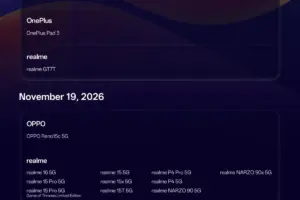
OPPO’s ColorOS Global account on X (formerly Twitter) has published a detailed timeline for the November rollout, clarifying months of speculation regarding which devices would receive the Android 17-based update first. This phased approach is designed to ensure stability across a diverse portfolio of hardware.
The November Schedule
The rollout is set to commence in early November, targeting the brand’s most powerful recent releases:
- November 5: The OnePlus 13R leads the charge. As a key mid-range powerhouse, its inclusion at the start of the cycle underscores its importance in OnePlus’ current global sales strategy.
- November 17: The OnePlus 12—the company’s previous flagship—receives the update. This is a critical milestone, as it brings the latest Android architecture to the brand’s most sophisticated camera and performance hardware.
- November 18: The OnePlus Pad 3 enters the cycle. By prioritizing the tablet, OnePlus is signaling its commitment to its ecosystem hardware, ensuring that the multitasking capabilities of ColorOS 17 are available for productivity-focused users.
- November 24: The OnePlus Open receives its update. As the company’s premier foldable, the integration of ColorOS 17 is expected to optimize the unique split-screen and multi-window workflows that define the foldable experience.
- November 26: The Nord 6 and Nord CE 6 join the fold, marking the first time the mid-range "Nord" line transitions to the new software paradigm.
December and Beyond: The Long-Term Horizon
The transition does not end with the November batch. The roadmap extends well into the first quarter of 2027. December is slated to be a high-traffic month for the company’s update servers, with the OnePlus 11, OnePlus 12R, and Nord 5 confirmed for deployment.
Beyond the confirmed December list, a sprawling group of 13 additional OnePlus devices is currently in the queue. While exact dates for these legacy or lower-tier devices have not been finalized, the message from the company is clear: the transition is mandatory, comprehensive, and inevitable for all supported hardware.
Supporting Context & Metrics: The Mechanics of the Merge
To understand why OnePlus is effectively sunsetting OxygenOS, one must look at the operational history of the parent company, BBK Electronics. For years, OnePlus and OPPO have operated under a "unified" software development model. Behind the scenes, the engineering teams have been merging their codebases, resulting in a scenario where OxygenOS became little more than a "skin" on top of the ColorOS kernel.
Why ColorOS 17?
The move to consolidate into ColorOS 17 is driven by several strategic metrics:
- Resource Allocation: By maintaining a single OS, OPPO significantly reduces the overhead required for software maintenance, security patching, and bug fixing. Instead of managing two distinct development cycles, engineers can focus on refining a singular, robust platform.
- AI Integration: ColorOS 17 is being marketed as an "AI-first" operating system. With advanced generative AI tools, improved object recognition in photography, and predictive battery management, the overhead of building these features for two different interfaces was deemed unsustainable.
- Global Harmonization: In markets like China, the distinction between OnePlus and OPPO was always blurred. By adopting a global standard, the company streamlines its supply chain and marketing efforts, presenting a cohesive brand image to international consumers.
The User Experience Trade-off
Critics argue that the move compromises the "clean" aesthetic that made OnePlus famous. Early testing of ColorOS 17 indicates a significant departure from the AOSP-adjacent (Android Open Source Project) feel of old OxygenOS. Users should expect a more "iOS-inspired" design language, complete with a heavily customized notification center, distinct system animations, and a more aggressive approach to background process management.
Official Statements and Corporate Vision
In recent briefings, spokespeople for the unified OnePlus/OPPO team have emphasized that this transition is not a degradation of service, but an evolution of capability. The official line from the ColorOS Global development team highlights the "seamless synergy" that the new OS provides.
"The transition to ColorOS 17 represents the pinnacle of our engineering efforts over the past three years," a company representative stated. "We are moving away from the fragmentation of the past and toward a future where our hardware is supported by the most intelligent, efficient, and responsive software environment we have ever built. The update provides not just a new look, but a fundamental improvement in how the device handles multi-tasking, energy consumption, and connectivity across our expanding ecosystem of wearables and tablets."
Despite the corporate polish, the company has remained transparent about the rollout nature. They have explicitly warned that these dates are "rollout start dates" rather than universal arrival times. Global logistics, carrier certifications in regions like North America, and regional server load balancing will dictate the speed at which individual users receive the over-the-air (OTA) notification.
Future Outlook: What Lies Ahead for OnePlus Users?
As we look toward 2027, the identity of the OnePlus brand is clearly changing. The "enthusiast brand" that once invited users to install custom ROMs is now a standard-bearer for a massive, vertically integrated mobile conglomerate.
The Challenges
The primary challenge for OnePlus moving forward will be retention. A significant portion of the user base chose OnePlus specifically because it was not OPPO. Whether the performance benefits of ColorOS 17—such as its superior AI capabilities and improved system stability—are enough to offset the loss of the "OxygenOS identity" remains to be seen.
The Opportunity
Conversely, for the average consumer, this is a net positive. Users will benefit from more frequent security updates, faster deployment of Android feature drops, and a more stable, highly optimized user experience. The integration also hints at deeper hardware-software optimization, which could lead to longer battery life and better camera performance across the entire OnePlus product stack.
As the November rollout kicks off, the industry will be watching closely. The success of this transition will serve as a bellwether for other smartphone manufacturers who are currently juggling multiple software identities. OnePlus is betting that in the modern era, consistency and technological prowess outweigh brand nostalgia. For the millions of users holding a OnePlus device, the update to ColorOS 17 is not just a software patch—it is the official end of an era and the beginning of a new, unified reality in the Android ecosystem.