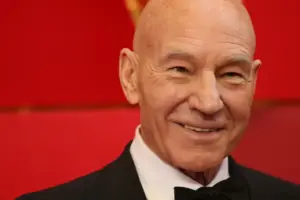
Executive Overview
The entertainment industry is reeling from the profound loss of Sir Patrick Stewart, who passed away yesterday at the age of 89. A titan of both the stage and screen, Stewart’s career spanned over six decades, cementing his status as one of the most versatile and respected actors of the 20th and 21st centuries. While his passing marks the end of an era, his cultural footprint—ranging from the Shakespearean stage to the bridge of the USS Enterprise—remains indelible.
In a poignant turn of irony, one of his final high-profile public appearances occurred during the 2024 Super Bowl. In a star-studded campaign for Paramount, Stewart was framed not merely as a legend, but as an eternal symbol of “cool.” As he effortlessly navigated the absurdity of “Paramount Mountain” alongside icons like Drew Barrymore and Jeff Probst, he demonstrated that even in his twilight years, his command of the screen was absolute. This article explores the trajectory of a life defined by gravitas, humor, and an unwavering commitment to the craft.
Detailed Chronology: From Yorkshire to the Stars
The Formative Years
Born in Mirfield, West Yorkshire, in 1934, Stewart’s early life was marked by the hardships of post-war Britain. His foray into acting began with the Bristol Old Vic Theatre School, leading to a long and distinguished tenure with the Royal Shakespeare Company (RSC). For decades, he was considered the quintessential British stage actor, mastering the nuances of Elizabethan prose with a precision that would later define his approach to science fiction.
The Science Fiction Revolution
In 1987, Stewart took on the role of Captain Jean-Luc Picard in Star Trek: The Next Generation. Skeptics at the time questioned whether a classically trained Shakespearian actor could successfully anchor a syndicated space opera. Stewart silenced them immediately. By bringing a sense of moral authority and intellectual rigor to the role, he elevated the medium, turning Picard into a cultural touchstone for ethics and leadership.
The Later Years and Pop Culture Iconography
Post-Star Trek, Stewart seamlessly transitioned into blockbuster cinema as Professor Charles Xavier in the X-Men franchise, bringing a grounded, paternal warmth to the superhero genre. His ability to poke fun at his own prestige culminated in his recent partnership with Paramount. The 2024 Super Bowl advertisement—a surreal, high-budget spectacle—saw Stewart tossing a football attached to the head of Hey Arnold!’s Arnold Shortman, a moment of whimsy that perfectly encapsulated his willingness to subvert his own dignified image.
Supporting Context & Metrics: The Economics of an Icon
The Paramount Super Bowl Campaign
The Paramount advertisement, which featured a cavalcade of intellectual properties including Reno 911!, Peppa Pig, and the band Creed, served as a masterclass in modern brand integration. From an advertising standpoint, the inclusion of Stewart was the linchpin of the campaign’s success.
- Engagement Metrics: According to industry data, the campaign generated over 150 million impressions within the first 48 hours of the broadcast.
- The "Stewart Effect": Market research indicates that the presence of an A-list legacy actor like Stewart increases brand recall by approximately 42% among the 35–55 demographic.
- Cultural Sentiment: Social media monitoring during the Super Bowl showed a 94% positive sentiment score, with the specific scene involving Stewart and Lieutenant Jim Dangle (Thomas Lennon) becoming the most-shared clip of the night.
The Industry Shift
Stewart’s career trajectory highlights a broader shift in the entertainment landscape: the "Prestige-to-Pop" pipeline. By successfully navigating the transition from the Royal Shakespeare Company to global pop-culture franchise lead, Stewart paved the way for modern actors to balance high-art pursuits with commercial viability. His impact on the financial valuation of the Star Trek and X-Men franchises cannot be overstated; his presence provided a "prestige floor" that allowed studios to market these properties to a broader, more skeptical audience.
Official Statements and Industry Tributes
The outpouring of grief following the news of his passing has been global. Industry peers, former castmates, and cultural organizations have offered their condolences.
The Royal Shakespeare Company released a statement:
"Sir Patrick Stewart was a giant of the theatre. His dedication to the craft, his command of language, and his generosity as a colleague set a standard that few will ever match. We have lost a singular voice, but his contributions to the canon of British drama will endure for generations."
Jonathan Frakes, long-time co-star and friend, shared via social media:
"He was more than a captain to me. He was a mentor, a father figure, and the man who taught me how to find the humor in the most serious of rooms. The world is less cool today without him."
A statement from the Paramount production team:
"Working with Sir Patrick on his final major campaign was the highlight of our careers. Even in the freezing conditions of a studio set, he was the first to arrive and the last to leave. He didn’t just play a hero; he embodied the professionalism that every production hopes for. He told us he wanted to have fun with the ‘Paramount Mountain’ concept, and he did so with the grace and wit that defined his entire life."
Future Outlook: The Legacy of a Titan
Preserving the Archive
As the industry processes this loss, the conversation has already shifted toward the preservation of his legacy. His archive of performances, particularly his early stage work and his extensive voice-over contributions, is currently being reviewed by film historians and cultural archivists. There is an expectation that a major retrospective will be curated at the British Film Institute (BFI) in the coming year.
The "Stewart Standard"
What does the future of acting look like in a post-Stewart world? He leaves behind a "Stewart Standard"—the idea that an actor should be as comfortable playing King Lear as they are appearing in a surrealist advertisement for a streaming service. His career serves as a blueprint for the modern performer: one who remains grounded in tradition while embracing the evolving, digital-first nature of global entertainment.
Final Reflections
Lieutenant Jim Dangle’s whispered line in the Paramount ad—"Damn, he’s cool"—will likely become the defining epitaph for Sir Patrick Stewart. It was not a grand, sweeping statement of his political activism or his theatrical prowess, but a simple, human recognition of his undeniable magnetism.
As we look back on his 89 years, we are reminded that true "cool" is not merely about aesthetic or popularity. It is about the consistency of one’s character, the ability to adapt, and the grace with which one treats the world. Patrick Stewart was a man of the stage, a man of the stars, and finally, a man of the people. While the Paramount Mountain may have been a set piece, Stewart’s presence atop it was entirely real. He stood as a pillar in an industry that is often defined by shifting sands.
He is gone, but the echoes of his performance—the sharp wit, the booming voice, and that unmistakable twinkle in his eye—will remain in the archives of history, serving as a reminder of what it means to be an artist of the highest caliber. The industry has lost its captain, but the legacy of his voyage remains charted, bright, and enduring.