Executive Overview
The United States Postal Service (USPS) is signaling a profound and potentially disruptive shift in its operational and pricing philosophy. Grappling with a stubborn, multi-year liquidity crisis and an inherently challenging financial structure, postal leadership has made it clear that volume maximization is no longer the primary goal. Instead, the agency is embracing a deliberate strategy of raising parcel and mail prices—even if those increases result in a net reduction in overall shipment volume.
During the USPS Board of Governors open session on August 7, 2026, Postmaster General and CEO David Steiner outlined the agency’s recalibrated approach. Pointing to encouraging financial metrics from the third quarter of fiscal year 2026, Steiner emphasized that strategic pricing serves as a powerful lever for driving revenue. By trading lower package volumes for higher profit margins per shipment, the Postal Service managed to narrow its net loss and expand operating revenue, proving that aggressive pricing can compensate for declining physical throughput.
For the broader ecommerce ecosystem, this strategic evolution carries significant weight. For decades, online merchants relied on the Postal Service as a cost-effective, ubiquitous carrier for lightweight residential shipments and last-mile deliveries—particularly in rural or hard-to-reach zip codes where private carriers impose hefty surcharges. However, as the USPS decouples volume growth from financial health, online retailers must prepare for a future defined by higher postal rates, potential seasonal price hikes, and a fundamental realignment of how public shipping services interact with private-sector supply chains.
Detailed Chronology: The Q3 2026 Financial Turning Point
To understand the catalysts behind this strategic pivot, one must examine the financial performance reported by the Postal Service for the third quarter of fiscal year 2026, which ended on June 30, 2026.
A Brighter, Though Still Deficit-Laden, Balance Sheet
For Q3 2026, the USPS announced total operating revenue of $19.9 billion. This figure represented a notable 6.1% increase compared to the same three-month period in the previous fiscal year. Concurrently, the agency’s net loss narrowed significantly, dropping to $2.5 billion from the $3.1 billion deficit recorded in Q3 2025.
While a multi-billion-dollar quarterly loss would spell doom for a standard for-profit enterprise, within the unique fiscal context of the quasi-governmental postal agency, it was heralded as a sign of progress. The primary driver behind this narrowing loss was a calculated willingness to test the limits of customer price elasticity across both mail and package segments.
The Shipping and Packages Paradox
The most striking data points from the quarterly report centered on the Shipping and Packages division. During Q3 2026:
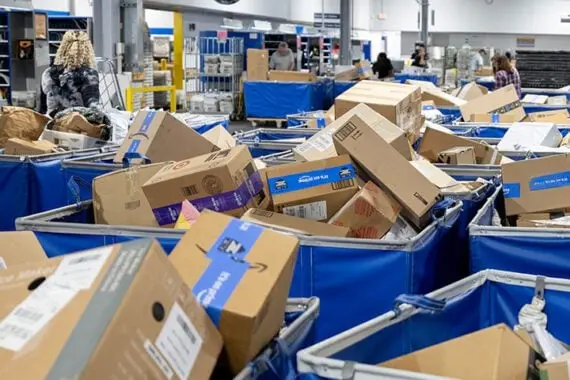
- Revenue Generated: $8.25 billion, representing a year-over-year increase of $588 million, or 7.7%.
- Volume Handled: 3.4 billion pieces—a decline of 55 million pieces, or 3.4%, compared to the previous year.
In simple terms, the Postal Service handled fewer physical items yet extracted significantly more financial value from the items it did carry. This inverse relationship between volume and revenue validated leadership’s hypothesis that the market could bear higher rates without devastating total revenue capture.
This trend was not isolated to parcel shipping. A parallel phenomenon occurred within First-Class Mail—a market segment where the Postal Service commands a near-monopoly. Despite a 3.5% drop in First-Class Mail volume, associated revenues climbed by 4.3% during the quarter.
Drivers of the Shift
The revenue growth observed in Q3 was bolstered by several specific factors:
- The Expansion of USPS Ground Advantage: Introduced as a streamlined, cost-effective shipping solution, Ground Advantage continued to capture market share and deliver solid financial returns.
- Temporary Price Adjustments: A temporary transportation-related price increase implemented in April 2026 for select parcel services successfully cushioned the agency against rising operational costs.
- Strategic Yield Management: By shedding low-margin or unprofitable routes and shipments, the agency optimized its network utilization.
Rather than viewing the loss of 55 million packages as a failure of market share acquisition, postal leadership interpreted it as a sign of untapped pricing power.
Supporting Context & Metrics: Parallels to Private Industry
For generations, the economic model of postal operations around the globe was rooted in high-volume, fixed-cost distribution. Because the USPS is legally mandated to deliver to every residential and commercial address in the United States six days a week—maintaining an expansive network of post offices, sorting facilities, and delivery vehicles—conventional wisdom dictated that maximizing package and mail volume was the only way to dilute those enormous fixed overhead costs.
Applying Retail and Airline Economics
During his remarks to the Board of Governors, Postmaster General Steiner explicitly rejected the notion that the Postal Service should operate under different economic laws than private enterprise. He drew direct comparisons between postal operations and industries like commercial aviation or grocery retail.
In an airline, empty seats are frequently priced at a premium during high-demand windows, and carriers adjust ticket prices to maximize total yield rather than simply striving to fly every plane at 100% capacity. Similarly, supermarkets adjust prices based on supply and demand dynamics to optimize financial returns.
"All of the statistics and results show that we have yet to cross the point that we should be changing our pricing strategy, and that we have more price [increases] to take in the marketplace. It would be financially irresponsible of us not to do so," Steiner stated during the August 7 session.
The Regulatory Boundary
While Steiner’s rhetoric aligns the USPS with private, profit-driven entities, the agency operates within strict regulatory boundaries. Federal oversight limits how aggressively the Postal Service can hike prices on its monopoly mail products, such as First-Class letters and flats.
However, within the competitive shipping and package delivery market—where the USPS battles private giants like FedEx, UPS, and regional carriers—the agency enjoys considerably more pricing flexibility and legislative protection. It is within this competitive sphere that management intends to push pricing limits further, leveraging its unique nationwide infrastructure while refusing to undercut private competitors at the expense of its own financial sustainability.
Official Statements and Leadership Vision
The public statements made by Postmaster General David Steiner and other postal executives during the August 2026 meetings paint a clear picture of an agency transforming its fundamental mission. No longer willing to act as a low-cost utility subsidizing the explosive growth of low-margin ecommerce, the USPS is positioning itself as a value-driven logistics provider demanding fair market compensation.
Redefining the Value of Ecommerce
For years, the partnership between the ecommerce sector and the Postal Service was viewed as symbiotic. Online merchants needed affordable last-mile delivery, especially for lightweight items that were cost-prohibitive for competitors to deliver profitably. The USPS, in turn, filled its trucks with Amazon Prime packages, eBay orders, and direct-to-consumer brand shipments.
Steiner’s commentary challenges the core assumption that more volume automatically equals a healthier postal system. As demonstrated by the Q3 metrics, carrying 55 million fewer packages while generating an extra $588 million in revenue represents a vastly superior operational trade-off for an agency struggling with liquidity.
This shift creates a distinct set of incentives for ecommerce shippers. While the Postal Service still welcomes parcel volume, it has established a hard boundary: it does not need volume at any price. If higher rates drive away low-margin shippers while retaining high-yielding accounts, leadership considers that a successful outcome.
The Cry for Legislative Reform
Crucially, Steiner did not frame pricing adjustments as a silver bullet. Even with aggressive rate hikes, the Postmaster General was quick to emphasize that the underlying business model of the USPS remains structurally flawed.
"As things stand, the Postal Service is expected to be self-sustaining while, at the same time, fulfilling mandates that are inherently unsustainable and do not cover their costs," Steiner warned. He pointed to a 17-year-long imbalance between operational costs and earned revenue—a systemic chasm that internal pricing strategies alone cannot bridge.
According to postal leadership, achieving long-term financial stability will ultimately require intervention and legislative reform from the U.S. Congress to address universal service obligation (USO) mandates and legacy liabilities. Until lawmakers step in, however, management intends to utilize every pricing lever at its disposal.
Future Outlook: Implications for Ecommerce and Supply Chains
As the U.S. Postal Service charts this new course, the ripple effects will be felt acutely across the retail, logistics, and ecommerce landscapes. Stakeholders must adapt to an environment where predictable, low-cost postal shipping is a relic of the past.
What Ecommerce Merchants Can Expect
- Frequent and Aggressive Rate Increases: Merchants should anticipate regular, above-inflation price adjustments across all major USPS shipping classes. The era of predictable, modest annual rate bumps has given way to dynamic pricing models designed to maximize yield.
- Pre-Holiday Peak Surcharges: With historical precedent and clear executive backing, online retailers must prepare for additional temporary price hikes and peak-season surcharges ahead of future holiday shopping seasons.
- Re-evaluating Carrier Mix: Direct-to-consumer brands and enterprise retailers will need to diversify their carrier networks, balancing USPS Ground Advantage with regional carriers, UPS, and FedEx to optimize shipping spend without sacrificing delivery speed or reliability.
- Absorbing or Passing Costs: As last-mile delivery costs creep upward, merchants face difficult choices regarding pricing architecture: absorb the margin compression, implement minimum order thresholds for free shipping, or pass increased shipping fees directly to consumers.
Conclusion
The strategic pivot announced by Postmaster General David Steiner in August 2026 marks the end of an era for the U.S. Postal Service. By proving that higher prices can successfully offset declining volumes, the agency has rewritten its operational playbook. For the USPS, financial survival now supersedes volume chasing. For the ecommerce merchants and consumers who rely on its network, this new reality demands strategic foresight, diversified logistics partnerships, and an acceptance that the true cost of nationwide delivery is finally coming due.