Executive Overview
In the perpetual quest to understand the deepest, most energetic mysteries of the cosmos, astronomers have taken a monumental leap forward. Leveraging the unprecedented sensitivity and near-infrared precision of the James Webb Space Telescope (JWST), an international team of researchers has successfully traced the origin of the most distant Fast Radio Burst (FRB) ever detected.
Originally captured in 2024 by the MeerKAT ground-based radio telescope array in South Africa, this ephemeral flash of cosmic energy—designated FRB 2024—traveled across billions of light-years to reach Earth. While the initial radio detection stunned the scientific community due to its staggering distance and immense redshift, the exact galactic home of the signal remained elusive until now.
By harnessing JWST’s cutting-edge capabilities, researchers have identified the host galaxy responsible for the emission. The findings reveal a startling reality: this ancient radio burst originated approximately 3 billion years after the Big Bang, deep within a galaxy vastly smaller and more primitive than those linked to previously studied FRBs. Furthermore, this monumental discovery provides crucial empirical data in the long-standing debate regarding the origin of FRBs, strongly pointing away from stellar mergers and toward the explosive deaths of massive stars, known as core-collapse supernovae, which give rise to ultra-magnetized neutron stars known as magnetars.
Detailed Chronology: From Deep Space Signal to JWST Breakthrough
The 2024 Detection by MeerKAT
The story of this groundbreaking discovery begins in 2024, when astronomers operating the MeerKAT radio telescope array detected a transient radio signal of extraordinary intensity. Fast Radio Bursts are among the most enigmatic phenomena in modern astrophysics. Lasting mere milliseconds—a fraction of the blink of an eye—these intense pulses of radio frequency waves release an unimaginable amount of energy, routinely matching in a fraction of a second what our Sun radiates over the course of three full days.
First discovered in 2007 using archival data from the Parkes Observatory in Australia, FRBs quickly became a major focus of observational astronomy. However, progress in understanding them was initially hindered by their unpredictable nature and the difficulty of localizing them on the sky. While some FRBs repeat—flashing intermittently from the same cosmic coordinate—many are one-off events ("one-peakers"), making it exceptionally difficult to pinpoint their exact host galaxies and determine the cosmological environments that spawned them.
When the MeerKAT array registered the 2024 signal, its advanced configuration allowed researchers to narrow down the localization zone on the sky with remarkable precision. Subsequent data analysis confirmed a high cosmological redshift, signaling that the burst had originated from an immense distance, making it the farthest fast radio burst ever observed by humanity.
Bringing the Webb Space Telescope to Bear
Knowing the rough coordinates of a cosmic beacon billions of light-years away is only half the battle. To truly understand the nature of the burst, astronomers needed to identify the exact host galaxy among a sea of background stars and ancient stellar systems. Traditional ground-based optical telescopes struggled to resolve the faint, distant light of the host galaxy, as the intervening expanse of space stretches and dims the photons on their multi-billion-year journey to Earth.
To overcome this celestial barrier, researchers turned to the James Webb Space Telescope. Operating in the vacuum of space far beyond Earth’s obscuring atmosphere, JWST utilizes massive primary mirrors and state-of-the-art near-infrared instruments (such as NIRCam and NIRSpec) to peer back in time with unprecedented clarity.
By targeting the coordinates provided by the MeerKAT radio detection, JWST’s near-infrared instruments successfully isolated a faint, diminutive galaxy nestled precisely at the site of the burst. The infrared data allowed researchers to measure the stretching of the galaxy’s light—its cosmological redshift—and accurately date the event. The analysis confirmed that the burst had occurred when the universe was a mere toddler, roughly 3 billion years old, during an epoch when star formation across the cosmos was operating at its absolute peak.
Supporting Context & Metrics: The Anatomy of an Ancient Cosmic Explosion
To fully comprehend the significance of the JWST discovery, one must look at the physical metrics and theoretical frameworks governing Fast Radio Bursts.
Defying Expectations: The Tiny Host Galaxy
Prior to this discovery, the majority of localized FRBs had been traced to massive, sprawling, star-forming galaxies that existed relatively late in cosmic history—billions of years after the era of peak star formation. These mature galaxies contained dense, complex stellar populations with abundant heavy elements.
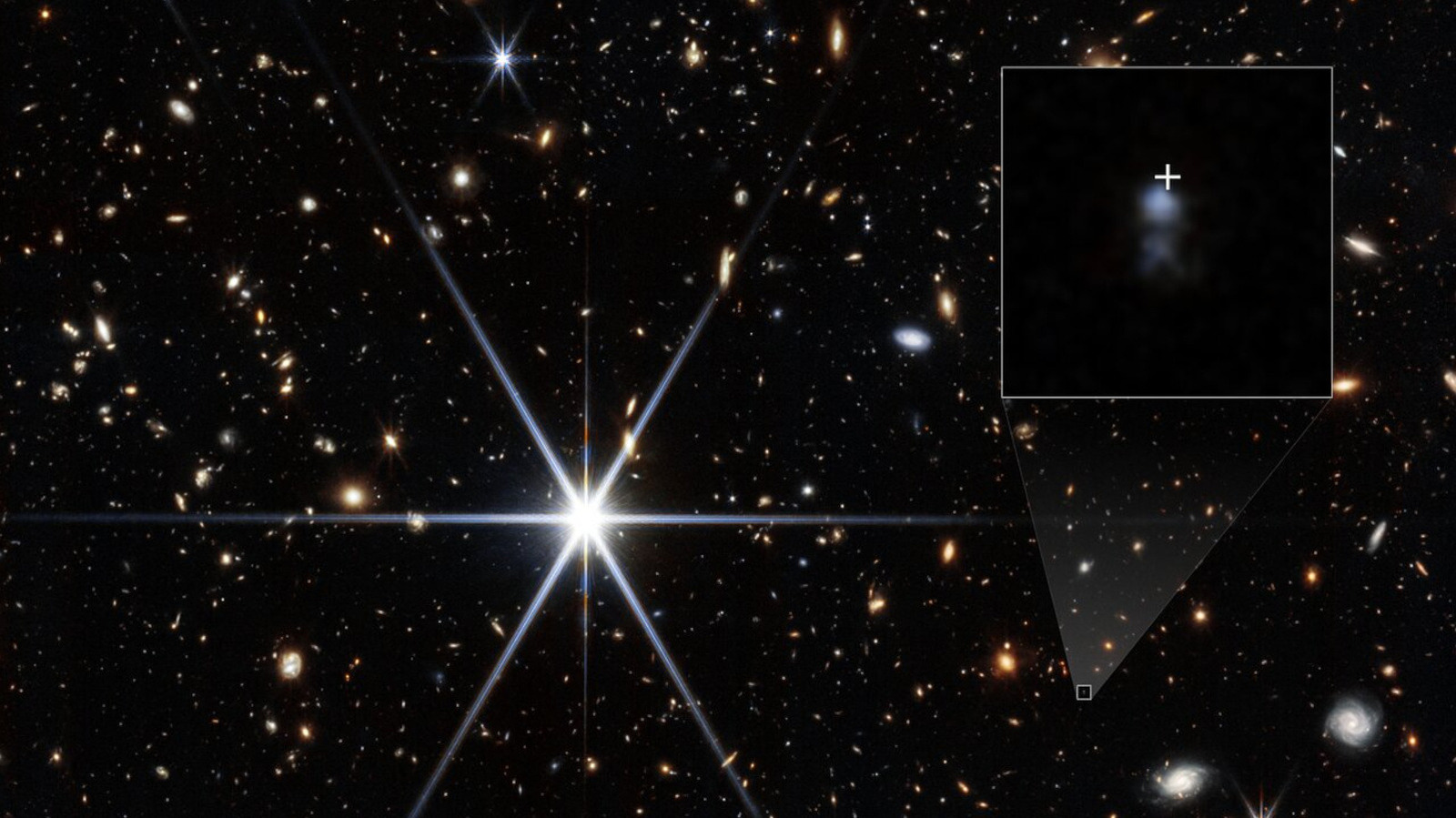
In stark contrast, the host galaxy identified by JWST for the 2024 distant FRB is an anomaly:
- Scale: The galaxy is roughly 1,000 times smaller than the host galaxies typically associated with lower-redshift FRBs.
- Epoch: It existed approximately 3 billion years after the Big Bang, placing it firmly in the early universe when chemical enrichment was low and galaxies were still coalescing.
- Environment: The host was active during the cosmic "noon" of star formation, an era when galaxies were hyper-efficient at birthing new stars, albeit under very different physical conditions than those seen in the modern universe.
The Great Astrophysical Debate: Mergers vs. Supernovae
For over a decade, astrophysicists have divided themselves into two primary camps regarding the progenitor mechanisms of Fast Radio Bursts:
- The Compact Object Merger Hypothesis: One prominent theory suggests that FRBs are born from the cataclysmic merger of two neutron stars—the ultra-dense, collapsed cores of massive supergiant stars. However, neutron stars are the endpoints of stellar evolution, and gravitational wave astronomy has shown that inspiral and merger timelines typically span billions of years. Consequently, this model predicts that merger-driven FRBs should predominantly occur in older, mature galaxies.
- The Magnetar Supernova Hypothesis: The alternative theory proposes that FRBs are spawned by massive stars undergoing core-collapse supernovae. These titanic stellar explosions leave behind a specialized class of neutron stars known as magnetars—rare, hyper-dense objects possessing magnetic fields millions of times stronger than any artificial magnet created on Earth. Because massive stars live fast and die young, magnetars can be formed rapidly in the early universe, requiring very short timescales from stellar birth to the generation of an FRB.
Official Statements and Expert Analysis
The implications of the JWST observations have reverberated throughout the astrophysical community, providing hard observational evidence that tilts the scales toward the magnetar hypothesis.
Manisha Caleb, a researcher from the University of Sydney, Australia, and lead author of the groundbreaking study published in the prestigious journal Science, highlighted the significance of the findings:
"Our work suggests that it’s very unlikely that this [fast radio burst] was produced by a merger."
Dr. Caleb elaborated that the physical characteristics of the dwarf host galaxy, combined with its ancient cosmic age, make the multi-billion-year timeline required for a binary neutron star merger nearly impossible to reconcile. Instead, the data strongly supports the core-collapse supernova model, pointing directly to young, highly active magnetars born from the fiery deaths of massive primordial stars.
Co-researchers and international collaborators echoed these sentiments, noting that the combination of radio astronomy (via MeerKAT) and infrared space-based astronomy (via JWST) represents a paradigm shift in transient astrophysics. By bridging the gap between high-frequency radio transients and deep-space infrared imaging, astronomers can now use FRBs not merely as astronomical curiosities, but as high-resolution cosmological probes. Because FRBs pass through vast expanses of intergalactic gas on their way to Earth, the dispersion and scattering of their radio waves encode a wealth of information about the "cosmic web"—the invisible filamentary network of matter that connects galaxies throughout the universe.
Future Outlook: The Next Frontier in Transient Astronomy
The successful localization and categorization of the farthest Fast Radio Burst to date marks the conclusion of one chapter in high-energy astrophysics and the opening of an entirely new era.
Armed with the proof that JWST can successfully resolve the tiny, distant host galaxies of ancient FRBs, astronomers are already preparing subsequent observation cycles. The goal moving forward is clear: build a statistically significant sample of high-redshift FRBs. By cataloging dozens—or eventually hundreds—of distant bursts and their host environments, scientists hope to map the evolution of star formation, magnetic field generation, and chemical enrichment across the history of the universe.
Furthermore, upcoming next-generation radio observatories, such as the massive Square Kilometre Array (SKA) currently under construction in South Africa and Australia, will work in tandem with space-based observatories like JWST and its eventual successors. This synergistic multi-messenger and multi-wavelength approach promises to dramatically increase the rate of FRB detections and localizations.
As technology marches forward, the flashes of radio energy that echo across the cosmos from billions of light-years away are transforming from fleeting mysteries into illuminating beacons. Thanks to the James Webb Space Telescope, humanity is no longer just listening to the whispers of the early universe—we are finally beginning to see where they live.