Executive Overview
Federal law enforcement agencies in the United States and abroad are aggressively widening their net around the notorious ShinyHunters cybercrime syndicate, uncovering a deeply troubling nexus between high-profile ransomware gangs and commercial cybersecurity negotiation firms.
Investigators pursuing the group—which made international headlines after executing a brazen cyberattack on the Federal Bureau of Investigation (FBI) recruitment portal—have set their sights on senior executives within the ransomware mediation industry. According to sources close to the unfolding federal probe, investigators have identified executives at two separate ransomware negotiation and incident response firms who allegedly maintained unusually close, illicit relationships with the extortion collective. Most alarmingly, authorities believe a U.S.-based corporate executive went so far as to actively help operate a public pressure and extortion website utilized by the hackers.
The sprawling international investigation highlights a darker, systemic vulnerability in the modern cyber-defense architecture. As digital extortion has evolved into a multi-billion-dollar enterprise, the boundaries separating enterprise defense consultants, professional intermediaries, and the malicious actors themselves have dangerously blurred.
This deep-dive investigation explores the anatomy of the ShinyHunters network, the pivotal arrests shaking the cybersecurity consulting sector, the mechanics of rogue extortion portals, and the inherent financial conflicts of interest plaguing the ransom negotiation industry.
Detailed Chronology: From Dutch Raids to Canadian Indictments
The modern incarnation of ShinyHunters represents a decentralized, highly aggressive evolution of a cybercriminal brand that first emerged in 2019. Initially operated primarily by threat actors based in France, the collective’s original leadership was systematically dismantled by international law enforcement over several years. Following these arrests, control over the ShinyHunters banner transitioned to "Rey," identified by researchers last year as a teenage hacker operating out of Amman, Jordan. According to estimates released by the FBI, ShinyHunters-aligned actors have successfully extorted upwards of $70 million from corporate and government victims throughout the year.
The Breach of the FBI and the Fall of Pepijn van der Stap
The syndicate’s hubris reached a breaking point in late September, when hackers tied to ShinyHunters successfully breached fbijobs.gov, the official recruitment portal of the FBI. The attackers taunted federal law enforcement by threatening to publicly release deeply sensitive personnel files. The stolen troves reportedly included detailed medical and psychological records, Social Security numbers, home addresses, and specific unit assignments of bureau employees.
The direct assault on a premier domestic law enforcement agency triggered an unprecedented response. Investigators moved with blistering speed to round up individuals communicating with Rey and his co-conspirators. On October 3, Reuters reported that Rey had been detained by authorities in Jordan and was actively cooperating with the FBI.
Rey’s elevation to the head of the syndicate had occurred only weeks prior, following the sudden neutralization of a critical senior member in Europe. On the evening of September 15, police forces in the Netherlands executed a high-risk tactical raid, deploying flash-bang grenades to apprehend convicted hacker and ShinyHunters suspect Pepijn van der Stap. Dutch authorities caught Van der Stap actively logged into his personal accounts, specifically targeting his Signal instant messaging application.

The Signal Chats and the Unraveling of a Murder-for-Hire Plot
Access to Van der Stap’s unencrypted session logs and message histories provided law enforcement with a goldmine of digital evidence, exposing communications with frequent contacts, including ransomware negotiators stationed in Canada and the United States.
More ominously, sources indicate that Van der Stap’s Signal messages formed the bedrock of evidence used to unravel an active murder-for-hire plot that surfaced immediately following his apprehension. Dutch news outlet RTL reported that the plot involved targeting two individuals abroad, with investigators uncovering indications that Van der Stap issued the orders for the attacks—though federal sources emphasize there is no indication those lethal orders were ultimately executed.
The Arrest of Edward Dubrovsky
The decrypted message trails also exposed extensive ties between Van der Stap and prominent figures in the North American cybersecurity and incident response community. On October 9, federal authorities arrested Edward Dubrovsky, a 54-year-old Canadian cybersecurity executive, in connection with the sprawling ShinyHunters investigation.
Dubrovsky, who recently authored a published book on handling cyber extortion that advised companies to always engage and negotiate with threat actors, was formally charged with threatening to disclose stolen data and interfering with interstate commerce through extortion, according to federal court records. Prosecutors have aggressively petitioned that Dubrovsky remain held without bail pending trial, with related court filings currently sealed from public view.
According to investigative sources, Van der Stap’s chats revealed that Dubrovsky was routinely tipped off regarding fresh ShinyHunters victims long before the target organizations even realized they had been breached. Most damningly, federal investigators discovered that Dubrovsky possessed advance knowledge that ShinyHunters had compromised internal FBI servers, yet he deliberately chose not to inform the bureau prior to the syndicate publicly weaponizing the breach on social media.
Supporting Context & Metrics: The Mechanics of "Shinywire" and Corporate Infighting
The Rise and Fall of Shinywire
Federal investigators have uncovered evidence indicating that at least one executive at a prominent U.S.-based consulting firm played an active, hands-on role in operating shinywire[.]com, a now-defunct victim extortion portal. While law enforcement has not yet formally named the specific company or executives pending formal indictments, the firm in question is an elite enterprise advisory body boasting a workforce of over 1,000 professional associates.
The Shinywire platform remained active from May 3, 2026, until mid-October, cataloging nearly 100 organizations compromised by the ShinyHunters collective. The portal functioned as an aggressive pressure valve: each listed organization was confronted with countdown timers, public samples of exfiltrated proprietary data, and explicit ultimatums demanding direct engagement with the extortionists.
For example, cached records from vulnerability scanning services index a Shinywire demand targeting Intuitive Surgical, a major American medical technology firm originally breached in March 2026 following a targeted employee phishing campaign. Under the site’s operating model, corporate victims who refused to negotiate within a strict seven-day window had their complete proprietary data repositories dumped onto the syndicate’s Tor-based shaming blog.

Corporate Warfare: Cypfer and CyberSteward
The federal scrutiny descending upon Dubrovsky mirrors an intense legal battle playing out in civil courts. Earlier this year, Dubrovsky filed a multi-million-dollar lawsuit in Ontario against Daniel Tobok, the former chief executive of Cypfer, an international cybersecurity firm with offices spanning North America, Europe, and the Middle East.
Dubrovsky, a former managing partner and chief operating officer at Cypfer, alleged in court documents that he had become "collateral damage" in a vindictive campaign orchestrated by Tobok to destroy his professional reputation after a bitter 2024 fallout. Tobok fiercely denied the allegations, filing a counter-suit accusing Dubrovsky of unauthorized access to confidential corporate intellectual property, unfair competition via a competing venture named CyberSteward Inc., and misrepresenting his status as a founding stakeholder.
The Ghostbyte Alias and Historical Roots
The web of connections deepens when examining historical digital footprints within the ransomware ecosystem. Interviews with former colleagues indicate that years prior, Daniel Tobok was known within certain ransomware circles by the alias "Ghostbyte."
Investigative records show that during a 2018 extortion event involving Dharma—a prolific Russian-language ransomware affiliate program—a victim seeking assurances that encrypted files could be safely recovered was explicitly directed by the threat actors to a third-party intermediary. A redacted copy of the Dharma representative’s email response advised the desperate victim: "If you want guarantees, you can write to the IT company… This IT company often solves such problems in Canada. You can contact them and sign a contract for services." The threat actor pointed the victim directly to the email address [email protected].
Threat intelligence gathered by Constella Intelligence reveals a compelling overlap: an email address frequently utilized by Tobok ([email protected]) shares historical ties to online profiles—including a Snapchat account—registered under the exact username "ghostbyte." Furthermore, blockchain analysis links the Dharma affiliate’s primary Bitcoin wallet (1BCc4zX5unvHrwJnhWaHRL48eSFV3BMCmb), associated with the email address [email protected], to 38 processed transactions totaling approximately 43 Bitcoin, valued at roughly $3.5 million at contemporary rates.
Official Statements and Industry Metrics
The Stance of Corporate Entities
In the wake of Dubrovsky’s arrest, corporate stakeholders have scrambled to distance themselves from the unfolding criminal proceedings. In an official statement released on October 14, Cypfer maintained that its official business operations do not involve facilitating, making, or encouraging ransomware payments.
"We had no prior knowledge of Mr. Dubrovsky’s arrest," a Cypfer spokesperson stated via email. "Cypfer has not received any outreach from law enforcement and, to our knowledge, is not the target of any law enforcement investigation."
Cypfer further noted that it operates entirely independently of CyberSteward, sharing no common directors or officers. The firm was recently acquired by the Apros Group, a private holding company led by Jason Hogg, a former FBI special agent and former chief executive of Aon Cyber Solutions Group. In 2020, Aon acquired Cytelligence, a boutique forensic firm where Tobok served as founder and CEO, and Dubrovsky held a managing partnership.

The Dangerous Illusion of Ransomware "Promises"
Law enforcement agencies and premier incident response organizations have long warned corporate boards against the false security of paying ransoms. In May 2026, the FBI issued a formal Private Industry Notification (PIN) strongly advising victim organizations against capitulating to ShinyHunters’ extortion demands.
These warnings are rooted in operational reality. In December 2024, educational technology giant PowerSchool suffered a massive breach executed by ShinyHunters, resulting in the theft of private records belonging to 62 million students and 9.5 million teachers across the U.S. and Canada. PowerSchool reportedly paid a $2.85 million ransom demand, assisted by incident response firm CyberSteward. (A 20-year-old Massachusetts college student and ShinyHunters affiliate, Matthew Lane, was subsequently sentenced to four years in federal prison for his role in the attack).
Yet, paying the ransom failed to secure the data. By May 2025, individual school districts began receiving independent extortion demands utilizing samples of the exact same stolen datasets. Leading incident response firms, including Coveware and Unit 221B, have repeatedly emphasized that threat actors routinely retain, monetize, and repurpose "deleted" data.
Rage from the Underworld: Telegram Leaks
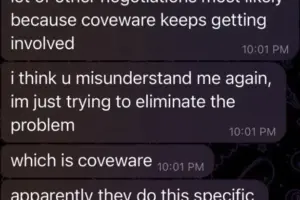
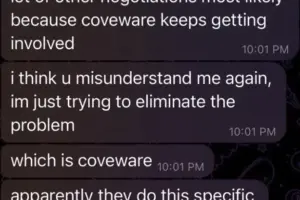
Internal communications captured by federal investigators demonstrate just how severely reputable incident response firms disrupted ShinyHunters’ profit margins. Private Telegram chat logs obtained from the syndicate’s primary administrative account reveal intense frustration directed squarely at Coveware.
In a May 6, 2026 conversation with a co-conspirator, the main ShinyHunters operator lamented:
"Go on my website, majority of those companies would’ve paid if it weren’t for Coveware giving them misinformation. Someone (100% Coveware) is going out of their way to make sure i am not paid."
Earlier, on April 11, the same administrator admitted they were actively plotting to "eliminate the problem" posed by Coveware’s continuous advisory warnings urging corporate victims to reject ransom demands. Coveware leadership has declined to comment on the threats.
Future Outlook: Systemic Conflicts of Interest and Regulatory Reckoning
The unfolding federal prosecution of ransomware negotiators exposes a fundamental conflict of interest inherent within the cyber incident response ecosystem.

According to Mark Camillo, Chief Executive of CyberAcuView—an industry group established in 2021 by major cyber insurance underwriters—compensation structures within the negotiation industry create perverse incentives. While some remediation firms operate on flat retainer fees, many specialized negotiators charge a sliding commission calculated as a direct percentage of the final ransom payout.
"This makes no sense if they are also the negotiator," Camillo warned. "There needs to be more transparency in the process, as no one in the ecosystem should be profiting purely on the size of the ransomware transaction or payment itself."
The Department of Justice Crackdown
Federal prosecutors are increasingly treating corrupt intermediaries as active co-conspirators rather than neutral negotiators. The Department of Justice has accelerated enforcement actions across the sector:
- October 2025: DOJ officials charged MonsterCloud CEO Zohar Pinhasi with wire fraud and conspiracy. Prosecutors allege Pinhasi charged corporate clients millions to remediate ransomware infections without paying hackers, while secretly funneling $8 million to cybercriminals behind his clients’ backs.
- July 2025: Ransomware negotiator Angelo Martino was sentenced to 70 months in federal prison after conspiring with the BlackCat/ALPHV syndicate to leak confidential client negotiation strategies, enabling attackers to maximize extortion payouts.
Conclusion
The convergence of federal agency hacks, international tactical raids in the Netherlands and Jordan, and the indictment of prominent cybersecurity executives marks a watershed moment in the war against cyber extortion. The illusion that the ransom negotiation industry operates entirely above board has been shattered. As the Department of Justice and the FBI continue to unpack encrypted communications from syndicates like ShinyHunters, the corporate governance of incident response, cyber insurance payouts, and ethical boundaries of digital mediation will face an inevitable, sweeping regulatory reckoning.