Executive Overview: A New Era of Security
For years, the smart home industry has grappled with a fundamental paradox: the very technology designed to grant us seamless access often introduces new anxieties—most notably, the fear of being locked out due to a dead battery. Today, Ring, the Amazon-owned titan of home security, announced its definitive entry into the smart lock market, aiming to dismantle this barrier to entry.
Rather than simply iterating on existing hardware, Ring has introduced a device that integrates a kinetic energy solution: a "power dial" that allows users to manually crank the lock to generate enough charge for entry, even if the primary battery pack is fully depleted. This hardware innovation, paired with a suite of new 4K-resolution security cameras, signals a calculated expansion of the Amazon ecosystem. By addressing the "anxiety of the dead battery," Ring is positioning itself to capture the cautious consumer segment that has previously avoided smart home entry solutions. With a scheduled U.S. launch in the first quarter of 2027, the company is set to challenge incumbent manufacturers by combining physical reliability with digital convenience.
Detailed Chronology: From Vacation Home Frustrations to Engineering
The genesis of this product began not in a sterile laboratory, but in the mundane, relatable frustration of a homeowner. Jamie Siminoff, the founder of Ring, recounts that the idea took root while he was researching smart locks for his own vacation property.
The "Vacation Home" Dilemma
Siminoff faced a common operational hurdle: properties that sit empty for weeks or months at a time. He realized that traditional smart locks, which rely exclusively on battery life, were inherently unsuitable for low-occupancy environments. The fear was twofold: the risk of a silent battery failure and the nightmare scenario of a visiting family member or guest finding themselves stranded on the porch.
"I struggled because this particular house will get used very little, and I know the freaking battery will die on it," Siminoff noted during the announcement. His solution was to engineer a fail-safe that bypassed the need for grid power or long-lasting lithium longevity. By utilizing specialized, energy-harvesting internal components, his team developed a mechanism where a simple manual dial rotation creates the necessary voltage to engage the bolt. Once inside, the user can remove the rechargeable battery pack—which is rated for a full year of standard use—and replenish it via USB.
The Developmental Timeline
The project, which reportedly utilized AI-assisted modeling for the mechanical gear assembly, underwent several iterations to ensure the "hand-crank" feature was both intuitive and durable. After settling on a design that fits standard single-cylinder deadbolts, Ring moved toward FCC authorization. The product is now finalized, with a commercial release set for early 2027, marking the culmination of a multi-year research and development phase aimed at redefining the "last mile" of home entry.
Supporting Context & Metrics: The Smart Lock Landscape
To understand the significance of Ring’s move, one must analyze the current state of the smart home security market.
The Barriers to Adoption
Despite the ubiquity of video doorbells, smart locks have seen slower adoption rates than their camera-equipped counterparts. Industry data suggests that the primary deterrents are:
- Power Anxiety: The fear of a dead battery preventing entry.
- Security Concerns: The perception that digital locks are more vulnerable to hacking than traditional deadbolts.
- Installation Complexity: The difficulty of retrofitting existing door hardware.
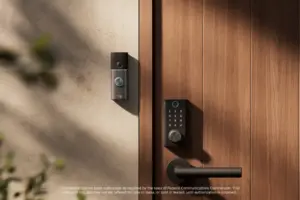
Ring’s new device attempts to address all three. By providing four distinct entry methods—fingerprint biometric authentication, a backlit touchscreen keypad, the Ring mobile application, and voice integration via Alexa—the company provides a tiered security strategy. If the app fails, the keypad works; if the code is forgotten, the fingerprint reader serves as the primary; and if the battery dies, the manual dial remains the "ultimate" backup.
A New Standard for Reliability
Historically, the "backup" method for smart locks has been archaic—often requiring homeowners to hide a physical key under a doormat or in a fake rock. This creates a significant security vulnerability. By integrating a kinetic power source, Ring is effectively rendering the "hidden key" obsolete. The device’s compatibility with standard single-cylinder deadbolts also reduces the barrier for DIY installers, a core demographic for the Ring brand.
Official Statements: Defining the Philosophy
The philosophy behind the new lock is rooted in the belief that "smart" does not have to mean "fragile." During the official unveiling, Siminoff emphasized that the feature set was born from a direct response to consumer sentiment analysis.
"I do think the power thing is a huge limiter of why people are not buying, and why they’re not putting them in, and why they’re worried about them," Siminoff stated. His vision for the device extends beyond simple locking and unlocking; he views the lock as a hub for access management.
"Eventually, the company wants to allow third-party app makers to design specialized software for the lock," the company stated in its official press release. This opens the door for significant B2B applications. For example, Airbnb hosts could integrate the lock with reservation software to automatically cycle through guest codes, removing the need for physical key exchanges or lockboxes. This level of interoperability is the hallmark of the modern Amazon strategy—creating an ecosystem where disparate software services converge on a single, reliable piece of hardware.
Future Outlook: Expansion and Ecosystem Integration
The announcement of the smart lock was accompanied by a significant expansion of Ring’s camera portfolio: the Outdoor Cam 4K Plus, Spotlight Cam 4K Plus, Floodlight Cam 4K Plus, and a pan-tilt Indoor Cam 4K. This massive infusion of high-resolution imaging hardware suggests that Amazon is doubling down on the "Security Perimeter" strategy.
The 4K Upsell
The transition to 4K across the entire product line is a calculated move to keep users subscribed to the Ring Protect plan. High-definition video requires more cloud storage and bandwidth, creating a natural incentive for users to continue their recurring monthly subscriptions. As the home security market matures, the competitive advantage is no longer just "having a camera," but having the highest quality evidence in the event of a security incident.
The Path to 2027
As we look toward the 2027 release window, the industry will be watching to see how competitors react to Ring’s kinetic power innovation. Patents surrounding energy-harvesting locks are likely to become a hotbed of litigation and innovation over the next 24 months.
Furthermore, the integration with Alexa will be a crucial differentiator. As the smart home ecosystem becomes increasingly voice-centric, the ability to control home access through verbal commands—secured by multi-factor authentication—could become the gold standard. Ring’s roadmap suggests a future where the home doesn’t just "protect" the resident, but proactively manages access for guests, service providers, and family members without the friction of physical keys or the constant monitoring of battery percentages.
Final Thoughts
Ring’s entry into the smart lock market is more than a product launch; it is a tactical correction of the smart home experience. By solving the most persistent pain point of the industry—the "what if the battery dies?" scenario—Ring is betting that consumer convenience will outweigh the skepticism surrounding high-tech home entry. If the device performs as promised, it will likely set a new benchmark for the industry, forcing competitors to rethink their reliance on simple battery-powered architectures. With the launch of the 4K camera suite simultaneously, the company is effectively locking down both the digital and physical perimeter of the modern home, proving that for Amazon, the front door is the most valuable real estate in the tech world.