Executive Overview: The End of the Impression Era
For nearly two decades, the marketing industry has been obsessed with the pursuit of “big data.” The prevailing wisdom was simple: if you collect enough granular data points, you can mathematically ensure better decision-making. However, Joe Marchese, CEO of Human Ventures Holdings and co-author of Human Dot AI: How the Fight for Your Attention Became the World’s Biggest Business, argues that this obsession has led the industry into a catastrophic blind spot. Marketers have spent years optimizing for "impressions"—the sheer volume of digital eyeballs—while failing to answer a fundamental question: did you actually earn anyone’s attention in the first place?
As we stand on the precipice of an AI-driven revolution, the stakes have shifted dramatically. We are entering an era where autonomous agents will soon purchase goods and services on behalf of consumers. In this new landscape, machines may influence—or entirely bypass—the buying decision before a brand ever has a chance to communicate its value proposition. This shift threatens to dismantle the traditional marketing funnel, forcing a radical rethink of brand equity, fiduciary responsibility, and the enduring value of human-centric experience.
Detailed Chronology: From Programmatic Overreach to AI Agency
The trajectory of modern advertising has been a long slide toward commoditization. In the early 2010s, programmatic advertising promised a utopia of efficiency. By automating the placement of ads, marketers believed they could lower costs and increase conversion rates.
The True[X] Thesis: Quality Over Quantity
Marchese, who founded the pioneering advertising company true[X] before its acquisition by Fox, built his career on the counter-intuitive idea that attention was a finite, high-value asset. While the industry chased impression volume, Marchese focused on engagement. He recognized early on that an ad viewed by a distracted user is worth virtually nothing, whereas an ad that earns genuine interest creates a bridge between brand and consumer. The industry’s failure, he suggests, was treating “attention” as a binary metric rather than a nuanced human behavior.
The Emergence of the AI Agent
The current shift is not merely an evolution of the interface; it is a fundamental change in the "incentive problem." We are moving from a world where humans browse and choose, to a world where AI agents—acting as digital proxies—navigate the marketplace for us. These agents are designed to optimize for efficiency, price, and convenience. The danger, as Marchese highlights, is that these agents are not necessarily designed to optimize for human satisfaction or brand loyalty.
Supporting Context & Metrics: The Fiduciary Problem
The core issue facing the marketing landscape today is one of alignment. When a human assistant recommends a product, we rely on a social contract of trust. When an AI agent recommends a product, we are often blind to the underlying architecture of that decision.
The Conflict of Interest
Marchese draws a sharp parallel between AI agents and traditional service professionals like real estate brokers or financial advisors. In these professions, the concept of "fiduciary duty" is paramount—the professional is legally bound to act in the client’s best interest.
In the digital realm, however, advertising incentives often conflict with consumer interests. If an AI agent is programmed to prioritize products that pay a commission to the platform developer, the "trusted advice" the agent provides becomes, in reality, "hidden persuasion." This creates a massive trust deficit. If consumers discover that their personal AI agents are acting as sophisticated sales funnels for third-party advertisers, the entire promise of the AI-driven personal assistant will collapse under the weight of skepticism.
The Failure of Last-Click Attribution
Marketers have long relied on "last-click attribution" to justify their spending, a metric that inherently undervalues brand awareness and cultural resonance. Marchese argues that this obsession with capturing immediate conversion is a symptom of a deeper malaise. By ignoring the “shared cultural currency” of a brand—how it lives in the conversations between friends, families, and colleagues—marketers are failing to account for the most powerful form of marketing: organic social influence. A brand that only matters to the buyer, and not to the culture surrounding them, is a brand with a short shelf life.
Official Statements: Insights from the Speed of Culture
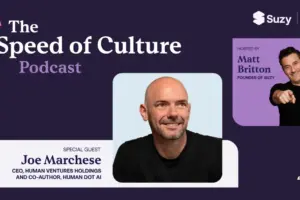
In a recent appearance on The Speed of Culture podcast, Joe Marchese offered a stark filter for Chief Marketing Officers (CMOs) navigating the AI era. His advice is a direct rebuke to those who believe the solution to AI is simply "better AI."
The "Optimize-Everything" Trap
“Anything machines can understand, they will eventually optimize,” Marchese notes. This is the existential crisis for the modern marketer. If a brand’s entire strategy is based on metrics that a machine can parse, that strategy is inherently vulnerable to being automated, commoditized, or bypassed by an algorithm.
The Human Advantage
Instead of competing with machines on their own turf—data processing, speed, and cost-efficiency—Marchese suggests that marketers must double down on what machines fundamentally cannot understand. These include:
- Strategy: High-level creative and business vision that requires contextual, historical, and emotional intelligence.
- Culture: The shared, lived experience of a community that cannot be distilled into a dataset.
- Experiential Marketing: Real-world human connections, live events, and tactile interactions that create memories, not just impressions.
For brands, this means that sponsorships and experiential plays are no longer just "awareness" tools; they are the building blocks of a brand’s cultural infrastructure.
Future Outlook: Navigating the Post-Algorithmic World
The transition toward AI-mediated consumption is inevitable, but the outcome for brands is not predetermined. The future belongs to those who recognize that the "attention economy" is evolving into an "intention economy."
Reclaiming the Relationship
As AI agents become the gatekeepers of commerce, brands must pivot from "reaching" consumers to "earning" the trust of the agents that serve them—or better yet, building direct, high-trust relationships with the consumers that bypass the agent’s incentive loops. This will likely involve a return to high-quality, long-form content, and deep investments in community-building that an algorithm cannot replicate.
A Call for Radical Transparency
To avoid the "hidden persuasion" trap, developers of AI agents must adopt higher standards of transparency. Consumers will eventually demand to know why a specific product was recommended. Brands that lean into this transparency—showing exactly how their value proposition benefits the user rather than just the platform—will gain a competitive advantage in a crowded, noisy marketplace.
Conclusion: The Human Imperative
The ultimate lesson of the AI revolution is that technology is not a replacement for human judgment; it is an accelerant. While machines can calculate the "best" path to a purchase based on current data, they cannot invent new desires, forge genuine emotional connections, or participate in the messy, wonderful chaos of human culture.
As Marchese suggests, the smartest CMOs will stop asking how they can use AI to squeeze one more percentage point of efficiency out of their digital spend. Instead, they will ask: "What are we doing that is so human, so authentic, and so culturally significant that no machine could ever dream of optimizing it away?" In the answer to that question lies the future of brand survival. The companies that thrive will be those that realize the most important data point of all remains the one that cannot be captured in a spreadsheet: the resonance of a shared human experience.