Executive Overview
For decades, the architectural boundaries of web development were cleanly drawn: HTML provided the structural foundation, JavaScript handled the dynamic logic and state changes, and Cascading Style Sheets (CSS) merely painted the canvas. But as modern applications demand higher performance, smoother animations, and more intuitive user interfaces, that rigid division of labor has begun to blur.
Today, CSS is undergoing a profound philosophical and technical evolution. Through the continuous expansion of pseudo-classes that track complex states and emerging proposals like the Animation Triggers specification, the styling language is increasingly absorbing tasks that were once exclusively the domain of JavaScript.
This is not a story of "JavaScript versus CSS," nor is it a manifesto declaring the obsolescence of scripting languages. Instead, it is an exploration of how CSS is absorbing the responsibilities of reactive design. By allowing developers to listen for states and user actions directly within stylesheets, modern CSS reduces the reliance on brittle event listeners, cuts down on execution overhead, and simplifies front-end architecture.
In this deep dive, we will examine the spectrum of "event-listening" pseudo-classes currently available in modern browsers, analyze how they map to traditional JavaScript events, and look ahead to the horizon at bleeding-edge proposals like event-trigger that promise to fundamentally redefine what a stylesheet can do.
Detailed Chronology: The Journey from Static Styles to Reactive Architecture
To understand how CSS arrived at the doorstep of event handling, we must retrace the historical milestones that transformed it from a static design document into a dynamic, state-aware engine.
1. The Era of Basic State Tracking (:hover, :active)
In the early days of CSS1 and CSS2, styling was strictly bound to rudimentary document states. Selectors like :hover and :active introduced the concept of time and user interaction into stylesheets, allowing elements to change appearance when a mouse cursor intersected them or when a button was pressed down. Under the hood, these pseudo-classes mapped directly to native browser input events—specifically capturing the delta between pointerenter and pointerleave, or pointerdown and pointerup.
2. The Form Validation Revolution (:valid, :invalid, :checked)
As web applications matured into software-as-a-service (SaaS) platforms, form handling became critical. Rather than forcing developers to write custom JavaScript to validate user inputs on every keystroke, browser vendors implemented native constraint validation. CSS quickly adopted pseudo-classes like :checked, :valid, and :invalid to expose these internal component states to the styling layer. Later iterations introduced :user-valid and :user-invalid, smart selectors that intentionally wait until the user has actively interacted with a field and moved away before triggering error styles, bridging the gap between passive validation and active user experience.
3. Structural Awareness and Context (:focus-within, :has())
For a long time, CSS suffered from a major limitation: it could look down the tree (descendant selectors), but it could not look up (parent selectors) or laterally across siblings. JavaScript dominated this space due to its ability to traverse the Document Object Model (DOM) dynamically.
The introduction of :focus-within marked a turning point by letting parent containers know when a descendant element gained focus. This was soon eclipsed by the revolutionary :has() pseudo-class—often dubbed the "parent selector." With :has(), CSS gained the power to conditionally style elements based on their internal contents or relationships, matching complex logical conditions (e.g., "style this form if it contains an invalid input") entirely within stylesheets, bypassing the need for DOM mutation scripts.
4. Component States and Native UI Elements (:popover-open, :modal, :fullscreen)
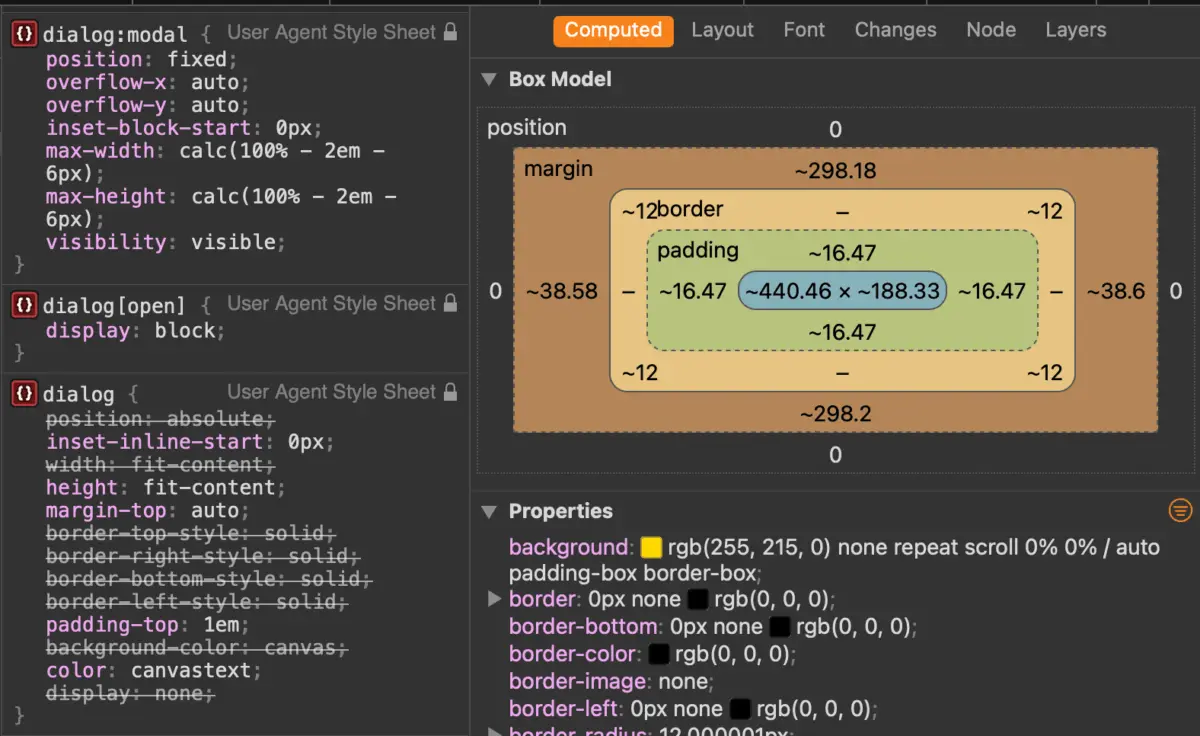
As HTML evolved to include native, high-performance UI primitives like <dialog>, <details>, and the Popover API, CSS expanded in lockstep. Instead of requiring JavaScript to toggle CSS classes when a modal opened or a popover was invoked, browsers introduced native state selectors such as :modal, :open, :popover-open, and :fullscreen. These pseudo-classes grant direct access to the lifecycle states of complex browser-managed layers, eliminating synchronization bugs between application state and UI presentation.
5. The Frontier: Event Triggers and Animation Triggers
Today, the World Wide Web Consortium (W3C) and browser engine contributors are pushing past the boundaries of state tracking entirely. Proposals like the Animation Triggers specification—featuring the event-trigger property—hint at a future where CSS can directly listen for explicit user interactions (clicks, interest, activations) and orchestrate complex animations natively, without a single line of JavaScript event-handling code.
Supporting Context & Metrics: CSS Pseudo-Classes vs. JavaScript Events
To appreciate the efficiency gains of modern CSS, it helps to examine how native pseudo-classes map to their JavaScript event equivalents. By offloading these checks to the browser’s internal rendering engine, developers can drastically reduce main-thread script execution.
The Pseudo-Class-to-Event Mapping Matrix
| CSS Pseudo-Class | Closest JavaScript Event Equivalent | Architectural Benefit |
|---|---|---|
:hover |
pointerenter / pointerleave |
Eliminates event listener boilerplate for simple hover transitions. |
:active |
pointerdown / pointerup |
Tracks active press states natively on the compositor thread. |
:focus |
focus / blur |
Tracks element focus without manual event delegation. |
:focus-visible |
focus (plus browser heuristics) |
Automatically distinguishes keyboard navigation from mouse clicks. |
:checked |
change / input |
Instantly styles toggles, checkboxes, and radio buttons based on state. |
:valid / :invalid |
invalid / checkValidity() |
Evaluates HTML constraint validation without imperative script calls. |
:user-valid / :user-invalid |
change (post-interaction) |
Defays validation styling until user interaction occurs. |
:autofill |
N/A (No clean JS equivalent) | Provides styling hooks for browser-saved credential autofills. |
:buffering / :stalled |
waiting / stalled |
Styles media elements during network interruptions. |
:paused / :playing |
pause / playing |
Directly reflects media playback states. |
:popover-open / :modal |
toggle / custom state logic |
Manages top-layer UI visibility states declaratively. |
:target |
hashchange |
Styles elements matching the current URL hash fragment. |
Deep Dive: Code Comparison
Consider the complexity required in JavaScript to implement a conditional focus-visible check versus the native CSS approach.
The JavaScript Approach:
element.addEventListener("focus", (event) =>
  if (event.target.matches(":focus-visible"))
    // Perform complex DOM manipulations or state updates
    event.target.classList.add("keyboard-focused");

);

element.addEventListener("blur", (event) =>
  event.target.classList.remove("keyboard-focused");
);
The Declarative CSS Approach:
button:focus-visible
  outline: 3px solid var(--brand-primary);
  box-shadow: 0 0 8px rgba(0, 123, 255, 0.5);
By leveraging the CSS engine, the browser handles the heuristic evaluation of keyboard versus mouse focus on the optimized C++ layer, avoiding unnecessary garbage collection and main-thread bottlenecks in JavaScript.
Official Statements and Architectural Philosophy
The shift toward event-aware styling has sparked robust debate within the web standards community. Architectural purists often question whether CSS is expanding beyond its core mission, while browser engineers emphasize the performance benefits of declarative UI definitions.
In discussions surrounding the Animation Triggers and Interop initiatives, working group members frequently highlight the performance implications of main-thread JavaScript execution. When animations and state changes are handled entirely via CSS pseudo-classes and upcoming triggers, browsers can execute these transformations on the compositor thread. This allows UI updates to run smoothly at 60 or 120 frames per second, even if the main JavaScript thread is heavily blocked by heavy computation, data fetching, or framework reconciliation.
Furthermore, proponents of feature-rich CSS emphasize maintainability. When a designer or developer updates a component, housing the state logic alongside the visual rules within stylesheets prevents the separation-of-concerns fallacy—where logic, structure, and presentation are artificially fractured across disparate files, making refactoring perilous.
As Miriam Suzanne, a prominent CSS Working Group contributor, has frequently noted in architectural discussions regarding container queries and nesting:
"CSS is no longer just about documents; it is about reactive layouts and components. Giving developers the tools to respond to state and context natively is essential for building resilient, high-performance web applications."
Future Outlook: The Horizon of event-trigger and Beyond
While today’s pseudo-classes successfully track static states and input moments, the next frontier of CSS aims to handle explicit event listening and triggering. The unreleased, experimental event-trigger proposal within the Animation Triggers specification offers a tantalizing glimpse into how we might write stylesheets in the near future.
Stateless vs. Stateful Event Triggers
The proposed specification introduces concepts for both stateless and stateful event-driven animations.
1. Stateless Event Triggers (e.g., Clicks)
Actions like clicking a button are fundamentally stateless in terms of reverse operations—you cannot "unclick" a click event in the same way you toggle a switch. A stateless event trigger maps an event directly to an animation sequence:
@keyframes pulse-pop
  0%  transform: scale(1);
  50%  transform: scale(1.08);
  100%  transform: scale(1);


button
  /* Define the event trigger source */
  event-trigger: --pulse-event click;


.card
  /* Trigger the animation when --pulse-event fires */
  animation-trigger: --pulse-event play-forwards;
  animation: pulse-pop 400ms ease-out both;
2. Stateful Event Triggers (e.g., Interest / Hover Intent)
For interactions that have distinct entry and exit states—such as user interest, hovering, or focus—the syntax accommodates bidirectional animation flows separated by a slash (/):
@keyframes fade-slide-in
  from  opacity: 0; transform: translateY(10px);
  to  opacity: 1; transform: translateY(0);


[data-tooltip-trigger]
  /* interest (entry) / interest (exit) */
  event-trigger: --tooltip-anim interest / interest;


.tooltip-box
  /* Play forward on entry, play backward on exit */
  animation-trigger: --tooltip-anim play-forwards play-backwards;
  animation: fade-slide-in 250ms cubic-bezier(0.16, 1, 0.3, 1) both;
The Road Ahead: Integration with Invoker Commands and Event Bubbling
Looking further down the roadmap, the W3C is exploring how CSS event triggers could eventually interface with upcoming HTML standards like the Invoker Commands API. While current proposals focus primarily on driving @keyframes animations, future iterations may allow CSS to invoke declarative browser methods or leverage event bubbling across component boundaries.
Critics of these proposals often raise valid concerns: Where do we draw the line? Are we reinventing JavaScript inside CSS?
The answer lies in balance. CSS event triggers do not replace complex conditional business logic, data fetching, or algorithmic state management—those will forever belong in JavaScript or backend systems. Instead, they liberate the presentation layer from the tedious plumbing required to animate and style user interface components in response to standard browser events.
Conclusion
The evolution of CSS pseudo-classes and the exploration of event triggers represent a maturing web ecosystem. By continuously bridging the gap between styling and interactivity, modern CSS empowers developers to write cleaner, faster, and more maintainable code. Whether these upcoming specifications make their way into baseline browser support over the next few years, the trajectory is clear: CSS is listening, and it is ready to respond.