
Executive Overview
In the intricate and ever-shifting landscape of Search Engine Optimization (SEO), few events strike as much latent anxiety into the hearts of webmasters and digital marketers as a site migration. Traditionally, moving a website to a new domain or overhauling its architecture was viewed primarily as a technical hurdle. Success was measured by the precision of 301 redirects, the submission of Change of Address forms in Google Search Console (GSC), and the seamless transfer of canonical tags and sitemaps.
However, a growing body of evidence suggests that the rules of engagement have fundamentally changed.
Recent reports from the SEO community highlight a troubling phenomenon: established websites executing technically flawless migrations are suddenly finding themselves trapped in an indexing purgatory. Pages that historically performed well on legacy domains are being crawled by Googlebot on the new domain, only to be deliberately classified under the dreaded "Crawled – Currently Not Indexed" status.
In a recent deep-dive case study, renowned SEO consultant Marie Haynes investigated a hobby-niche blog that migrated to a new domain after experiencing a slow, multi-year decline in traffic. Despite executing every technical migration best practice to the letter, 98% of the site’s URLs remained unindexed four months post-migration.
Based on this and similar investigations, Haynes has proposed a provocative and disruptive theory: A site migration acts as a mandatory trigger for a comprehensive, automated quality review by Google’s algorithms—and Google’s modern standards for what constitutes indexable content have become exponentially stricter.
This article provides an investigative look into this emerging SEO crisis, exploring the mechanics of post-migration indexing failures, the evolving definition of "commodity content," and what website owners must do to survive this new era of algorithmic scrutiny.
Detailed Chronology: Anatomy of a Modern Migration Failure
To understand the gravity of this new indexing trend, one must examine the step-by-step chronology of how these migrations unfold and where the traditional playbook breaks down.
Phase 1: The Setup and Execution
For the hobby-niche site investigated by Haynes, the migration process was textbook. The site owner, recognizing the need for a fresh start, followed every technical prescription mandated by search engine guidelines:
- The Change of Address Tool: Properly submitted within Google Search Console to signal the move from the old property to the new domain.
- Redirect Mapping: Every single legacy URL was mapped via 301 redirects to its exact equivalent on the new domain, preserving link equity and user flow.
- Internal Linking and Sitemaps: Internal links were meticulously updated to point to the new domain structure, and fresh, error-free XML sitemaps were generated and submitted.
- Crawlability Verification: Robots.txt files and server responses confirmed that Googlebot had unhindered access to crawl the new environment.
Phase 2: The GSC Reality Check
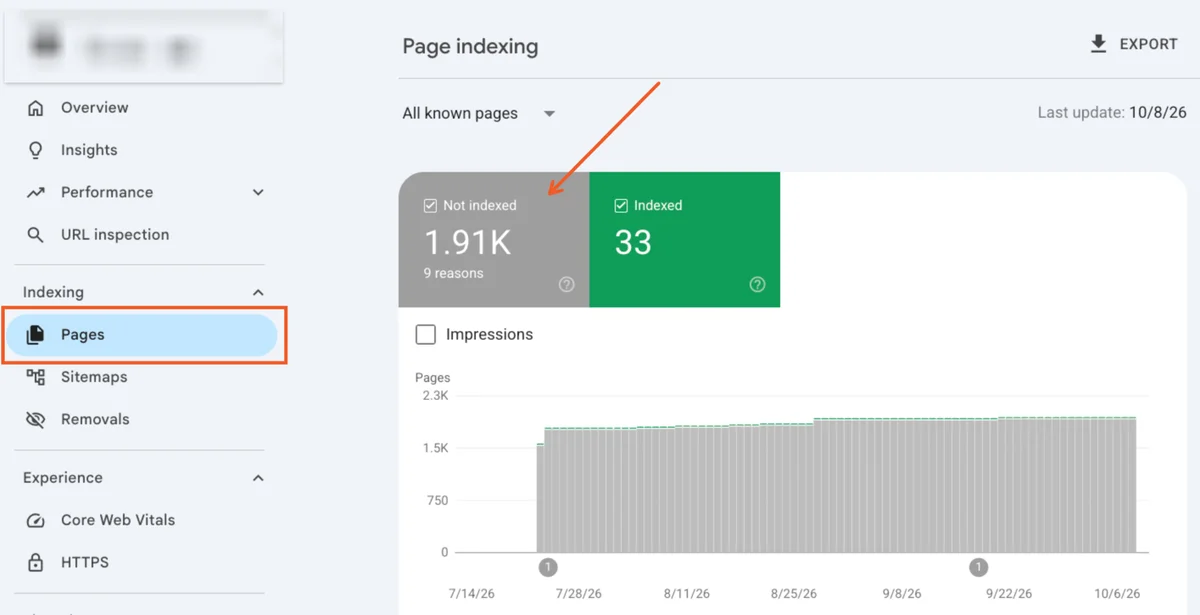
Despite the technical precision, the GSC Page Indexing Report quickly revealed a catastrophic failure. Out of nearly 2,000 migrated pages, only 33 pages were indexed—amounting to roughly 98% of the site sitting in architectural limbo.

When inspected individually, even those 33 "indexed" pages revealed a harsh reality: they were not showing up in search results and were classified as "Crawled – Currently Not Indexed." Google was having zero trouble discovering the pages. The bots were visiting, reading the content, and making a conscious, programmatic decision not to include them in the live index.
Phase 3: Live Testing and the "Indexing Conditions" Warning
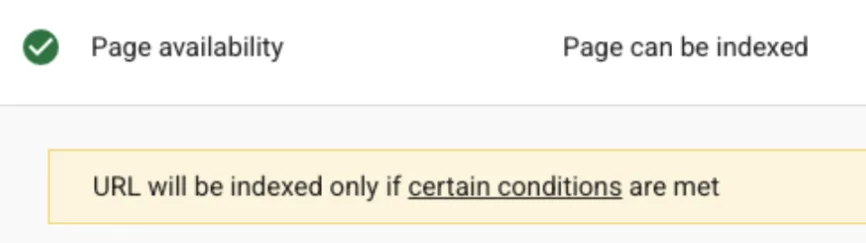
Running a live test within Google Search Console on these orphaned pages yielded a confusing contradiction. The tool explicitly stated that the pages were available to be indexed—but only if certain conditions were met.
Following the documentation links provided by Google led back to core indexing guidelines. The search engine outlines three primary blockers for valid pages:
- Manual Actions: The site has been penalized for policy violations (ruled out via GSC security and manual action reports).
- Duplicate Content: The page is a duplicate of another asset (ruled out, as canonicals correctly pointed to the new domain and old URLs redirected properly).
- Quality Thresholds: The page quality must be high enough to warrant indexing.
It is this third pillar—page quality—that forms the crux of the modern migration crisis.
Supporting Context & Metrics: The Commodity Content Trap
What separates a page that Google happily indexes from one it leaves in the cold? According to Haynes’s analysis, the answer lies in the intrinsic value of the content relative to the broader web ecosystem.
The Problem with "Commodity Content"
Upon reviewing the failing hobby blog, Haynes noted a paradoxical truth: the content was well-written, thoroughly researched, and grammatically sound. However, it suffered from a fatal modern flaw—it lacked original value.
In the SEO industry, this is frequently categorized as commodity content: information that is essentially interchangeable across hundreds or thousands of competing websites. If a searcher types a query into Google and finds that a specific blog post offers the exact same advice, definitions, and surface-level insights found on five other ranking sites, Google’s algorithms increasingly view that post as redundant.
Evolving Helpful Content Standards
This aligns directly with Google’s ongoing updates to its Creating Helpful Content documentation. The search giant has heavily emphasized the importance of the "Main Content" (MC) of a webpage—the specific section dedicated to fulfilling the user’s intent.
Within these guidelines, Google places immense weight on originality, defining it as:
"The extent to which the content offers unique, original information or perspectives that aren’t already available on other websites."
Before a migration, legacy sites often coast on historical authority, established backlink profiles, and legacy trust signals. Even if their content is marginally commoditized, Google’s index may tolerate them because they have already earned a place.
However, a site migration acts as a hard reset. When a site moves domains, it temporarily sheds its historical momentum, forcing Google to re-evaluate the property from scratch. Stripped of its historical safety net, the site’s true content value is exposed to modern, highly aggressive quality filters. If the content is deemed unoriginal commodity text, the migration acts as a trigger that halts indexing entirely.
Official Guidelines & Theoretical Frameworks
To contextualize why a migration triggers such a drastic review, we must examine how search engine architecture handles domain transitions and quality assessment.
Why Didn’t the Old Site Suffer the Same Fate?
The most pressing question for digital marketers is simple: If the content was acceptable on the old domain yesterday, why is it suddenly "low quality" on the new domain today?
Haynes posits a sobering hypothesis: If Google applied its current indexing quality standards uniformly across every legacy website currently in its index, the vast majority of websites would experience catastrophic traffic losses overnight.
Search engines operate on computational efficiency and user satisfaction metrics. Re-evaluating billions of legacy pages simultaneously requires immense resources and risks destabilizing search results. Therefore, algorithmic quality enforcement is often applied dynamically during major touchpoints—such as core updates, algorithmic rollouts, and, most notably, site migrations.
When a site initiates a domain move, it enters a staging and evaluation phase where Google’s quality filters are applied with maximum stringency. If the site fails to prove it offers unique, non-commodity value during this window, the migration stalls permanently.
Strategic Playbook: How to Diagnose and Overcome Post-Migration Indexing Failures
For webmasters currently trapped in post-migration indexing purgatory, traditional technical fixes will yield zero results. If your problem is rooted in quality rather than crawlability, you must pivot your strategy.
Step 1: Rule Out Technical Failures First
Do not jump straight to content rewrites without verifying the plumbing of your migration. Ensure that:
- Old URLs are correctly 301-redirected to their exact content equivalents on the new domain.
- The Change of Address tool in Google Search Console has been fully processed.
- GSC Live Tests confirm that Googlebot can successfully render and read the page text.
- You have allowed sufficient time; Google has noted that complex migrations can occasionally take several months to process fully. However, if four months have passed (as in Haynes’s case study) and only the homepage is indexed, technical processing time is no longer the issue.
Step 2: Audit for Content Originality
Evaluate your top-performing legacy pages with brutal honesty. Ask yourself:
- Does this page offer data, insights, case studies, or perspectives that cannot be found anywhere else on the internet?
- Or does it simply summarize what other sites have already said in a slightly different tone?
Step 3: Leverage Large Language Models (LLMs) for Content Enhancement
If your content is deemed commodity material, you must elevate its intrinsic value. Haynes suggests utilizing advanced AI tools to help brainstorm and restructure content to introduce genuinely original perspectives. You can prompt your LLM of choice with the following framework:
LLM Prompt Template:
"I would like to create a new version of this page that contains information that is truly original compared to what already exists on the internet. My goal is for it to provide helpful information or functionality that searchers cannot find anywhere else. Brainstorm with me, helping me find ways to draw from my experience and knowledge to produce something that searchers are likely to find more helpful than what currently exists."
Step 4: Consider Starting Over
For sites deeply entrenched in unoriginal, commoditized niches, the bitter pill of SEO reality may require starting completely fresh on a new domain with a brand-new content strategy. If a site’s entire business model relies on scraping, summarizing, or re-packaging widely available web data, no amount of technical SEO wizardry will force Google to index it under modern quality frameworks.
Future Outlook: The New Paradigm of Domain Transitions
As Google’s algorithms continue to prioritize user-centric, highly original information, the traditional mechanics of SEO are undergoing a permanent evolution. The days of lifting and shifting old content to a fresh domain and expecting immediate recovery are rapidly coming to an end.
Site migrations are no longer merely technical exercises in redirect mapping and sitemap submission; they are audits of systemic digital relevance. For website owners and content creators, the message from search engine quality trends is clear: survival in the modern SERPs requires moving away from commodity content production and investing heavily in true, defensible originality.
Until search engines adjust their migration evaluation protocols—or website owners adapt to these stricter quality thresholds—post-migration indexing walls will remain one of the most formidable obstacles in digital marketing.