Executive Overview: A Paradigm Shift in E-Reading
For over a decade, the Amazon Kindle has remained the undisputed titan of the e-reader market. Its dominance is a result of a sophisticated ecosystem that seamlessly marries hardware accessibility with an unrivaled digital bookstore. However, this success has often come at the cost of innovation and user agency. While competitors like Barnes & Noble and Boox have aggressively experimented with color e-ink displays, temperature-adjustable lighting, and open-peripheral support, Amazon has traditionally maintained a "walled garden" approach, keeping its firmware locked and its hardware focused on core, singular functionality.
That era of rigid restriction is finally beginning to soften. With the launch of the Kindle Click, Amazon has signaled a pivot in its hardware philosophy. By finally releasing an official Bluetooth-enabled page-turn remote and, more importantly, updating its firmware to allow for broader Bluetooth peripheral integration, the retail giant is acknowledging a long-standing demand from its power-user base. This development marks a significant transition: for the first time, Amazon is inviting third-party interoperability into its ecosystem, fundamentally changing how we interact with our digital libraries.
Detailed Chronology: From BookTok Trends to Corporate Adoption
To understand the significance of the Kindle Click, one must look at the grassroots movement that preceded it. Several years ago, the "BookTok" community—a subset of TikTok dedicated to reading—began championing the use of third-party Bluetooth page-turners. These devices, often small, inexpensive plastic peripherals, became the "must-have" accessory for dedicated readers.
However, because the Kindle’s Bluetooth protocols were strictly limited to audio streaming for headphones, owners were forced to rely on "hacky" workarounds. The most prominent solution was a mechanical clip-on device that physically tapped the screen at the command of a remote. These devices were bulky, blocked screen real estate, and were prone to misalignment. They were a testament to the fact that Kindle users were willing to go to great lengths to improve their reading comfort, even when the manufacturer refused to provide an official path.
Amazon’s decision to develop the Kindle Click represents a strategic reversal. By creating a proprietary remote and opening up the Bluetooth firmware for models released in 2024 and later, Amazon has effectively validated a consumer behavior they previously ignored. This shift didn’t happen in a vacuum; it follows years of competitive pressure from devices like the Boox series, which offered superior peripheral support, forcing Amazon to finally address the "coziness" factor that Kindle users have been clamoring for.

Supporting Context: The Science of the "Cozy" Reading Experience
Critics might ask: why go to the trouble of a remote for a device you are already holding? The answer lies in the ergonomics of comfort. Reading is a leisure activity, and for many, it is an act of relaxation that demands specific environmental conditions.
The Ergonomic Advantage
The utility of a page-turn remote becomes immediately apparent when traditional reading posture is compromised. Whether one is reading while on an elliptical machine, where holding a device steady is a logistical challenge, or buried deep under a heavy winter blanket, the remote serves as an ergonomic bridge. By offloading the act of page-turning to a small, hand-held button, the user can maintain their physical position without the need to expose their hands to the cold or disrupt their exercise rhythm.
The Technical Implementation
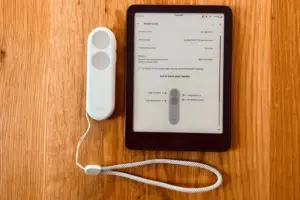
The Kindle Click operates with the minimalist efficiency characteristic of Amazon’s design language. Pairing is handled through a newly added "Accessories" tab within the device’s Settings menu. Once paired, the latency is negligible. The device offers four buttons: two for page navigation and two for front-light intensity. While the hardware is aesthetically refined, the real breakthrough is the firmware update. By allowing the Kindle to recognize these signals as input commands rather than audio triggers, Amazon has effectively unlocked a new dimension of interface control that could, in theory, be expanded to other devices in the future.
The Competitive Landscape: Is Amazon Lagging?
While the Kindle Click is a welcome addition, it is worth noting that Amazon remains in a game of catch-up. Competitors like Boox have been offering versatile remotes for years, devices capable of scrolling web pages, navigating menus, and jumping through audiobook chapters.
The Kindle Click, by contrast, is somewhat limited. It does not allow for navigation of the Kindle’s internal library, nor does it interact with the Audible interface in a meaningful way—a missed opportunity for a company that owns both platforms. As we look at the broader metrics of e-reader adoption, Amazon’s decision to limit the Click to devices manufactured in 2024 or later is likely a move to encourage hardware upgrades. For those owning devices from 2023 or earlier, the restriction feels like a missed opportunity for backward compatibility, potentially alienating a segment of their loyal, long-term user base.

Official Statements and Industry Reception
Amazon has been characteristically quiet regarding the technical specifications of the new Bluetooth protocol, framing the launch of the Kindle Click as a feature enhancement for the "modern reader." In recent internal documentation, the company emphasized that the goal was to provide "seamless, tactile control that keeps the reader immersed in the story."
Market analysts, however, view this as a necessary defensive move. As the e-reader market matures, the differentiation between devices is shrinking. By leaning into modularity—allowing users to choose how they interact with the hardware—Amazon is attempting to prevent its user base from migrating to more "open" platforms. The reception has been largely positive, with early adopters praising the build quality of the Click, though many have expressed frustration regarding the lack of advanced functionality for audiobook management.
Future Outlook: Where Does the Kindle Go From Here?
The release of the Kindle Click is likely the first step in a broader strategy to make the Kindle ecosystem more modular. If Amazon is willing to open up the Bluetooth protocol for page-turning, what stops them from allowing users to connect external keyboards for note-taking, or perhaps third-party Bluetooth-enabled styluses for more advanced annotation?
The roadmap for the next three years appears to be focusing on "peripheral-enhanced reading." As screens become more capable of rendering complex media and the devices themselves gain more processing power, the boundary between an "e-reader" and a "distraction-free tablet" will continue to blur.
Strategic Implications
- The Ecosystem Expansion: Amazon will likely continue to introduce specialized peripherals to drive accessory sales, similar to the strategy used for the Kindle Scribe.
- Firmware as a Service: We should expect more frequent updates that "unlock" features, turning older devices into more capable machines through software, though with the hardware gatekeeping seen in the 2024 cutoff, this will remain a contentious point.
- The Rise of Third-Party Integration: With the Bluetooth protocol now "cracked," we will inevitably see a surge in specialized third-party remotes that might offer features the official Kindle Click lacks, such as ergonomic grips or programmable macros.
Ultimately, the Kindle Click is more than just a $35 piece of plastic. It is a symbol of Amazon’s shifting priorities. By listening to the demands of the "BookTok" generation and the power-user community, Amazon is moving away from the rigid, monolithic design language of the past. The company has realized that in a world of infinite digital distractions, the most premium experience is the one that offers the most control to the user. Whether or not Amazon continues to open its ecosystem remains to be seen, but for now, the Kindle is finally—if only slightly—letting go of the reins.