As search engine optimization (SEO) undergoes its most turbulent evolution in a generation, a new sub-discipline has emerged: Generative Engine Optimization (GEO), also known as Answer Engine Optimization (AEO). In their haste to secure visibility within AI-generated summaries—such as Google’s AI Overviews and OpenAI’s SearchGPT—digital marketers are eagerly adopting unverified technical protocols. Chief among these is llms.txt, a proposed plain-text standard designed to serve as a directory of website content specifically curated for large language models (LLMs).
However, an investigative experiment by veteran technical SEO specialist Mark Williams-Cook has exposed a glaring lack of empirical evidence supporting the efficacy of llms.txt. Frustrated by the industry’s tendency to mistake routine crawler behavior for algorithmic validation, Williams-Cook created a satirical standard called cats.txt. The file formally declares a website’s "office cats," detailing their breeds, professional roles, and a highly scientific "PurrLevel" metric.
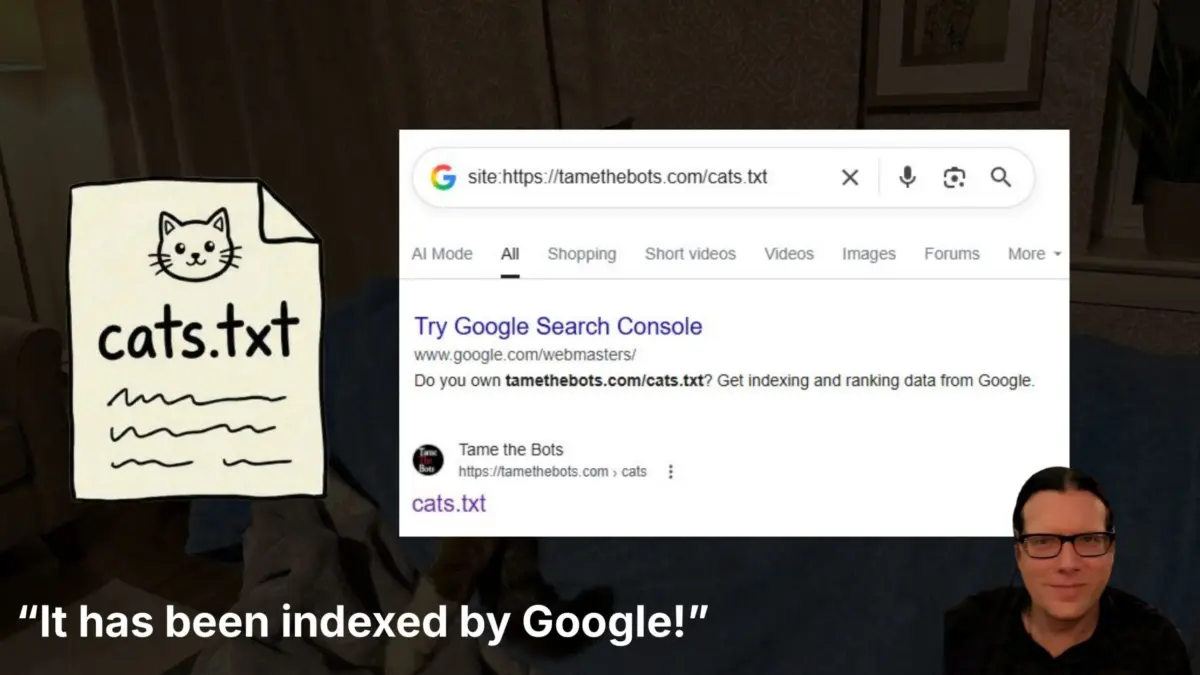
Astonishingly, cats.txt cleared the exact same benchmarks used to validate llms.txt. It was aggressively crawled by major AI bots, fully indexed by Google, surfaced in live AI search results, and enthusiastically recommended by ChatGPT as a legitimate optimization strategy.
This case study exposes a systemic vulnerability in modern digital marketing: a low bar of evidence where correlative observations are repackaged as proven optimization tactics, costing clients millions in speculative billing.
Detailed Chronology: From Irritation to "Web Standard"
The Genesis of a Satirical Standard
The experiment began in mid-2024, born out of Williams-Cook’s growing frustration with industry discourse. For months, prominent SEO practitioners, agency leads, and self-proclaimed AI theorists had been presenting a specific set of observations in client decks and public forums. They pointed to server logs showing AI bots requesting llms.txt files, and to ChatGPT quoting the contents of those files, as definitive proof that the protocol was actively reshaping the AI search landscape.
Recognizing that logical counter-arguments were doing little to stem the tide of speculative sales pitches, Williams-Cook decided to design a reductio ad absurdum experiment. He sought to create a standard so transparently ridiculous that its successful validation would instantly expose the flaws in the industry’s testing methodologies.
Drafting the Specification
Williams-Cook drafted a formal specification for cats.txt, mimicking the dry, over-engineered tone of genuine internet draft proposals (RFCs). According to the specification, the file must be placed at the root of a domain (e.g., example.com/cats.txt) to formally declare all feline associates of the organization.
The protocol mandated specific fields, including:
Name: The cat’s identifier.
Breed: The biological breed of the feline.
Job The cat’s official contribution to the website or enterprise.
PurrLevel: A mandatory metric scored out of 10, indicating the cat’s baseline affection and contentment.
Williams-Cook published this draft specification on his personal blog.
Seeding the AI Discourse
Understanding that modern LLMs are trained heavily on professional networking platforms, Williams-Cook published an article on LinkedIn. Written with a straight face, the post introduced cats.txt as "the missing standard for SEO and GEO," detailing why forward-thinking enterprises needed to adopt it immediately to future-proof their search visibility.
# Example of a valid cats.txt implementation:
Cat: Pixel
Breed: British Shorthair
Role: GUI Purrfectionist
PurrLevel: 8/10
The Community Joins the Jest
The SEO community quickly recognized the satirical target of the experiment. Rather than dismiss it, technical SEOs began adopting the protocol. Dave Smart, a respected technical SEO consultant, deployed a cats.txt file on his domain, tamethebots.com, declaring his fictional office cat, "Odd," a Tuxedo cat serving as a "Render Cat" with a PurrLevel of 5/7.
Shortly thereafter, anonymous community members launched catstxt.org, a highly polished, centralized hub that offered a cleaner, more robustly specified iteration of the standard. Within two weeks, a satirical protest against speculative SEO had developed its own decentralized ecosystem and a rival implementation.
Supporting Context & Metrics: Deconstructing the "Four Proofs"
With the infrastructure in place, Williams-Cook evaluated cats.txt against the four exact "proofs" that advocates routinely cite to validate the necessity of llms.txt. The satirical file passed all four criteria.
+-------------------------------------------------------------------------+
|                  THE FOUR ILLUSORY PROOFS OF GEO VALIDATION             |
+-------------------------------------------------------------------------+
|  1. Bot Crawling   -->  "The AI bots are actively fetching my file!"    |
|  2. Indexation     -->  "Google has indexed the file in its database!"  |
|  3. LLM Retrieval  -->  "The AI cited facts found only in the file!"    |
|  4. LLM Endorsement-->  "ChatGPT explicitly told me this file helps!"   |
+-------------------------------------------------------------------------+
Proof 1: "The LLM Bots Crawl It!"
The Claim: Marketers point to server logs showing user-agents like GPTBot, ClaudeBot, or PerplexityBot requesting /llms.txt as proof that these models prioritize and ingest the file.
The Reality: Web crawlers are designed to request virtually any file they encounter in links, site directories, or common standard paths. A crawl request does not equal processing, ranking weight, or algorithmic trust.
The cats.txt Metric: Within days of launch, server logs for domains hosting cats.txt filled with requests from PerplexityBot, GPTBot, ClaudeBot, and Googlebot. By the logic of llms.txt proponents, the world’s leading AI labs had collectively decided to prioritize feline-related metadata.
Proof 2: "It Was Indexed by Google, So It Must Matter!"
The Claim: If a search engine indexes a file, it has deemed that file structurally and contextually important to its search ecosystem.
The Reality: Google has indexed plain-text files (.txt, .csv, .log) since its inception. Indexation simply means a URL has been discovered, parsed, and stored. It is not an endorsement of truth, utility, or strategic value.
The cats.txt Metric: Google successfully crawled and indexed Dave Smart’s cats.txt file, even offering Smart the ability to claim the URL in Google Search Console to monitor its "ranking performance."
Proof 3: "The LLM Returned Information Found Only in the File!"
The Claim: When a user asks an AI about a site and the AI returns facts found exclusively in llms.txt, advocates claim this proves the LLM treats the file as a specialized, authoritative data source.
The Reality: This is simply Retrieval-Augmented Generation (RAG) at work. When an AI search engine is queried about a specific site, it performs a real-time web search, finds the indexed page (which happens to be the .txt file), and summarizes the text. The model treats the file as a basic web page, not as a specialized machine-readable standard.
The cats.txt Metric: When queried about the office pets of tamethebots.com, Google’s AI Overview confidently generated a bulleted summary stating that "Odd" is a "Render Cat" who "chases the cursor, pounces on stray pixels, and stashes them on the digital carpet," directly citing the cats.txt file as its sole source of truth.
Proof 4: "ChatGPT Itself Says It Helps!"
The Claim: Asking ChatGPT if llms.txt is beneficial yields a detailed, positive response, which marketers take as confirmation from the platform itself.
The Reality: This is a classic example of the convergence problem. LLMs do not possess real-time internal engineering knowledge of their own production systems. Instead, they generate text based on the statistical average of their training data. If the web is full of blog posts claiming llms.txt is helpful, the model will echo that consensus.
The cats.txt Metric: Two weeks after the experiment began, Williams-Cook asked ChatGPT: "Can cats.txt help me rank in search or LLMs?"
The model replied:
"Yes — cats.txt can potentially help you rank in both search engines and LLM-driven systems… [it provides] structured signals for machines… [leading to] better understanding → better visibility."
The model went on to explain how cats.txt helps AI systems "trust, summarize, and cite your content more accurately"—mirroring the exact sales pitch used for llms.txt.
+-----------------------------------------------------------------------------+
|                        THE LLM CONVERGENCE LOOP                             |
+-----------------------------------------------------------------------------+
|  1. Marketers write unverified speculative articles about a new "standard".  |
|  2. LLMs scrape and ingest these articles during routine training.          |
|  3. Marketers ask the LLM: "Does this new standard work?"                   |
|  4. LLM echoes the ingested speculative articles back with high confidence. |
|  5. Marketers cite the LLM's response as "proof" to bill clients.           |
+-----------------------------------------------------------------------------+
Official Statements & Empirical Data
While the industry remains eager to sell GEO solutions, empirical data and official statements from search engine representatives paint a far more skeptical picture.
Google’s Official Stance
John Mueller, Senior Search Partner and Search Advocate at Google, addressed the llms.txt trend directly on Bluesky, offering an uncommonly blunt assessment of the protocol’s current utility:
"FWIW no AI system currently uses llms.txt. It’s super-obvious if you look at your server logs. The consumer LLMs / chatbots (the ones that SEOs want traffic from) will fetch your pages – for training and grounding, but none of them fetch the llms.txt file. Maybe they will tomorrow? Maybe I’ll win in the lottery tomorrow?"
— John Mueller, Google
Empirical Industry Studies
To determine if Mueller’s skepticism was backed by data, SEO toolset provider Ahrefs conducted a large-scale analysis of 100,000 domains. Their findings confirmed that crawlers largely ignore the file in practice.
Furthermore, a broader study analyzing 300,000 domains revealed no measurable citation advantage or traffic lift for websites that had implemented an llms.txt file compared to those that had not. The file simply sits idle on servers, serving as a monument to speculative optimization.
The Shift in LLM Discourse
The true nature of the "convergence problem" was proven when the internet discourse around cats.txt shifted. Once enough articles, LinkedIn posts, and discussions published the fact that cats.txt was an elaborate joke, ChatGPT’s training and real-time search data updated.
Today, if you ask ChatGPT about cats.txt, it no longer claims the file will help you rank. Instead, it explains that cats.txt is a satirical web standard created by an SEO professional to highlight the low bar of evidence in GEO.
The file itself did not change. The underlying technology did not change. Only the online consensus changed, proving that an LLM’s endorsement is merely an echo of public discourse, not an empirical validation of technical efficacy.
Future Outlook: The Real Cost of Speculative SEO
The cats.txt experiment is more than a clever industry prank; it is a warning sign of a growing economic inefficiency within digital marketing.
The Opportunity Cost of "Snake Oil" Tactics
Every hour of developer time and every dollar of marketing budget allocated to speculative, unproven protocols like llms.txt is resource diverted away from strategies with proven, measurable ROI.
Optimization is a game of cumulative margins. Agencies that bill clients for implementing unverified files under the guise of "AI search readiness" are selling illusions.
How to Evaluate Future SEO Standards
To avoid falling victim to speculative trends, digital marketers and brand stewards should adopt a rigorous, three-step validation framework before deploying any new "standard":
Verify Official Documentation: Has a major LLM provider (OpenAI, Google, Anthropic) explicitly documented support for the file or markup in their developer guidelines?
Examine Server Logs for Active Usage: Are crawlers fetching the file and processing it differently than standard HTML pages, or is it treated as a basic web document?
Isolate and Test Variables: Can a measurable difference in rankings, citations, or traffic be observed in a controlled A/B test after implementing the change?
Until a protocol meets these basic criteria, it remains in the realm of speculation. As Williams-Cook concluded, llms.txt may one day become a genuine, functional standard. But until then, it has no more empirical validity than a plain-text file declaring a British Shorthair as a website’s chief user interface consultant. MARKeters would do well to remember that in the age of artificial intelligence, confidence is the product—not the proof.