Executive Overview
The rapid integration of Large Language Models (LLMs) and generative AI into the fabric of search engines has triggered an existential crisis for digital marketers and search engine optimization (SEO) professionals. For over two decades, the economic foundation of the web was built on a simple, transactional premise: search engines indexed website content, and in return, they directed traffic back to those websites. Today, that pact is unraveling.
With the deployment of Google’s AI Overviews, OpenAI’s search capabilities, and conversational engines like Perplexity, search platforms are increasingly acting as information synthesis agents. By answering complex queries directly on the search results page, these AI systems satisfy user intent without requiring a single click-through to the source. This rise in "zero-click" searches has forced corporate executives and CMOs to ask a fundamental question: How can organizations justify continued investment in SEO, content creation, structured data, and knowledge management if AI is systematically starving websites of organic traffic?
The answer lies in shifting the paradigm from traffic volume to brand sovereignty and value-driven engagement. In this investigative analysis, we examine a transformative strategic framework proposed by search industry pioneers: Click Worthiness.
Rather than chasing lost transactional clicks or attempting to recover traffic that AI can easily satisfy, forward-thinking enterprises must evaluate whether a search query retains enough residual value after an AI answer to warrant direct customer engagement. By transitioning from keyword-first to decision-first optimization, brands can defend their digital sovereignty and ensure their marketing budgets are allocated where they can drive actual, measurable business outcomes.
Detailed Chronology: The Evolution of Search and the Zero-Click Paradigm
To understand the necessity of "Click Worthiness," we must trace how the search landscape evolved from a directory of links to a conversational answer engine.
+------------------------------------+---------------------------------------+---------------------------------------+
| Era 1: The Retrieval Era (2000-15)  | Era 2: The Rich Snippet Era (2015-23) | Era 3: Generative Search (2023-Pres)  |
| - High CTR, "Ten Blue Links"       | - Featured Snippets, Direct Answers   | - AI Overviews, Synthesized Answers   |
| - Traffic scales with rankings     | - Rise of zero-click search behavior  | - Decoupled information consumption   |
| - Primary metric: Search Volume    | - Focus on capturing SERP real estate | - Primary metric: Click Worthiness    |
+------------------------------------+---------------------------------------+---------------------------------------+
Phase 1: The Retrieval Era (2000–2015)
In the early days of search, search engines acted as pure indexers. The "ten blue links" model meant that high search volume directly translated into business opportunity. If an organization ranked at the top of the search engine results page (SERP) for a high-volume query, they were virtually guaranteed a proportional stream of traffic. During this era, keyword volume was the primary mechanism for prioritizing marketing spend.
Phase 2: The Rich Snippet and Featured Snippet Era (2015–2023)
Google and other search engines began to realize that users preferred instant gratification. The introduction of featured snippets, knowledge panels, and interactive widgets (such as weather reports, flight trackers, and calculators) began to erode organic click-through rates (CTRs).
A prominent historical precedent occurred when global enterprises began losing massive amounts of informational traffic to these rich search features. For example, during this period, a global spirits brand operating a major cocktail recipe website noticed a sharp decline in traffic. Google had introduced rich recipe cards and direct-answer snippets on the SERP, displaying ingredients and instructions directly to users.
Initially, the brand’s instinct was defensive: attempt to win back the lost traffic by publishing more recipes and targeting a broader array of keywords. However, the brand soon realized it was fighting a losing battle against search engine convenience. Instead of trying to retrieve every lost informational click, they shifted their strategy. They optimized their content for the "drink curious"—users who weren’t just looking for a simple recipe retrieval, but who wanted to explore ingredient substitutions, visual inspirations, and mixology techniques. By focusing on curiosity and deeper decision-making rather than simple factual retrieval, the brand turned zero-click features into brand-building touchpoints, proving that engagement could be earned even when simple informational queries were intercepted.
Phase 3: The Generative Answer Era (2023–Present)
The launch of generative AI has accelerated this trend exponentially. AI Overviews and conversational interfaces do not merely pull structured snippets; they synthesize information from dozens of sources to construct personalized, context-aware answers.
This technological leap has fundamentally severed the relationship between search demand and website traffic. While search volume still accurately reflects customer interest and intent, it no longer guarantees that the brand providing the underlying knowledge will receive a visitor. The consumption of information has been decoupled from the business engagement on which traditional business plans were built.
Supporting Context & Metrics: Redefining Value in the Age of AI Overviews
To survive in this new ecosystem, enterprises must learn to distinguish between queries that are easily resolved by AI and those that require human-to-brand interaction. This distinction is the core of the Click Worthiness framework.
The Mechanics of Click Worthiness
Click Worthiness is not a tactical trick to inflate CTRs, nor is it a methodology for recovering lost traffic. Instead, it is a strategic filter that asks:
"If an AI engine provides a comprehensive answer to this query, does there still remain enough unique value or complexity for the customer to benefit from clicking through to our digital property?"
While search volume measures the demand for information, Click Worthiness measures the residual business value of engagement after that information demand has been satisfied.
Case Study in Contrast: Factual vs. Decision-Centric Queries
To illustrate this dynamic, let us analyze two search queries targeting the same brand: United Airlines.

       [Query 1: Factual Retrieval]                   [Query 2: Decision-Centric]
"Does United Airlines fly to Buenos Aires?"   "Which United itinerary to Buenos Aires gives me the
                                               best connection from Boston using my miles?"
                    |                                               |
         +----------+----------+                                    |
         |                     |                                    v
         v                     v                        +-----------+-----------+
  [AI Direct Answer]   [User Journey Ends]              |                       |
      "Yes, from..."     (Zero Click)                   v                       v
                                                [AI Narrows Options]   [User Needs Direct Interface]
                                                 (Schedules, Miles)     (Booking, Seat Selection)
                                                                                |
                                                                                v
                                                                        [High Value Click]
Query 1: "Does United Airlines fly to Buenos Aires?"
- Intent Class: Factual Retrieval.
- AI Intervention: High. An AI assistant can confidently answer "Yes, United operates direct flights from Houston and Newark to Buenos Aires" within milliseconds.
- Click Worthiness: Low. The customer’s immediate information need is entirely satisfied. While United would prefer the user click through to view schedules, the user has no compelling functional reason to do so at this stage. Spending resources to capture this organic traffic is highly inefficient in an AI-first world.
Query 2: "Which United itinerary to Buenos Aires gives me the best connection from Boston while allowing me to use my miles?"
- Intent Class: Decision Evaluation.
- AI Intervention: Moderate. While an AI engine can synthesize flight schedules and outline general loyalty program rules, it cannot confidently complete the transaction. The decision depends on real-time award seat availability, connection quality, pricing fluctuations, and individual customer preferences.
- Click Worthiness: High. The AI’s synthesized answer does not end the journey; it initiates it. The user must navigate to United’s owned platform to authenticate their account, verify dynamic mileage pricing, and execute the booking.
In this scenario, investment in high-fidelity structured data, dynamic API accessibility, and loyalty program content yields a direct return on investment (ROI). The click is earned because continuing the journey past the AI interface provides immense, irreplaceable value to the customer.
The Danger of the "Completeness Trap"
Many organizations have reacted to traffic declines by doubling down on content creation. They perform gap analyses to identify what their competitors—or AI engines—are saying, and then publish highly similar, "complete" guides to match them.
This approach leads to what strategists call the Completeness Trap. When every brand uses the same AI-driven keyword tools to fill the same topical gaps, their content becomes functionally interchangeable. Completeness is no longer a competitive advantage; it is merely the baseline cost of participation. True competitive advantage is realized by what happens after the initial search query is resolved.
Official Statements & Industry Perspectives
The shift toward Click Worthiness is gaining traction among leading digital marketing theorists and enterprise search strategists.
In their seminal book Search Engine Marketing, Inc., authors Bill Hunt and Mike Moran argued that search performance succeeds only when there is a alignment of three distinct objectives:
- The Business Objective: Driving profitable growth and customer acquisition.
- The Customer Objective: Gaining the confidence and information needed to make an optimal decision.
- The Search Engine Objective: Delivering the most authoritative, contextually accurate evidence to answer the user’s query.
                   +-----------------------+
                   |  Business Objective:  |
                   |   Profitable Growth   |
                   +-----------+-----------+
                               |
                               v
   +---------------------------+---------------------------+
   |                                                       |
   v                                                       v
+-----------------------+                             +-----------------------+
|  Customer Objective:  | <=========================> |  Search/AI Objective: |
| Decision Confidence   |                             | Authoritative Evidence|
+-----------------------+                             +-----------------------+
Industry analysts point out that in the age of generative AI, this triad must be recalibrated. Search engines have been joined by AI agents that require highly structured, authoritative knowledge graphs to confidently recommend a brand.
"If an AI agent cannot verify the authority and truthfulness of your data, it will simply recommend a competitor whose data is better structured and more verifiable," notes one enterprise search consultant. "But once that recommendation is made, the brand must offer a seamless, high-value experience on their own site to convert that recommendation into an actual customer relationship. That is where Click Worthiness acts as the ultimate filter."
Future Outlook: Building a Decision-First Optimization Engine
As organizations transition from keyword-first optimization to decision-first optimization, their internal planning workflows must evolve. The traditional sequence of keyword research, content drafting, and metadata implementation is no longer sufficient.
The Click Worthiness Planning Model
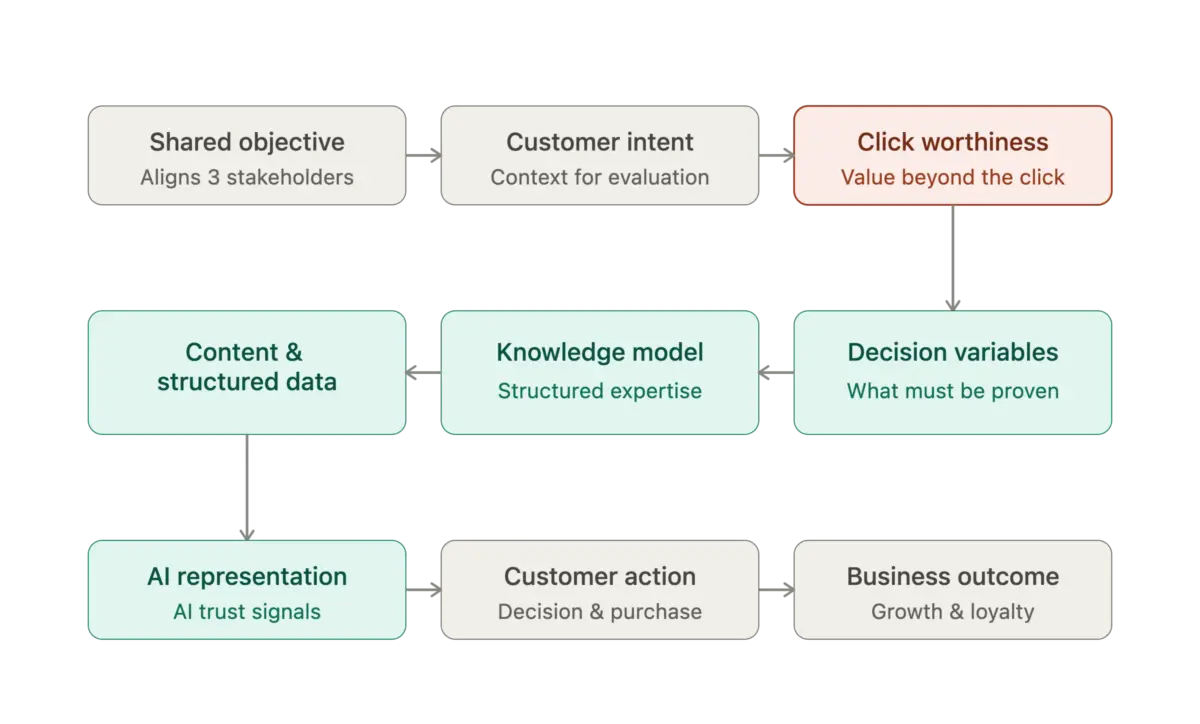
To operationalize this strategy, enterprises should adopt a structured, five-stage planning model that places Click Worthiness at the center of all content and infrastructure investments.
+-------------------------------------------------------------------------------------------------+
|                                 Click Worthiness Planning Model                                 |
+-------------------------------------------------------------------------------------------------+
|                                                                                                 |
|  [Step 1: Define Objectives & Intent]                                                           |
|  Identify the shared business goals and the underlying customer intent.                         |
|                                                                                                 |
|                                 v                                                               |
|                                                                                                 |
|  [Step 2: Apply the Click Worthiness Gate]                                                      |
|  Determine if the user journey continues after an AI-synthesized answer.                        |
|                                                                                                 |
|                                 v                                                               |
|                                                                                                 |
|  [Step 3: Map Decision Variables]                                                               |
|  Identify the dynamic variables (pricing, rules, configurations) the user needs to evaluate.    |
|                                                                                                 |
|                                 v                                                               |
|                                                                                                 |
|  [Step 4: Build the Knowledge Model]                                                            |
|  Construct a robust, semantically linked data model to feed search engines and internal apps.   |
|                                                                                                 |
|                                 v                                                               |
|                                                                                                 |
|  [Step 5: Implement Structured Data & Optimization]                                             |
|  Deploy schema markup and optimize API endpoints for LLM consumption.                           |
|                                                                                                 |
+-------------------------------------------------------------------------------------------------+
Step 1: Define Shared Objectives and Customer Intent
Rather than beginning with search volume, start by identifying the shared business objective and the customer’s core intent. What is the customer trying to accomplish, and how does that action drive business value?
Step 2: Apply the Click Worthiness Gate
Assess the query using the Click Worthiness criteria. If an AI engine provides a complete, factual answer to this query, will the customer still have a compelling reason to visit your website?
- If No (e.g., purely informational or factual queries): De-prioritize heavy content development. Focus instead on lightweight, highly structured data feeds to ensure your brand is cited as the source of truth by the AI engine (Brand Sovereignty).
- If Yes (e.g., complex, multi-variable, transactional, or highly personalized queries): Proceed to Step 3.
Step 3: Map Decision Variables
Identify the complex parameters, rules, and variables that influence the customer’s decision. For a travel company, this might include loyalty tiers, dynamic pricing, and cancellation policies. For an enterprise SaaS provider, this might include integration compatibility, security standards, and customized pricing models.
Step 4: Build the Knowledge Model
Develop a robust semantic knowledge model that maps these decision variables. This step ensures that your organization’s proprietary data, expert insights, and product relationships are organized logically and can be easily navigated by both human users and machine crawlers.
Step 5: Implement Structured Data and AI Optimization
Finally, implement Schema.org markup, custom API integrations, and LLM-friendly formats. This allows AI engines to easily digest and confidently represent your expertise to users, maximizing the likelihood that your brand will be featured as the primary recommended solution.
Measuring Success in a Post-Traffic Era
This new strategic direction requires a complete overhaul of digital marketing KPIs. Traditional metrics like impressions, organic sessions, and keyword rankings are no longer the sole indicators of health. Instead, organizations must learn to measure:
- Brand Citation Share (Share of Model Voice): How frequently and prominently is your brand cited as the authoritative source in AI Overviews and LLM responses for your target industry?
- High-Value Click-Through Rate: The percentage of clicks generated specifically from complex, high-intent queries that lead directly to high-value actions (such as conversions, demo sign-ups, or purchases).
- Downstream Engagement Value: The depth of interaction, dwell time, and multi-page journey progression of users who land on your site after interacting with an AI search agent.
- Cost-per-Value-Engagement: The marketing spend required to drive a user to a decision-making tool or transaction page, rather than simply driving a user to a generic informational blog post.
By shifting focus to these metrics, organizations can stop mourning the loss of low-value informational traffic and start maximizing the high-value conversions that drive sustained business growth. Brand Sovereignty is the destination; Click Worthiness is the roadmap. Together, they ensure that search engine marketing remains a highly profitable, strategically vital component of the modern enterprise.