Executive Overview
Hot off the heels of the critical and festival success of his autobiographical feature debut, Diciannove (Nineteen), rising Italian auteur Giovanni Tortorici is firmly staking his claim as one of European cinema’s most exciting new voices. With his sophomore directorial effort, Ketticè, Tortorici has secured a prestigious competition slot at the Locarno Film Festival. Set against the sun-baked, yet politically stagnant backdrop of Palermo in 2012, Ketticè examines the combustible friction of adolescence, bridging the gap between social inequality, youthful rebellion, and the encroaching shadow of the modern digital age.
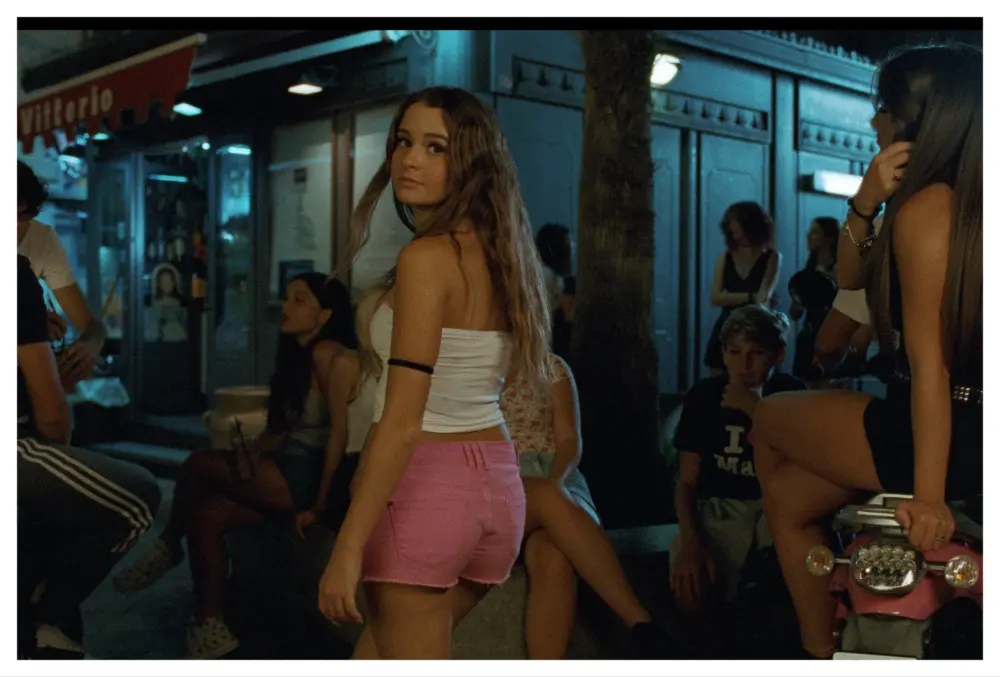
Derived from a Sicilian dialect nickname for its fierce, working-class female protagonist, Ketticè tells the story of an exclusive, counter-cultural bond formed by two sixteen-year-olds from starkly different stratifications of society. Driven by a raw, unpolished aesthetic, Tortorici made the daring decision to populate the film largely with first-time, street-cast actors—most notably Rachele Testagrossa and Salvatore Gallina. The singular exception in the primary cast is Italian cinematic icon Monica Bellucci, who lends her gravitas and sophisticated screen presence to the role of an eccentric, upper-class matriarch.
Behind the scenes, Tortorici continues his creative partnership with celebrated filmmaker Luca Guadagnino, who serves as a producer on the project. Guadagnino’s unique Socratic, maieutic approach to mentorship has helped shape Tortorici’s distinct cinematic lens. In this comprehensive feature, we examine the roots of Ketticè, the socio-political realities of 2012 Palermo, the mechanics of street casting, and the delicate intersection between youthful alienation and aristocratic rigidity.
Detailed Chronology: From Forgotten Scripts to Locarno Competition
The trajectory of Ketticè is as unconventional as its subject matter, born largely out of serendipity and archival rediscovery. Following the whirlwind international rollout of Diciannove—which made a major splash in the Venice Horizons (Orizzonti) section last year—Tortorici found himself sifting through old files when he stumbled upon a discarded screenplay. Written when the director was just 22 years old, the script centered on the universal turmoil, peculiar vernacular, and idiosyncratic mannerisms of sixteen-year-olds.
"I had zeroed in on lots of dynamics, expressions, mannerisms, that I’d actually even forgotten about," Tortorici reflects. The discovery served as a creative catalyst. Struck by the clarity of adolescent emotion and social maneuvering captured in his early writing, the 30-year-old director decided to reconstruct that specific era of his life. Growing up in Palermo provided a vivid, highly localized canvas for exploring the invisible walls separating different social classes.
Unlike Diciannove, which focused narrowly on an introspective, semi-autobiographical nineteen-year-old navigating the intellectual spheres of higher education, Ketticè broadens its scope. It is an ensemble-driven, less intellectualized work where power dynamics are immediately and physically manifest. By anchoring the narrative in 2012—an era defined by economic stagnation and the dawn of ubiquitous social media surveillance—Tortorici tracks how his young protagonists carve out physical and psychological safe spaces. Their routine ritual of buying and smoking cannabis in a Palermo housing project becomes an act of micro-rebellion, offering a shared refuge away from both the judgmental gaze of adult authority and the omnipresent lenses of modern civic control.
Supporting Context & Metrics: Class Divides and the Palermo Landscape
To fully appreciate the narrative tension of Ketticè, one must understand the stark socioeconomic geography of Palermo. The film’s dramatic engine is fueled by the collision of two vastly different worlds: the gritty, survivalist working-class neighborhoods and the insulated, hyper-controlled drawing rooms of the city’s old aristocracy and upper-middle class.

The Protagonists: Ketty and Giulio
At the center of the narrative are Ketty and Giulio. Ketty, played with visceral energy by newcomer Rachele Testagrossa, embodies the rough-around-the-edges reality of working-class Palermo. Her lineage carries dangerous undertones, including familial ties to the Mafia. Unlike the sheltered youth of privileged backgrounds, Ketty possesses a physical, aggressive response to conflict. She is entirely unconcerned with societal decorum, comfortable with physical brawling, and driven by a primal need for autonomy.
Conversely, Giulio—portrayed by fellow non-professional actor Salvatore Gallina—is the quintessential product of aristocratic repression. Giulio’s upbringing is dictated by strict physical and social control; his mother’s voice constantly rings in his ears, reminding him to keep his elbows off the dinner table and to suppress wild, expressive hand gestures.
This behavioral polarization is precisely what draws them together. Their relationship functions as a mutual exchange of forbidden traits: Ketty finds a momentary tether to a calmer, safer universe, while Giulio is intoxicated by Ketty’s unrestrained freedom and defiance of institutional boundaries.
The 2012 Milieu
Tortorici specifically selected 2012 as the narrative anchor because of its unique transitional cultural fingerprint. It was a time characterized by political stagnation and cultural numbness across Italy. More importantly, it marked the first pervasive wave of social media integration into daily youth culture. For teenagers like Ketty and Giulio, the era represents a strange liminal space: the analog world of street corners, hidden housing projects, and physical evasion of local authorities was beginning to clash with the digital Panopticon of modern surveillance. When the characters sneak away to smoke weed, their anxiety is twofold—they are hiding from the police, but they are also acutely aware of a changing world where privacy is rapidly evaporating.
Official Statements & Production Insights: Working with Monica Bellucci and Luca Guadagnino
The production methodology behind Ketticè represents a fascinating juxtaposition between raw authenticity and polished, elite cinematic experience. Tortorici’s reliance on street casting for the bulk of the adolescent roles infuses the film with a documentary-like immediacy, capturing real regional dialects, authentic body language, and unscripted behavioral ticks. However, anchoring the adult authority figures required a contrasting approach, leading to the casting of international icon Monica Bellucci as Giulio’s mother.
Capturing the Upper-Class Matriarch
Bellucci plays a character who, on the surface, adheres to the pristine standards of Sicilian high society. In public, she projects elegance, grace, and impeccable manners. Behind closed doors, however, her psychology shifts into something eccentric, volatile, and subtly terrifying.
When asked about the inspiration behind this complex maternal figure, Tortorici notes that the character was drawn directly from real-life observations of upper-class Sicilian women. "In public, they are very elegant and well-mannered… but then in their private lives, within the walls of their homes, they become pretty eccentric and even slightly violent," the director explains.

Securing a professional of Bellucci’s caliber for such an eccentric role was a deliberate creative gamble that paid off immensely. Tortorici recalls that from the very first table reads and rehearsals, Bellucci grasped the deep-seated psychological contradictions of the role. Rather than playing a caricature of a wealthy mother, Bellucci delivered a grounded, realistic performance that resonated profoundly with viewers who actually inhabit that insular aristocratic world.
The Guadagnino Method: Maieutic Mentorship
The film’s production also highlights the ongoing creative and personal partnership between Tortorici and acclaimed director Luca Guadagnino, who serves as a producer on both of Tortorici’s feature films. Guadagnino’s guidance, however, eschews traditional top-down notes or heavy-handed script doctoring.
Instead, Tortorici describes Guadagnino’s methodology as strictly maieutic—referencing the Socratic technique of helping an individual draw out latent ideas and knowledge through guided, probing dialogue.
"He doesn’t necessarily tell you specific things about a certain problem, but he tries to draw them out from within you," Tortorici shares. "Then, through dialogue, he helps you understand what you really want, or are looking for… He’s like a kind of psychoanalyst who can help you discern what might be an external influence, or what might be something you are holding back on out of prudence, or even cowardice."
This unique mentorship style has allowed Tortorici to preserve his authentic directorial voice, avoiding the trap of pandering to industry trends or succumbing to creative timidity.
Future Outlook: The Rise of a Distinct Italian Voice
With Ketticè making its world premiere in competition at the Locarno Film Festival, Giovanni Tortorici is systematically cementing his reputation as an essential voice in contemporary European art-house cinema. Moving fluidly from the intellectual, university-bound introspection of Diciannove to the raw, visceral, class-divided asphalt of 2012 Palermo in his sophomore outing, Tortorici has proven that he possesses both thematic range and a fearless approach to casting and storytelling.
As Ketticè begins its international festival run under the banner of producer Luca Guadagnino and distributor PiperFilm, industry insiders are watching closely to see how global audiences and critics respond to this unvarnished portrait of Sicilian youth. By blending street-cast naturalism with the formidable talents of icons like Monica Bellucci, Tortorici has crafted a coming-of-age drama that refuses to romanticize youth, choosing instead to honor the dangerous, beautiful, and complicated realities of growing up on the margins of class and control.