Executive Overview
The modern enterprise data stack stands at a critical crossroads. For years, the prevailing wisdom in machine learning and data architecture dictated that artificial intelligence workloads demanded purpose-built, highly specialized infrastructure. When vector embeddings emerged as the foundational data type for semantic search, retrieval-augmented generation (RAG), and recommendation engines, a wave of dedicated vector databases entered the market. Vendors pitched these systems as an absolute necessity, warning that general-purpose databases would buckle under the mathematical weight of high-dimensional similarity searches.
Yet, a quieter counter-revolution has been unfolding in production environments worldwide. Teams routinely drop the open-source pgvector extension into existing PostgreSQL instances on a Tuesday afternoon, combining relational data and embeddings in a single table. They execute hybrid filters and vector searches within a single SQL statement, bypassing the friction of maintaining an entirely separate storage layer. Months later, vendor pitches arrive in their inboxes, warning of inevitable system collapse unless they migrate to a "real" vector database.
Historically, these rival claims—pitched with absolute confidence by both camps—were rarely backed by empirical data. Engineering teams were forced to choose between the operational simplicity of PostgreSQL and the specialized promises of dedicated systems based on intuition rather than hard metrics.
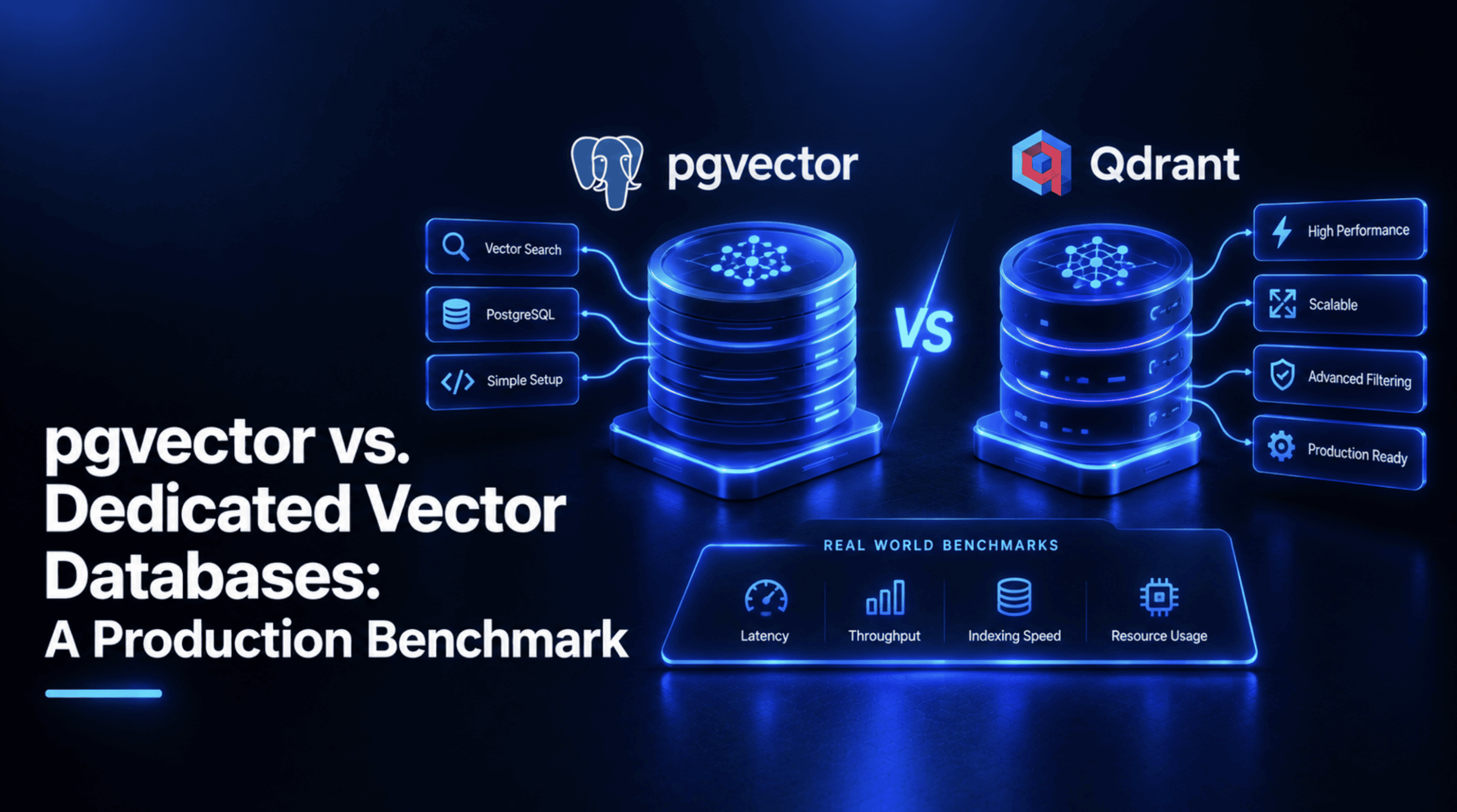
To bridge this analytical gap, this investigation examines the real, measured performance of pgvector versus dedicated vector databases like Qdrant, Pinecone, Weaviate, Milvus, and ChromaDB. By analyzing local prototyping mechanics, large-scale benchmarks involving tens of millions of high-dimensional vectors, and operational trade-offs, this article provides an authoritative framework to help engineering leaders determine which architecture truly suits their production workloads.
Detailed Chronology: The Evolution of Vector Search and Hybrid Infrastructure
To understand how the industry reached the current debate, it is necessary to trace the technological trajectory that brought vector search into the mainstream enterprise database market.
Phase 1: The Specialized Era (Pre-2023)
In the early days of deep learning-driven search and recommendation systems, vector operations were largely confined to specialized libraries such as FAISS (Facebook AI Similarity Search), Annoy, or NMSLIB. These libraries excelled at approximate nearest-neighbor (ANN) search over static datasets in memory, but they lacked fundamental database primitives. They offered no transactional guarantees (ACID), no native support for metadata filtering alongside vector lookups, and no persistence layers capable of handling dynamic updates without completely rebuilding indices.
Recognizing this operational vacuum, a new wave of venture-backed startups emerged to build purpose-built vector databases from scratch. Platforms like Pinecone, Qdrant, Weaviate, and Milvus were engineered explicitly around vector distance calculations (Cosine, Euclidean Inner Product, Manhattan distance) and graph- or tree-based index structures like Hierarchical Navigable Small World (HNSW) and Inverted File (IVF) indices. These systems provided distributed architectures, dedicated storage engines, and developer-friendly APIs designed exclusively for AI workflows.
Phase 2: The Extension Movement (2023–2024)
As large language models (LLMs) catalyzed enterprise AI adoption in 2023, developers quickly grew fatigued by the operational overhead of managing multi-database architectures. Keeping a primary transactional database (such as PostgreSQL) synchronized with a separate vector database introduced distributed systems challenges: eventual consistency gaps, dual-write failure modes, complex data pipelines, and doubled infrastructure monitoring costs.
Amid this friction, the pgvector extension—initially released as an open-source project by Ankane—gained massive traction. By integrating native vector data types, exact distance functions, and eventually HNSW indexing directly into PostgreSQL, pgvector allowed developers to store a 1,536-dimensional OpenAI embedding in the exact same table row as the user profile, order history, or product catalog it described. Suddenly, complex hybrid queries—combining relational filters, full-text search, and semantic vector similarity—could be executed within a single query planner pass using standard SQL.
Phase 3: The Scale and Benchmark Reality (2024–Present)
As adoption scaled into tens of millions of records, the engineering community demanded rigorous, transparent performance benchmarks. Initial assumptions that relational extensions would inevitably lag behind purpose-built systems were challenged by empirical tests. Rigorous third-party evaluations, such as those conducted by Tiger Data on 50-million-vector datasets, revealed a nuanced operational reality: pgvector (when paired with performance enhancements like pgvectorscale) could achieve exceptional query throughput, while dedicated systems often maintained superior tail latencies. The architectural debate shifted away from sweeping generalizations toward granular workload matching.
Supporting Context & Metrics: Technical Breakdown and Benchmarks
Evaluating the performance of vector search requires dissecting both local prototyping configurations and massive production-scale stress tests.
Understanding the Architectures
To make an informed architectural decision, one must contrast the fundamental design philosophies of both approaches:
pgvector: An open-source PostgreSQL extension (currently supporting Postgres 13 through 17) that introduces native vector data types (vector,halfvec,sparsevec) and distance operators (<=>for cosine distance,<->for L2 distance,<#>for inner product). It operates inside your existing database infrastructure, eliminating network hops and ensuring atomic consistency between relational records and vector embeddings.- Dedicated Vector Databases: Purpose-built, standalone services with custom storage engines designed exclusively for high-dimensional spatial indexing. They decouple vector search from primary relational data stores, necessitating synchronization pipelines but often providing advanced out-of-the-box features like built-in text chunking, native multi-tenancy, and distributed sharding.
The industry landscape of dedicated vector databases is anchored by five primary systems, each tailored to distinct operational niches:
| Database | Primary Architecture & Language | Best-Fit Production Workload |
|---|---|---|
| Pinecone | Cloud-native, fully managed SaaS | Low-ops enterprise scale requiring zero infrastructure management |
| Qdrant | Rust-based, standalone service | High-performance queries with complex JSON payload filtering |
| Weaviate | Go-based, AI-native system | Integrated vectorization modules and hybrid BM25 lexical search |
| Milvus | Distributed, cloud-native C++ engine | Massive, billion-scale enterprise workloads and GPU-accelerated indexing |
| ChromaDB | Lightweight, embedded database | Local prototyping, testing, and Python-centric development |
Local Prototyping and Mechanics
To understand the operational mechanics, developers can establish a local benchmarking environment using Docker. For pgvector, initializing a container running PostgreSQL 17 with the extension enabled requires minimal overhead:
services:
  postgres:
    image: pgvector/pgvector:pg17
    ports:
      - "5432:5432"
    environment:
      - POSTGRES_PASSWORD=benchmark
      - POSTGRES_DB=vectorbench
Once running, creating a table to house 1,536-dimensional vectors (matching models like OpenAI’s text-embedding-3-small) is executed via standard SQL:
import psycopg2
from pgvector.psycopg2 import register_vector

conn = psycopg2.connect(
    host="localhost", port=5432, dbname="vectorbench",
    user="postgres", password="benchmark"
)
conn.autocommit = True
cur = conn.cursor()

# Register extension and vector adapter
cur.execute("CREATE EXTENSION IF NOT EXISTS vector;")
register_vector(conn)

cur.execute("""
    CREATE TABLE IF NOT EXISTS items (
        id bigserial PRIMARY KEY,
        embedding vector(1536)
    );
""")
Conversely, deploying an equivalent dedicated instance using Qdrant involves launching its standalone container and configuring a matching collection via its Python client:
from qdrant_client import QdrantClient
from qdrant_client.models import Distance, VectorParams

qdrant = QdrantClient(url="http://localhost:6333")
qdrant.create_collection(
    collection_name="items",
    vectors_config=VectorParams(size=1536, distance=Distance.COSINE),
)
When executing local benchmarks with synthetic datasets (e.g., 100,000 normalized vectors), both systems easily achieve low single-digit millisecond latencies on standard laptop hardware. However, local benchmarks serve primarily to validate functional mechanics rather than predict enterprise behavior. True production capacity requires examining large-scale empirical benchmarks.
Production-Scale Performance Analysis
To evaluate how these architectures scale under heavy enterprise loads, we examine methodology-transparent public benchmarks (such as those conducted on AWS r6id.4xlarge hardware running 50 million real Cohere embeddings at 768 dimensions).
It is vital to note an important technical distinction: enterprise evaluations of PostgreSQL often utilize pgvector paired with pgvectorscale (an additional extension incorporating StreamingDiskANN indexing), rather than vanilla pgvector alone. Below is a summary of performance metrics measured at scale:
| Metric Profile | pgvector + pgvectorscale |
Qdrant (Dedicated Engine) |
|---|---|---|
| p50 Latency (@ 99% Recall) | 31.07 ms | 30.75 ms |
| p95 Latency (@ 99% Recall) | 60.42 ms | 36.73 ms |
| p99 Latency (@ 99% Recall) | 74.60 ms | 38.71 ms |
| Throughput (@ 99% Recall) | 471.57 QPS | 41.47 QPS |
| p50 Latency (@ 90% Recall) | 9.54 ms | 4.74 ms |
| Throughput (@ 90% Recall) | 1,589.79 QPS | 360.81 QPS |
| Index Build Time (50M Vectors) | 11.1 hours | 3.3 hours |
Analyzing the Data: Throughput vs. Tail Latency
The empirical data defies simplistic narratives. The benchmark results highlight a distinct architectural trade-off:
- Throughput Dominance: At a demanding 99% recall rate, PostgreSQL paired with advanced vector scaling delivered over 11 times the query throughput of Qdrant (471.57 QPS versus 41.47 QPS). At 90% recall, this throughput gap widened even further to nearly 1,600 QPS.
- Tail Latency Advantage: Conversely, Qdrant maintained a pronounced advantage in tail latency stability. Its p99 latency was nearly 48% faster (38.71ms vs. 74.60ms), ensuring that outlier queries under heavy concurrent load completed faster in the dedicated storage engine.
- Index Construction Costs: Dedicated vector databases built their HNSW indices substantially faster—completing the 50-million vector index in 3.3 hours compared to over 11 hours for the Postgres-based configuration.
Crucially, both systems kept all measured latency percentiles well under 100 milliseconds at scale, conclusively disproving the notion that general-purpose relational databases cannot handle large-scale vector search workloads.
Official Statements & Industry Perspectives
Industry leaders, database architects, and maintainers have increasingly spoken out on the architectural nuances separating extensions from dedicated engines.
- The PostgreSQL & Extension Advocates: Proponents of
pgvectoremphasize operational consolidation. By keeping relational metadata, full-text search, and vector embeddings within a single ACID-compliant database, engineering organizations eliminate entire classes of failure modes. Data corruption caused by asynchronous synchronization pipelines between a primary database and a secondary vector store is entirely eradicated. Furthermore, teams do not need to retrain engineering staff on new operational runbooks, backup strategies, or monitoring frameworks. - The Dedicated Infrastructure Advocates: Enterprise architects defending dedicated vector databases point to blast-radius isolation and hardware specialization. Running resource-intensive HNSW graph traversals alongside heavy transactional relational workloads (such as OLTP row locks, heavy writes, and complex multi-table joins) can introduce CPU and memory contention on a single PostgreSQL instance. Dedicated vector engines allow infrastructure teams to scale vector search clusters independently from transactional databases, optimizing memory-to-CPU ratios specifically for spatial index caching.
Future Outlook: Where the Market is Heading
As artificial intelligence systems transition from experimental prototypes into deeply embedded enterprise infrastructure, the boundary between relational databases and vector stores will continue to blur.
1. The Rise of Hybrid Storage Engines
We are witnessing a convergence in database design. Major relational database vendors are aggressively optimizing their vector capabilities, recognizing that developers strongly prefer unified data stacks. Concurrently, dedicated vector database vendors are expanding their feature sets to support richer metadata filtering, transactional updates, and traditional relational querying capabilities.
2. Hardware-Accelerated Vector Processing
Future iterations of enterprise vector search will increasingly leverage specialized hardware acceleration. While current benchmarks heavily evaluate CPU-bound HNSW implementations, the integration of GPU-accelerated index building and searching (pioneered by engines like Milvus) will become standard practice for billion-scale datasets. PostgreSQL extensions will likewise need to integrate more deeply with hardware-level optimizations to remain competitive at extreme scale.
3. Workload-Driven Selection Criteria
Ultimately, the future of this architectural debate is not winner-take-all. Organizations are moving past vendor hype and evaluating infrastructure based on strict workload parameters:
- Choose
pgvectorif your scale remains under 5 to 10 million vectors, your team already operates PostgreSQL, and you require strict transactional consistency between relational business data and semantic embeddings. - Choose a Dedicated Vector Database if you are operating at hundreds of millions to billions of vectors, require strict sub-40ms tail latencies under extreme concurrent query loads, or demand fully managed zero-ops cloud infrastructure.
By anchoring technical decisions in measured empirical performance rather than marketing narratives, modern engineering teams can build resilient, high-performance AI applications designed to scale effectively into the next decade.