Executive Overview
For decades, the cultural perception of cinematic costume design has been inextricably linked to high-end shopping, glamorous montages, and surface-level aesthetics. Yet, behind every iconic silhouette on the silver screen lies a rigorous, deeply intellectual discipline dedicated to world-building, psychological profiling, and historical preservation. Contemporary costume design is not merely about sourcing what looks fashionable; it is about visually codifying who a character is, where they come from, and what they are trying to hide.
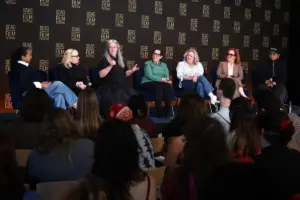
This reality took center stage at the recent SCAD Savannah Film Festival, where a panel of Hollywood’s top-tier costume designers gathered for the annual Costume Design Roundtable. Moderated by Variety’s Senior Artisans Editor, Jazz Tangcay, the panel featured an extraordinary roster of industry veterans: Molly Rogers (The Devil Wears Prada, The Devil Wears Prada 2), Ellen Mirojnick (The Odyssey, Wall Street, Basic Instinct), Arianne Phillips (The Invite, Nocturnal Animals), Linda Muir (Werwulf, The Northman), Amy Roth (I Play Rocky), and Marci Rodgers (Michael, She’s Gotta Have It).
Together, these visionary artists unpacked the grueling complexities of their craft, challenging the pervasive industry misconception that costume design is just a glorified shopping trip. From navigating the pressures of blockbuster sequels and historical authenticity to battling executive interference and the rising tide of corporate product placement, the conversation offered a rare, unfiltered look at the blood, sweat, and archival research required to dress the modern cinematic landscape.
Detailed Chronology: Insights from the SCAD Savannah Film Festival Roundtable
The roundtable progressed as a masterclass in cinematic art direction, moving fluidly from foundational philosophies to the intricate, often hazardous realities of contemporary production.
The Myth of the "Shopping Trip"
The session opened with a stark reality check from Molly Rogers, whose extensive resume includes assisting on the original The Devil Wears Prada before stepping into the role of costume designer for its anticipated sequel. Rogers didn’t mince words when describing how she evaluates incoming talent:
"When someone comes up to me and says, ‘I really want to learn and work with you. I love to shop.’ That’s an automatic exit."
This sentiment set the foundational tone for the panel: contemporary design is hard-won anthropology. Ellen Mirojnick, whose legendary career spans decades of defining cinematic style in films like Wall Street, Basic Instinct, and Fatal Attraction, echoed this weight, noting the tightrope walk of modern costuming.
"In the beginning of my career, I did a lot of contemporary costume, and I loved it. I loved being able to document what New York was like at that period… Contemporary design is very difficult and very beautiful at the same time to create."
Navigating Community, Culture, and the Unpredictable Actor
Marci Rodgers shared her foundational experiences entering the industry on Spike Lee’s She’s Gotta Have It. Recognizing early on that her Midwestern background did not grant her an innate understanding of New York’s distinct subcultural fashion, Rodgers took the proactive step of sitting in on background casting with Lee to study how everyday people walked into the room.
When developing the wardrobe for Nola Darling, Rodgers discovered the character’s allegiance to Prince. Instead of opting for easy luxury labels like Saks Fifth Avenue, Rodgers took to thrift stores, curating "tidbits of purple" that felt organic to a struggling artist. On Barbershop, set in Chicago, Rodgers focused heavily on capturing the pulsating community heartbeat of the era. She also shared a vital piece of advice handed down to her by a professor: contemporary design is frequently the hardest thing a designer will tackle because actors constantly arrive with preconceived notions that shift wildly after the first table read.
Power Dynamics and Product Placement Pressures
Arianne Phillips brought a sharp, systemic critique to the table regarding how studio executives and producers view the department. Drawing from her work on Nocturnal Animals, The Invite, and I Want Your Sex, Phillips highlighted a glaring disconnect between the decision-makers holding the purse strings and the artists executing the vision:
"I’ve been in rooms with studio executives… They’re rich. They make a lot of money. They have a relationship to shopping, someone shopping for them. They can afford what they want, and they’re experts… You have to be, as Marci said, a salesperson for your character. Costume design can be disrespected so easily by people sitting behind desks moving numbers around and not giving you the support you need."
Phillips further warned of an emerging frontier complicating modern design: the encroachment of luxury brand financing and mandatory product placement. As studios increasingly rely on corporate partnerships to balance budgets, designers are routinely handed directives from producers dictating specific brands that must be worn—a trend that threatens the narrative integrity of independent character-building unless filmmakers fiercely protect their creative teams.
Supporting Context & Metrics: Deconstructing Current and Legacy Projects
The second half of the roundtable transitioned into case studies of the designers’ most ambitious upcoming and recent projects, illustrating the staggering scope of research required to bring these worlds to life.
Epic Scale and Historical Precision
- Ellen Mirojnick & The Odyssey (Dir. Christopher Nolan): Mirojnick faced the monumental task of crafting over 5,300 costumes for Nolan’s cinematic retelling, paying hyper-specific attention to Anne Hathaway’s Queen Penelope. The House of Ithaca was anchored by a deliberate "burned red" color palette to maintain unbroken narrative continuity. For the film’s climactic sequence—the triumphant return of Odysseus—Penelope sheds her grief and dons a striking blue dress functioning as emotional and physical armor. Featuring fine, rigid pleats engineered precisely to Hathaway’s form and paired with a rare golden neckpiece, the gown was designed to communicate that Penelope was ready for battle and fully prepared to hold her own against the returning suitors.
- Linda Muir & Werwulf / The Northman (Dir. Robert Eggers): Muir’s dedication to historical fidelity is legendary. Discussing her work in the realm of Viking and medieval folklore, Muir detailed an exhaustive deep-dive into the economics of wool. In ancient and medieval societies, wool was a primary currency of wealth. Muir noted historical ironies—such as how British monarchs systematically eradicated local wolf populations to protect valuable sheep herds—which dictated that characters draped in heavy wool were demonstrably upper-class. The core production hurdle, however, was not just historical accuracy, but finding modern artisans capable of manufacturing authentic wool fabrics, bespoke buttons, belts, and primitive jewelry from scratch.
The Psychology of Contemporary Subtext
- Arianne Phillips & The Invite (Dir. Olivia Wilde): Marking her third collaboration with Wilde, Phillips utilized a minimalist yet deeply psychological approach. To convey the emotional stagnation of Angela, a stay-at-home artist who has lost her creative spark, Phillips coordinated closely with production designer Jade Healy to ensure Angela’s wardrobe actively allowed her to "blend into the walls." By orchestrating a subtle disharmony between Angela’s color palette and her partner Seth’s blues, Phillips visually telegraphed a relationship quietly falling out of sync.
- Molly Rogers & The Devil Wears Prada 2: Stepping into the shoes of a beloved classic is a notoriously perilous undertaking. Rogers admitted to intense deliberation regarding the "curse of the sequel." Yet, she triumphed by honoring continuity, even bringing back Andy Sachs’ (Anne Hathaway) legendary cerulean sweater. In a delightful behind-the-scenes revelation, Rogers explained that while she originally intended to artificially distress the sweater to mimic a beloved, worn-in piece, Hathaway took matters into her own hands:
"Annie had scissors in her hands… She chopped the sleeves off, and I realized it’s now a vest. I was trying to do menswear a little with her, so it read that way — it’s a vest."
- Amy Roth & I Play Rocky: Tasked with recreating the mythos of one of the most culturally ingrained cinematic universes in history, Roth faced a unique vacuum: the original Rocky film never employed a dedicated costume designer, leaving zero historical department archives to pull from. Rebuilding public memory items—the fedora, the heavy leather jacket, the boxing gloves—required obsessive resourcefulness. Roth tracked down the exact vintage leather jacket style on eBay in her lead actor’s precise size. Furthermore, she praised actor Anthony Ippolito for physically embodying Sylvester Stallone down to his posture, often bringing in personal reference pieces for Roth’s team to replicate.
- Marci Rodgers & Michael: Recreating the pop-culture earthquake of Michael Jackson’s Thriller music video for the biographical feature Michael demanded microscopic precision. Operating from an 800-page research binder, Rodgers consulted with legendary original designer Deborah Landis, who revealed a surprising historical tidbit: Michael’s iconic red leather jacket was paired with Levi’s jeans that were originally white, requiring custom red dye treatments. Through close collaboration with Levi’s, Rogers utilized Pantone color books to accurately match two distinct shades of red for Jackson’s beaded jacket, while obsessively replicating background details—down to the precise placement of pearls on the iconic pink dress worn by a zombie dancer.
Official Statements & Industry Perspectives
The resounding takeaway from the SCAD Savannah Film Festival roundtable is that costume design functions as the silent narrator of cinema.
When actors, producers, and directors attempt to reduce costume departments to shopping assistants or commercial billboards, they undermine the foundational psychology of filmmaking. Whether it is Ellen Mirojnick engineering 5,300 unique garments to mirror the geopolitical shifts of an ancient Greek kingdom, or Marci Rodgers scouring thrift shops to capture the artistic soul of a 1980s Brooklynite, these designers operate at the intersection of history, sociology, and fine art.
As Arianne Phillips poignantly argued, the industry must evolve past viewing wardrobe departments as logistical afterthoughts:
"You have to choose directors who support staying true to the story, as this is only going to get more complicated with how films are financed."
Future Outlook
Looking ahead, the landscape of cinematic costume design faces both unprecedented challenges and thrilling technological horizons. As film financing models increasingly lean toward corporate brand integrations and direct product placement mandates, the sovereignty of the costume designer will face mounting pressures from studio executives. Designers of the future will need to act as fiercely protective guardians of narrative truth, navigating corporate partnerships without sacrificing character authenticity.
Simultaneously, the rising demand for hyper-realistic historical epics and deeply layered contemporary character studies ensures that the intellectual rigor of the craft will only deepen. As master artisans like Molly Rogers, Ellen Mirojnick, and Arianne Phillips continue to prove, a costume is never just clothes—it is character, history, conflict, and armor wrapped into one. The era of dismissing costume design as mere shopping is officially over; the age of the cinematic architect is here to stay.