Executive Overview
The landscape of digital discovery shifted fundamentally on November 10, 2026, when OpenAI officially rolled out its long-awaited Businesses in ChatGPT feature in beta. This groundbreaking platform introduces a centralized destination—the Business Hub—allowing organizations, brands, and digital publishers to claim, manage, and optimize their corporate profiles directly within the world’s most dominant conversational AI ecosystem.
For nearly a decade, digital marketers, Search Engine Optimization (SEO) professionals, and enterprise strategists have lived under the paradigm of search engine dominance. Optimization meant catering to crawler algorithms, securing backlinks, and formatting schemas for Google or Bing. Today, the rapid ascent of Generative Engine Optimization (GEO) forces a pivot toward conversational agents that do not merely supply a list of blue links, but rather synthesize narratives, draw direct comparisons, and make absolute recommendations to users.
The Business Hub acts as the foundational interface for this new era. By allowing businesses to verify domain authority, submit official corporate data, track conversational mentions, and analyze direct website traffic originating from chat interactions, OpenAI has bridged the gap between raw algorithmic discovery and accountable brand management.

However, navigating this emerging frontier requires precision. Unlike legacy directory submissions, OpenAI’s verification protocols integrate deep technical validation (such as DNS TXT records) alongside rigorous identity confirmation via Persona. Furthermore, the ecosystem treats online-only entities and brick-and-mortar storefronts through distinct pipelines, offering unprecedented inclusion for digital publishers while imposing strict structural requirements.
This exhaustive guide synthesizes firsthand implementation experiences—detailing the submission process of Search Engine Journal (SEJ) as a case study—to provide digital marketers with an authoritative roadmap. We will dissect the prerequisite preparations, execute a step-by-step walkthrough of the Business Hub interface, analyze the realities of AI-driven visibility metrics, and evaluate how proactive profile management impacts SEO and GEO strategies moving forward.
Detailed Chronology: The Rollout and Firsthand Implementation
The path to operationalizing a brand profile within ChatGPT is governed by a precise sequence of technical gates, legal identifiers, and verification checks. To understand the friction points and best practices of this system, we can trace the exact timeline and operational flow encountered during the beta launch.
Phase 1: Pre-Submission Preparation and Structural Assessment
Before interacting with the Business Hub interface, administrative teams must assemble critical assets. Attempting to navigate the onboarding process without these prerequisites leads to workflow abandonment or verification rejection:
- Domain Access: Full administrative control over the target domain’s DNS settings (specifically the capability to create TXT records).
- Legal Business Information: Exact corporate names, "Doing Business As" (DBA) monikers, and official registration numbers. A point of friction in early testing involves confusion between global tax identifiers (such as a U.S. Employer Identification Number, or EIN, which matches the
12-1234567placeholder) and state-specific business entity registration numbers. Marketers must verify which identifier is requested based on geographic jurisdiction. - Representative Authorization: Because OpenAI mandates that only owners or authorized legal representatives manage corporate profiles, the designated individual must be prepared to complete an identity verification check.
Phase 2: Navigating the Business Hub Entry Point
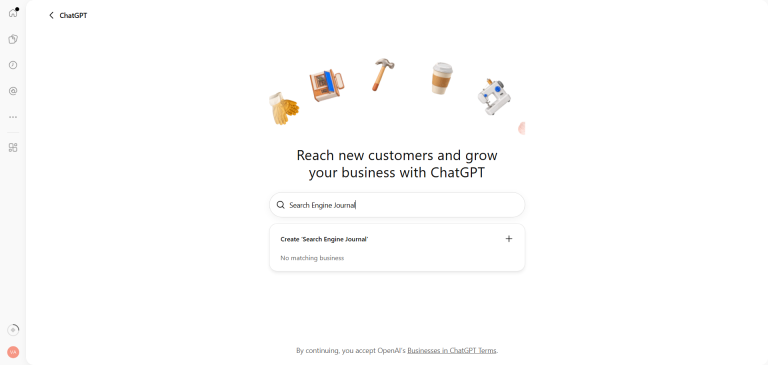
Upon signing into ChatGPT and navigating to the Business Hub, the initial step requires querying the platform’s internal directory to determine if a pre-existing profile exists.
- If a match appears (common for established local businesses or popular brands), the user initiates a claim workflow.
- If no profile exists—as was the case during the test submission for Search Engine Journal—the platform presents the user with an option to create a completely new profile.
Phase 3: Defining the Interaction Type
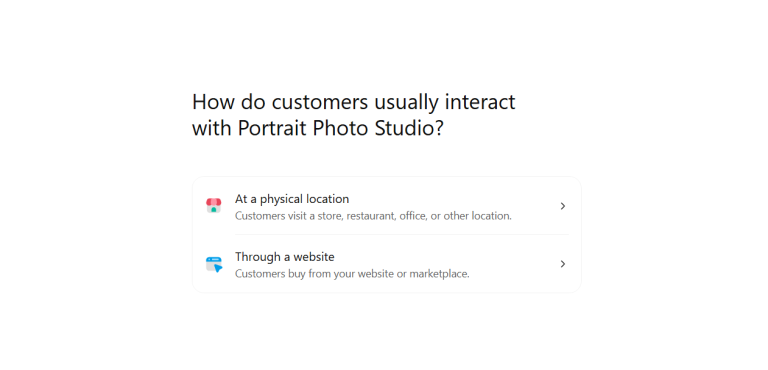
The system immediately bifurcates based on how customers interact with the enterprise:
-
Physical Locations: Choosing this path for retail storefronts, restaurants, or brick-and-mortar operations frequently triggers a system waitlist. Approved users with existing U.S. local listings must then complete a verification call or SMS code. Strict operational advice: if selecting an
automated phone call, ensure the line is active during business hours and completely bypasses automated attendants or Interactive Voice Response (IVR) systems that block external verification codes.
- Website-Only Businesses: Selecting the online interaction type bypasses the physical waitlist entirely, opening up direct pathways for digital-first enterprises, media outlets, SaaS platforms, and ecommerce operations. This inclusion marks a stark departure from legacy local directories like Google Business Profile, which explicitly lists online-only brands, organizations, and artists under its "Ineligible businesses" guidelines.
Phase 4: Technical Domain Verification
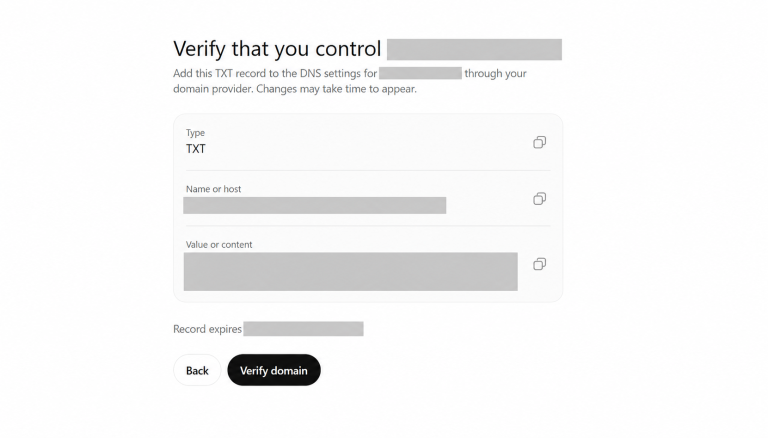
To prove legitimate ownership of a digital asset, ChatGPT mandates DNS verification. The platform generates a unique TXT record value that administrators must copy and deploy into their domain registrar’s DNS management console. Once propagating, returning to the Business Hub and completing the check confirms domain control, unlocking the profile configuration screens.
Phase 5: Profile Configuration, Categorization, and Policy Declarations
With the domain secured, the profile takes shape through structured data entry:
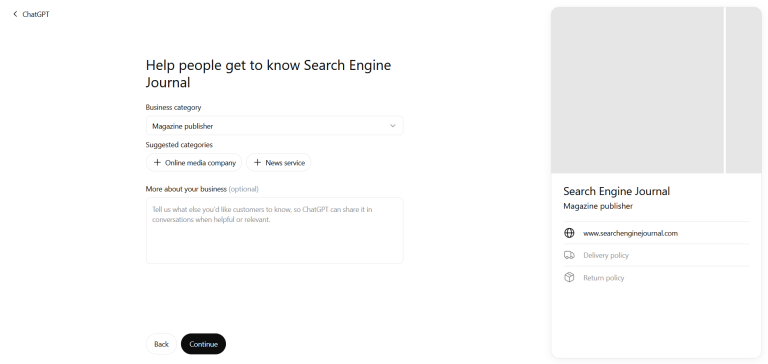
- Category Selection: Users select from a rigid list of pre-approved categories (e.g., selecting "Magazine publisher" while noting suggested alternatives like "Online media company" or "News service").
- Brand Description: A free-text field allowing the inclusion of a comprehensive corporate summary. Crucially, OpenAI explicitly notes that ChatGPT accesses these descriptions during relevant user conversations. Strategists must draft this copy with both SEO and GEO principles in mind, integrating natural-language phrasing that reflects user search intent.
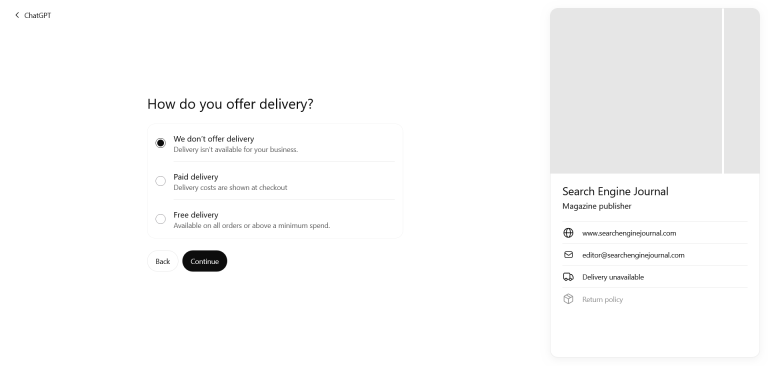
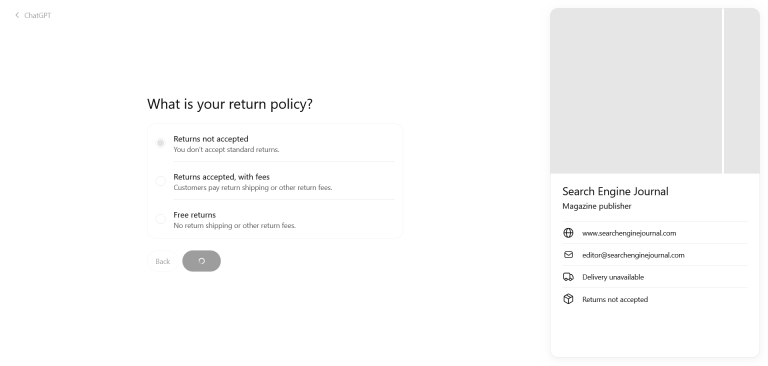
- Anomalous Policy Prompts: During testing, digital-first publishers encountered mandatory prompts regarding "delivery options" (no delivery, paid, free) and "return policies" (unavailable, with fees, free). Because these fields automatically populate the public profile preview, teams must carefully evaluate and adapt these selections—even if they do not traditionally sell physical goods—to prevent confusing end-users who preview the profile via conversational agents.
Phase 6: Identity Verification and Publication
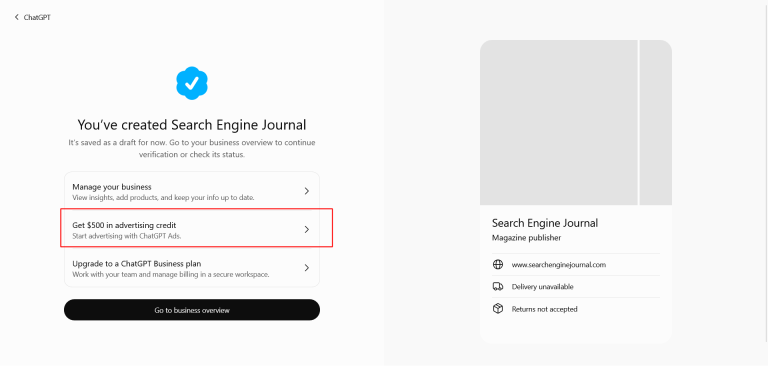
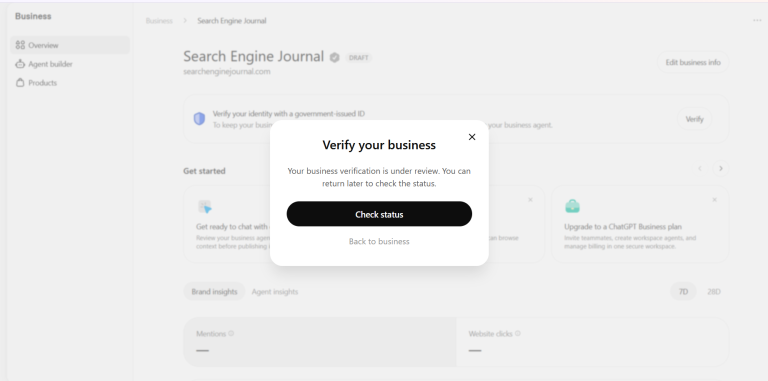
The final operational hurdle involves confirming the identity of the human administrator. Utilizing secure third-party identity verification protocols (such as Persona), authorized representatives complete a personal identity check. Once approved, new profiles created through this workflow are automatically published, securing the coveted verified badge.
Supporting Context & Metrics: Decoding Business Hub Insights
Claiming a profile is merely the first step; measuring its efficacy requires a nuanced understanding of how OpenAI reports interaction data. The Business Hub features a dedicated analytics dashboard tracking two core performance indicators: mentions and website clicks.
+-----------------------------------------------------------------+
|                   BUSINESS HUB ANALYTICS                        |
|                                                                 |
|   [ Mentions ]                         [ Website Clicks ]       |
|   • Strict threshold: Must reference   • Direct referral link   |
|     the specific website URL.            conversions originating  |
|   • Brand name alone does NOT count.     from chat responses.     |
|                                                                 |
+-----------------------------------------------------------------+
The Definition of an AI "Mention"
Marketers accustomed to traditional web analytics must recalibrate their definitions of visibility. Within the ChatGPT ecosystem, a "mention" does not simply mean a user typed your brand name into a prompt, nor does it mean the AI referenced your company casually in passing.
According to OpenAI’s official insights documentation, an AI mention requires ChatGPT to explicitly reference the business’s official website URL within the conversational output. If the model discusses a brand conceptually without linking or anchoring to the underlying domain, it is excluded from the Business Hub metrics. This strict definition ensures that reported figures represent high-intent conversational placements rather than empty brand awareness.
Analyzing Aggregated Reporting Thresholds
Insights within the Business Hub operate on aggregated data governed by strict privacy reporting thresholds. To protect user confidentiality and prevent reverse-engineering of private chat logs, businesses never receive access to individual user conversations or personally identifiable details.
Instead, dashboards provide macro-level trends. For instance, early beta participants tracking metrics across a multi-week window observed dramatic shifts—such as daily conversational mentions climbing by nearly 90% over a 30-day monitoring period, accompanied by measurable, albeit selective, website click-through rates.
To derive actionable intelligence from these numbers, digital strategists must cross-reference Business Hub data with traditional web analytics suites (e.g., Google Analytics or Adobe Analytics). By isolating the exact date ranges and matching AI-driven click spikes against backend referral traffic, marketing teams can quantify the direct conversion value of conversational search engine optimization.
Official Statements and Strategic Policy Realizations
To contextualize the launch of Businesses in ChatGPT, industry analysts must examine OpenAI’s stated philosophies regarding search, algorithmic ranking, and corporate representation.
The Illusion of "Pay-to-Play" Placement
A primary concern among enterprise brands entering the beta was whether financial investment or profile verification would artificially inflate a company’s conversational ranking. OpenAI has explicitly clarified this concern in its core business overviews: Claiming a business profile and verifying identity does not guarantee higher placement or preferential algorithmic recommendations.
ChatGPT retains complete autonomy in synthesizing responses, executing comparisons, and recommending products or services based on the contextual relevance of a user’s prompt. The Business Hub does not function as an ad network where higher bids secure conversational real estate; rather, it acts as an authoritative database ensuring the AI has access to accurate, clean, and verified data when it independently chooses to feature an organization.
The Problem of Inconsistent Citations and NAP Data
For years, local SEO strategies have heavily emphasized NAP (Name, Address, Phone Number) consistency across external citations. This principle remains vital in the age of Generative Engine Optimization.
OpenAI’s profile policies explicitly state that business profiles do not exist in a vacuum; ChatGPT compiles information from the verified Business Hub alongside a wide array of public web sources, third-party directories, and historical web training data. If a brand suffers from fragmented naming conventions—such as historical rebrands leaving multiple legacy titles in circulation—the AI may synthesize contradictory narratives.
Strategists are therefore advised to execute a comprehensive digital audit:
- Harmonize External Footprints: Ensure that all primary social channels, press releases, and directory listings match the foundational data submitted to OpenAI.
- Contextualize Rebrands: If an enterprise has undergone a significant corporate evolution, the official business description within the Business Hub must explicitly map the historical relationship to prevent model hallucination.
- Recognize Multi-Location Limitations: Current beta architecture lacks a centralized parent-company dashboard capable of managing dozens of disparate regional sub-brands or store locations under a single umbrella. Each location or distinct brand entity must be claimed and managed individually through dedicated workflows.
Future Outlook: The Evolution of GEO and AI-Driven Commerce
The rollout of the Business Hub is widely viewed by industry insiders as the opening salvo in a much larger transformation of digital commerce. As conversational interfaces increasingly displace traditional search engines as the primary gateway to the internet, the infrastructure supporting these platforms will inevitably mature.
Anticipating a "ChatGPT Search Console"
Given the rapid pace of feature deployment, digital marketers anticipate that OpenAI will eventually expand the Business Hub into a comprehensive developer and marketer suite—effectively mirroring the trajectory of Google Search Console or Bing Webmaster Tools. Future iterations will likely offer deeper query breakdown insights, structured data validation alerts, and granular indexing controls allowing webmasters to fine-tune how conversational models ingest their site content.
The Rise of Commerce Feeds and Agent Builders
Beyond basic profile management, the frontier of businesses in ChatGPT points directly to transactional integration. OpenAI’s ongoing rollout of commerce specs—allowing merchants to upload product feeds detailing real-time inventory, pricing, and fulfillment metrics—signals an ecosystem where conversational agents will execute end-to-end commercial transactions on behalf of users. Furthermore, as enterprise-grade Agent Builders become more accessible regionally, brands will move past static informational profiles toward autonomous digital agents capable of booking appointments, processing support queries, and closing sales directly inside the chat interface.
Conclusion
The introduction of Businesses in ChatGPT marks a defining milestone for digital marketing. It forces an evolution from passive search engine optimization to active, verified generative engine management. While claiming a profile within the Business Hub does not bypass the algorithmic independence of OpenAI’s models, it provides an essential anchor of truth—ensuring that when conversational agents recommend your brand, they do so with accurate data, verified identity, and unbroken authority. Marketers who embrace this tool early will secure a definitive competitive advantage in the unfolding landscape of conversational discovery.