Executive Overview
For years, the world of multicolour 3D printing was defined by financial barriers. Achieving vibrant, multi-hued prints meant investing heavily in high-end industrial systems or wrestling with complex, temperamental multi-material upgrade kits that frequently tested the patience of even the most seasoned makers. Multicolour desktop manufacturing was, fundamentally, an expensive and exclusive business.
However, the landscape of additive manufacturing is undergoing a profound structural shift. A new wave of engineering efficiency and fierce market competition has prompted several leading manufacturers to introduce highly capable, budget-friendly models tailored for hobbyists, independent designers, and small studios. Among the latest machines to disrupt the marketplace is the Elegoo Centauri Carbon 2, a printer that has quickly captured the attention of the maker community for its impressive feature set, robust build quality, and aggressive pricing structure.
Following extensive hands-on testing by industry veterans who have evaluated the best 3D printers over the past decade, the Centauri Carbon 2 has emerged as a watershed moment for affordable Fused Deposition Modeling (FDM). Not only does it undercut formidable competitors like the Creality K2 Pro right out of the box, but recent retail adjustments—including a price drop on Amazon from $424.97 down to $401.28—have made high-performance multicolour printing more accessible than ever before.
This report provides an in-depth analysis of the Elegoo Centauri Carbon 2, exploring its core architecture, user-experience metrics, competitive positioning, and the broader implications of budget-driven multicolour capabilities on the future of desktop digital fabrication.
Detailed Chronology: The Evolution to Affordable Multicolour
To understand the significance of the Elegoo Centauri Carbon 2, one must first examine the historical trajectory of desktop 3D printing technology and the persistent hurdles of multi-material integration.
The Single-Extruder Era and Early Multi-Material Experiments
In the early days of the consumer FDM boom, nearly all desktop printers relied on a single-extruder architecture. Printing in multiple colours required manual filament swaps mid-print—a tedious process prone to human error, layer adhesion issues, and misalignment.
To solve this, developers introduced complex multi-extruder setups (such as independent dual extruders) or external switching boxes. While functional, these early systems introduced massive toolhead weight, calibration nightmares, and frequent nozzle clogging. They were expensive to manufacture, complicated to maintain, and largely restricted to advanced users willing to spend hours troubleshooting hardware quirks.
The Shift Toward Automated Filament Switching Systems
Over the last several years, the industry shifted toward automated filament management hubs—systems that retract one colour and feed another into a single, high-speed hotend via a unified Bowden or direct-drive path. While revolutionary, these systems were initially tethered exclusively to premium, high-cost flagship machines.
The introduction of the Elegoo Centauri Carbon 2 marks the culmination of this transitional phase. By distilling enterprise-grade automation down into a streamlined, cost-effective consumer package, Elegoo has effectively bridged the gap between professional-grade multi-material workflow and consumer-grade pricing.
The Retail Breakthrough
As supply chains stabilized and manufacturing efficiencies improved throughout 2024 and 2025, manufacturers began aggressively targeting the sub-$500 sweet spot. The Centauri Carbon 2 entered this competitive arena with a full retail price already positioned lower than established rivals like the Creality K2 Pro.
The recent promotional markdown on Amazon, slashing the price further to $401.28, represents a critical juncture. It signals that high-speed, CoreXY multicolour printing is no longer a luxury tier reserved for early adopters willing to pay a premium; it is rapidly becoming the baseline expectation for modern desktop 3D printers.
Supporting Context & Metrics: Under the Hood of the Centauri Carbon 2
To evaluate whether the Centauri Carbon 2 lives up to the industry buzz, reviewers subjected the machine to rigorous benchmark testing, evaluating everything from raw deposition speed to dimensional accuracy and user-interface ergonomics.
Architectural Performance and Specifications
At its core, the Centauri Carbon 2 utilizes a CoreXY kinematic design. Unlike traditional Cartesian printers, which move the heavy bed along the Y-axis, CoreXY systems employ a stationary bed (in the Y-axis plane) while the lightweight print head moves rapidly across X and Y axes via a system of synchronized belts and motors. This configuration dramatically reduces mechanical inertia, enabling exceptionally high speeds without sacrificing structural rigidity.
- Maximum Print Speed: Up to 500 mm/s, allowing complex geometries to be completed in a fraction of the time required by legacy machines.
- Build Volume: A respectable 256 x 256 x 256 mm, offering ample space for functional prototypes, artistic models, and multi-part mechanical assemblies.
- Surface Finish Quality: Reviewers noted that the machine delivers some of the smoothest FDM surface finishes observed in its class, largely thanks to refined firmware input shaping and vibration compensation algorithms.
The Canvas System and RFID Automation
The standout feature of the Centauri Carbon 2 is its integrated multi-filament management solution, known as the Canvas system. Designed to streamline what is traditionally a frustrating setup process, the Canvas system accommodates up to four distinct reels of filament simultaneously.
Key user-experience metrics gathered during testing highlight several operational efficiencies:
- Rapid Loading Workflow: Testers reported that loading filaments into the Canvas system is exceptionally fast and intuitive.
- RFID Auto-Configuration: Modern smart-spools equipped with RFID chips require zero manual input; users simply hold the spool up to the side of the unit, and the printer automatically reads the material type, optimal temperature parameters, and colour data.
- Seamless Slicer Integration: When opening a multicolour digital file, an intuitive setup window within the slicing software allows operators to visually map out which physical spool corresponds to each specific colour channel in the design.
Real-World Testing: The Fidget Toy Benchmark
To test the limits of its multicolour precision and mechanical tolerances, reviewers printed a complex, one-piece mechanical fidget toy featuring numerous interconnected, moving parts printed directly in place.
The results were telling: the print emerged from the build plate completely free of fused joints, exhibiting silky-smooth mechanical articulation and crisp colour boundaries with minimal stringing or purge contamination.
Spatial Footprint and Ergonomic Considerations
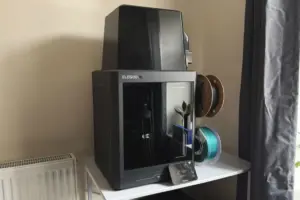
Despite its impressive performance metrics, the Centauri Carbon 2 is not without spatial compromises. Because the multi-filament spools mount externally on the side of the unit, and because automated colour-switching requires a dedicated purge/waste chute at the rear, the physical footprint of the printer expands significantly during operation.
Users considering this machine must account for ample desk or workbench clearance around the printer to accommodate the external spool holder and the rear waste management zone.
Official Statements and Industry Insights
The democratization of advanced manufacturing technologies has prompted widespread commentary from hardware engineers, industrial designers, and retail analysts alike.
Industry analysts emphasize that the aggressive pricing strategy deployed by Elegoo and its competitors is a direct response to shifting consumer demands. "Makers today expect the reliability and multi-material capabilities that were once exclusive to commercial prototyping labs," notes a leading additive manufacturing consultant. "When a company delivers a CoreXY, multi-colour capable printer with smart-spool recognition for roughly $400, it fundamentally alters the competitive baseline. Other manufacturers are forced to innovate faster or adjust their margins."
Furthermore, early feedback from beta testers and consumer advocates highlights the profound impact of automation features like RFID filament detection. According to Elegoo’s engineering philosophy shared during product rollouts, reducing friction points—such as manual temperature calibration and material profiling—is the single most effective way to onboard a new generation of creative professionals who view the 3D printer as a creative appliance rather than an engineering project requiring constant tinkering.
Future Outlook: The Horizon of Multicolour Additive Manufacturing
As the dust settles on the current generation of budget multicolour printers, industry observers are already looking toward the horizon to predict where the technology—and market—will head next.
1. Further Reduction of Material Waste
One of the persistent engineering challenges associated with automated multi-material switching is the generation of purge waste (often referred to as the "poop" or purge tower). When transitioning from a dark filament to a light one, the hotend must purge residual material to prevent colour bleeding. Future iterations of systems like Elegoo’s Canvas are widely expected to incorporate smarter purging algorithms, optimized nozzle designs, or dual-nozzle hybrids that minimize wasted plastic and reduce print times even further.
2. Standardization of Smart-Spool Ecosystems
The integration of RFID tags for automatic filament recognition points toward a broader trend: the intelligent ecosystem. As more manufacturers adopt proprietary or open-standard smart-spools, users will benefit from plug-and-play material profiles across different brands. This reduces human error and ensures optimal thermal bonding between dissimilar materials (such as PLA and specialized support interfaces).
3. Mainstream Adoption in Creative Industries
With hardware costs hovering near the $400 threshold, multicolour 3D printing is transitioning from a niche hobbyist pursuit into a standard tool for creative professionals. Independent board game designers, miniature painters, architectural model makers, and industrial prototype studios are increasingly adopting these budget platforms to iterate faster and present full-colour visual concepts directly to clients without outsourcing to expensive industrial bureaus.
Conclusion
The Elegoo Centauri Carbon 2 represents a major milestone in the evolution of desktop fabrication. By combining high-speed CoreXY mechanics, intelligent RFID spool management, and an accessible price point—further sweetened by recent retail discounts down to $401.28—Elegoo has proven that advanced multicolour manufacturing no longer demands a prohibitive financial investment. While users must still account for the machine’s generous spatial requirements, the overall value proposition is undeniable, signaling a bright, highly colourful future for makers everywhere.