Executive Overview
Choosing a laptop for university should be a straightforward exercise in utilitarianism. In an ideal world, you would look at a few basic specifications, select a color that doesn’t cause you immediate aesthetic distress, and get on with your academic career. Instead, the modern student is forced to navigate a labyrinthine marketplace characterized by processor names that sound suspiciously like Cold War experimental aircraft, display specifications that read like ancient runes, and conflicting advice from every corner of the internet.
The most common trap students fall into is overspending on hardware they do not need—or, conversely, under-specifying a machine that will inevitably buckle under the weight of their coursework. The golden rule of academic technology procurement is simple yet frequently ignored: your major dictates your hardware requirements.
Decisions should be driven by the practical demands of your core field of study, not by fleeting tech trends, aesthetic vibes, or the enthusiastic advice of social media influencers insisting that every undergraduate requires a workstation-class GPU "just in case." Whether you are an English major drafting multi-page thesis papers at 3:00 AM, a Computer Science student running multiple virtual environments simultaneously, or a 3D animation student rendering complex polygons, matching your laptop to your academic discipline ensures long-term reliability, fiscal responsibility, and academic success.
Detailed Chronology: The Evolution of Student Computing Requirements
To understand why laptop specifications vary so wildly across different academic disciplines today, it is helpful to examine how student computing needs have evolved over the past three decades.
The Late 1990s to Early 2000s: The Word Processor Era
At the turn of the millennium, a student laptop’s primary function was to serve as a digital typewriter. Word processing suites like Microsoft Office and basic dial-up web browsing were the ceiling of most academic software demands. Hardware requirements were remarkably uniform: if a machine could run Windows 98, had 64MB of RAM, and featured a CD-ROM drive, it was deemed university-ready. Specialized computing tasks—such as statistical analysis or graphic design—were largely relegated to heavy desktop computer labs operated by individual departments.
The Mid-2000s to 2010s: The Rise of the Multitasking Student
As web technologies matured and software ecosystems expanded, laptops transformed from glorified typewriters into portable information hubs. The introduction of Wi-Fi across university campuses meant students could now research, stream, and collaborate on the go. During this period, the division between majors began to emerge. While humanities students could still get by with basic configurations, business and science majors required specialized spreadsheet modeling software and early versions of statistical packages like SPSS and MATLAB. Battery life and portability became major selling points alongside raw processing power.
The 2020s and Beyond: Specialized Ecosystems and Remote Learning
The COVID-19 pandemic permanently altered the landscape of higher education. Remote learning, hybrid lecture formats, and cloud-based collaboration tools transformed laptops from optional study aids into critical lifelines. Concurrently, the silicon revolution—exemplified by Apple’s transition to its custom M-series architecture and significant efficiency gains in Intel and AMD mobile processors—radically changed performance benchmarks.
Today, a laptop is no longer just a window to the internet; it is an integrated creative studio, a software development sandbox, and an intensive data-crunching engine depending entirely on what you choose to study. This shift has eliminated the "one-size-fits-all" student laptop, making major-specific purchasing decisions more critical than ever.
Supporting Context & Metrics: Decoding the Spec Sheet
Before breaking down the ideal hardware configurations by academic discipline, it is vital to demystify the core components that dictate a laptop’s performance. Understanding these metrics prevents buyers from falling victim to inflated marketing claims.
Processors (CPUs): The Brains of the Operation
The Central Processing Unit handles the vast majority of computing instructions.
- Entry-Level (Intel Core i3 / Apple A-series or older M-series base): Suitable for basic word processing, web research, and media consumption.
- Mid-Range (Intel Core i5 / AMD Ryzen 5 / Apple M1/M2/M3 base): The sweet spot for general multitasking, moderate coding, and everyday academic workloads.
- High-End (Intel Core i7/i9 / AMD Ryzen 7/9 / Apple M-series Pro/Max): Essential for heavy data processing, compiling massive codebases, video editing, and 3D rendering.
Random Access Memory (RAM): The Short-Term Workspace
RAM dictates how many applications your laptop can run simultaneously without lagging.

- 8GB: The bare minimum for humanities and light administrative tasks. However, operating systems and modern web browsers (especially Chrome with multiple tabs open) consume RAM aggressively.
- 16GB: The modern baseline for most university students. Recommended for computer science, heavy multitasking, and moderate design work.
- 32GB and Above: Reserved for heavy lifters—video editors, 3D artists, and students running complex virtual machines.
Storage (Solid State Drives vs. Hard Disk Drives): Space and Speed
Traditional mechanical hard drives (HDDs) are virtually extinct in modern laptops, replaced by lightning-fast Solid State Drives (SSDs).
- 256GB: Adequate only if you store the vast majority of your files in cloud storage (such as Google Drive or OneDrive).
- 512GB: The recommended sweet spot for most students, providing ample room for applications, local documents, and medium-sized project files.
- 1TB+: Necessary for creative majors dealing with massive video footage libraries, high-resolution photo assets, and complex 3D project files.
Major-by-Major Breakdown: Finding Your Machine
Humanities & Social Sciences: The Essay Machines
If your academic career is built around English literature, history, journalism, philosophy, or political science, your primary academic tools are text editors, PDF readers, and academic databases. You do not need a technological warhorse.
- Ideal Specifications: An Intel Core i5 (or AMD Ryzen 5) or an Apple M-series base chip, paired with 8GB to 16GB of RAM and a 256GB to 512GB SSD.
- Why It Works: Your workflows prioritize battery life, keyboard comfort, and screen clarity over raw computational muscle. Because you will be lugging your machine to libraries, seminar rooms, and lecture halls, prioritize build quality, lightweight chassis design, and battery endurance over processing cores.
- Pro Tip: Invest the money you save by skipping high-end graphic cards into high-quality noise-cancelling headphones to maintain your focus in busy student unions and campus libraries.
Computer Science & Engineering: The Compilation Engines
Computer Science students often fall into the trap of assuming they can write code on any basic machine, only to find their laptops choking when forced to run local virtual machines, compile large software projects, or manage heavy integrated development environments (IDEs) alongside dozens of browser tabs for documentation.
- Ideal Specifications: An Intel Core i7 / AMD Ryzen 7 or Apple M-series Pro processor, 16GB of RAM at absolute minimum (32GB strongly recommended), and a 512GB or 1TB SSD.
- Why It Works: Compiling code and running virtualized operating systems demand robust multi-core processing and substantial memory. If you intend to specialize in artificial intelligence, machine learning, or data science, look for a machine with strong parallel processing capabilities and, where applicable, a dedicated graphics card for training models.
2D Design, Fine Arts, & Photography: The Colour Purists
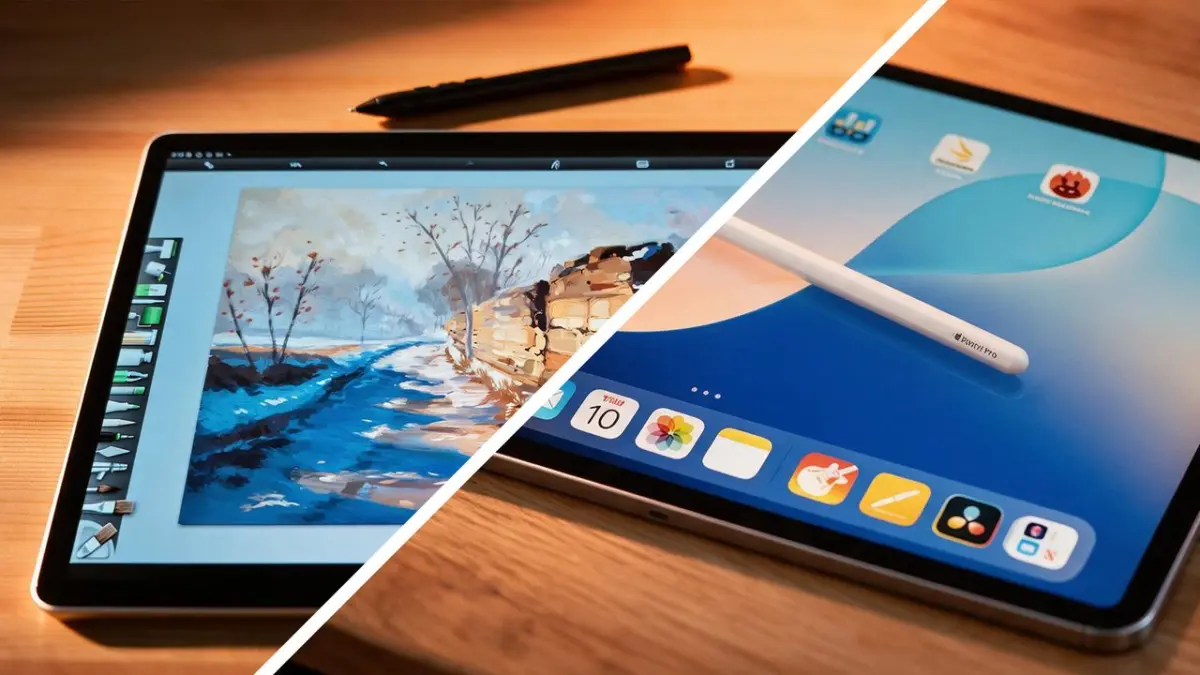
For graphic designers, illustrators, digital artists, and photographers, your laptop is essentially a portable studio. While raw processing power is important for handling large Adobe Creative Suite files, display fidelity is paramount.
- Ideal Specifications: A mid-to-high-end processor (Intel i7 or Apple M-series), 16GB of RAM, and crucially, a high-color-accuracy display covering 100% DCI-P3 or sRGB color space. Storage should start at 512GB to accommodate your ever-expanding folders of
final_final_v3.psdproject files. - Why It Works: A fast processor is useless if the screen displaying your work suffers from poor color calibration. Prioritize OLED or high-tier IPS panels with accurate color reproduction over raw gaming performance.
Video Production, Animation, & 3D Modeling: The Heavy Lifters
If your major involves editing 4K video, rendering complex 3D environments, or working with motion graphics, you are dealing with the most hardware-intensive workflows in undergraduate education.
- Ideal Specifications: An Intel Core i9, Apple M-series Pro/Max chip, or a dedicated NVIDIA/AMD mobile GPU (such as an RTX 4060 or higher), paired with 32GB of RAM and a minimum of 1TB of high-speed SSD storage.
- Why It Works: Video rendering, ray tracing, and physics simulations will quickly expose any hardware bottlenecks. Skimping here leads to catastrophic render failures, missed deadlines, and immense frustration. Buy once, buy right, and keep your charger close at hand.
Official Statements and Industry Insights
Academic institutions and hardware manufacturers increasingly recognize the friction caused by mismatched student technology. In a recent advisory statement regarding student technology standards, university IT directors emphasized the importance of aligning purchases with curriculum demands:
"The modern higher education environment relies heavily on software ecosystems that are deeply integrated into specific academic tracks. When a student purchases a device that falls short of departmental recommendations, it limits their ability to fully participate in collaborative labs, specialized modeling software, and remote learning modules. Conversely, over-purchasing enterprise-grade hardware places an unnecessary financial burden on students and families. Balance and institutional alignment are key."
— Higher Education Technology Infrastructure Consortium (HETIC)
Hardware manufacturers have similarly adapted their product lineups to target specific student demographics. Apple’s emphasis on unified memory architectures in its M-series chips has streamlined performance for creative and coding majors alike, while Windows OEMs continue to offer modular configurability, allowing engineering and gaming students to prioritize discrete graphics cards and upgradeable storage components.
Future Outlook: What Lies Ahead for Student Computing
As universities continue to embrace emerging technologies, the landscape of student computing will inevitably shift. Several key trends are poised to shape the next generation of student laptops:
- The Integration of On-Device AI: With artificial intelligence tools becoming standard fixtures in research, coding, and content creation, future laptops will increasingly feature dedicated Neural Processing Units (NPUs). Students entering university in the coming years will benefit from hardware capable of running local large language models and advanced data analysis tools without relying entirely on cloud connectivity.
- Shift Toward Cloud-Centric Computing: While heavy engineering and creative majors will always require robust local hardware, general education and humanities tracks are leaning further into cloud-based workspaces. This transition may eventually reduce baseline local storage and processing requirements for non-technical majors, resulting in even lighter, more energy-efficient portable devices.
- Battery Efficiency Breakthroughs: The ongoing maturation of ARM-based architectures and advanced silicon manufacturing nodes points toward a future where all-day battery life under heavy workloads becomes the industry standard, eliminating the eternal campus scramble for wall outlets.
Conclusion
Your major shapes your academic journey, and by extension, it should shape your machine. By looking past marketing hype, understanding the core metrics that matter to your specific field of study, and investing sensibly in the hardware your coursework demands, you can avoid the heartbreak of discovering your laptop wheezes in despair every time you launch your critical course software. Choose smart, buy once, and set yourself up for academic success.