
Executive Overview
In an era defined by hyper-connected households, the modern digital ecosystem has outgrown simple cloud storage solutions. Managing a smart home packed with nearly 80 active devices—ranging from mobile workstations and Android TVs to sprawling arrays of IoT smart lighting—requires robust, enterprise-grade local infrastructure. At the center of this technological hub sits the network-attached storage (NAS) system. It is no longer merely a digital filing cabinet; it is the beating heart of a home network, acting as a centralized media streaming engine, a lossless music server, and an autonomous private cloud.
When media and hardware specialists look to expand or optimize their home server architecture, the criteria are uncompromising. High performance, hardware-accelerated media transcoding, blazing-fast local networking capabilities, and long-term hardware reliability are mandatory prerequisites. Following extensive evaluation across a grueling three-and-a-half-month testing cycle totaling well over 2,500 hours of continuous utilization, the UGREEN DXP4800 Pro 4-Bay NAS has emerged as the definitive champion in its class.
Priced competitively at $719 via major online retailers like Amazon and direct through UGREEN’s official storefront, this powerhouse 4-bay enclosure combines top-tier consumer-grade enterprise hardware with increasingly polished proprietary software. This comprehensive review dives deep into the architecture, deployment methodologies, performance metrics, and ultimate verdict surrounding the UGREEN DXP4800 Pro as the premier media server solution available today.
Detailed Chronology: From Unboxing to 54 Terabytes of Stress Testing
Phase 1: Hardware Setup and Storage Configuration
The foundation of any high-performance NAS begins with its physical architecture and component selection. The UGREEN DXP4800 Pro arrives packing an exceptionally robust spec sheet for a 4-bay form factor. At its core lies an Intel Core i3-1315U processor—a raptor-lake derived hybrid architecture widely lauded by enthusiasts and adopted by top-tier manufacturers for high-end homelab platforms. This silicon provides native support for Intel Quick Sync Video, making it a dream scenario for real-time video transcoding via Plex and Jellyfin.
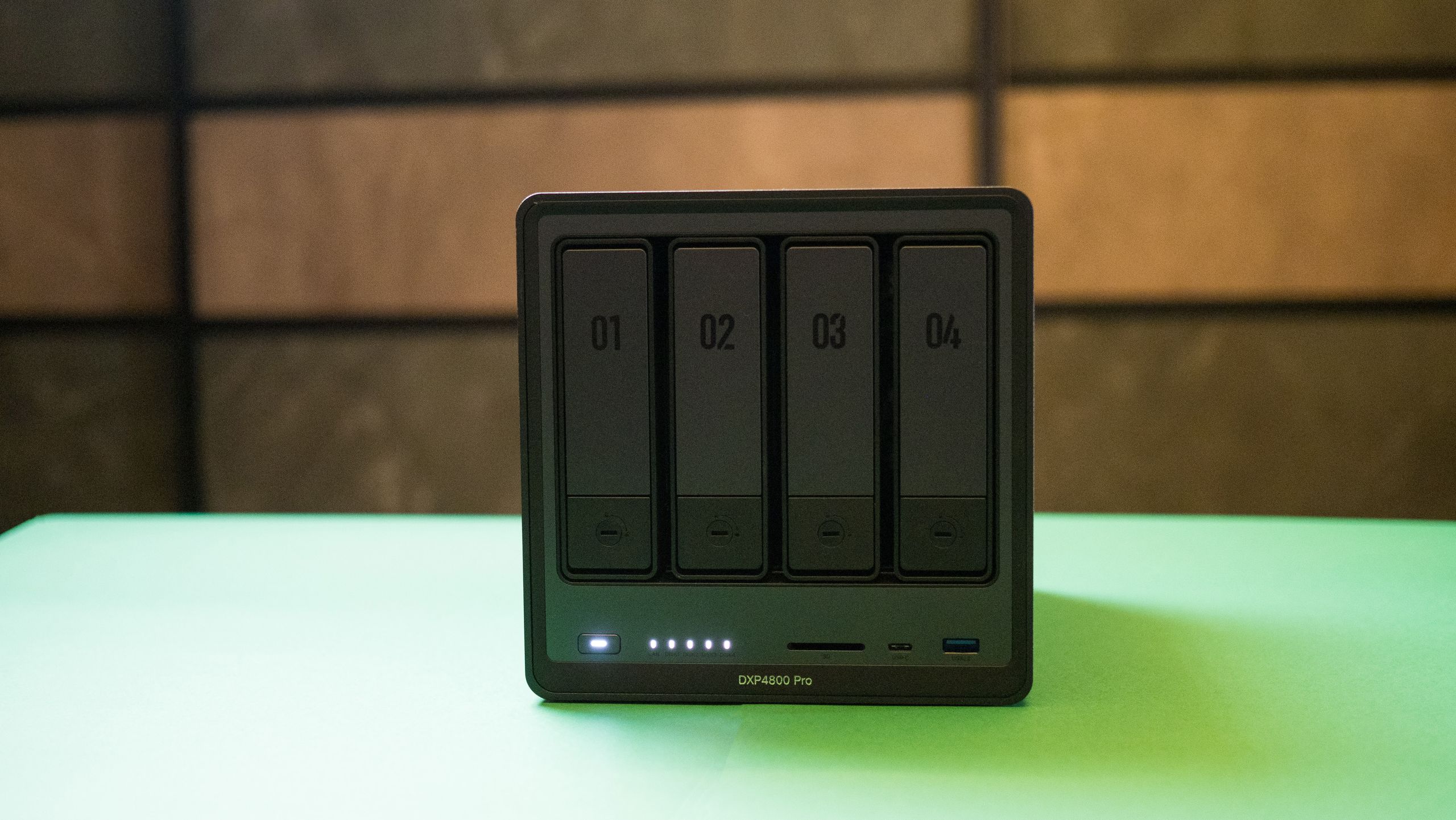
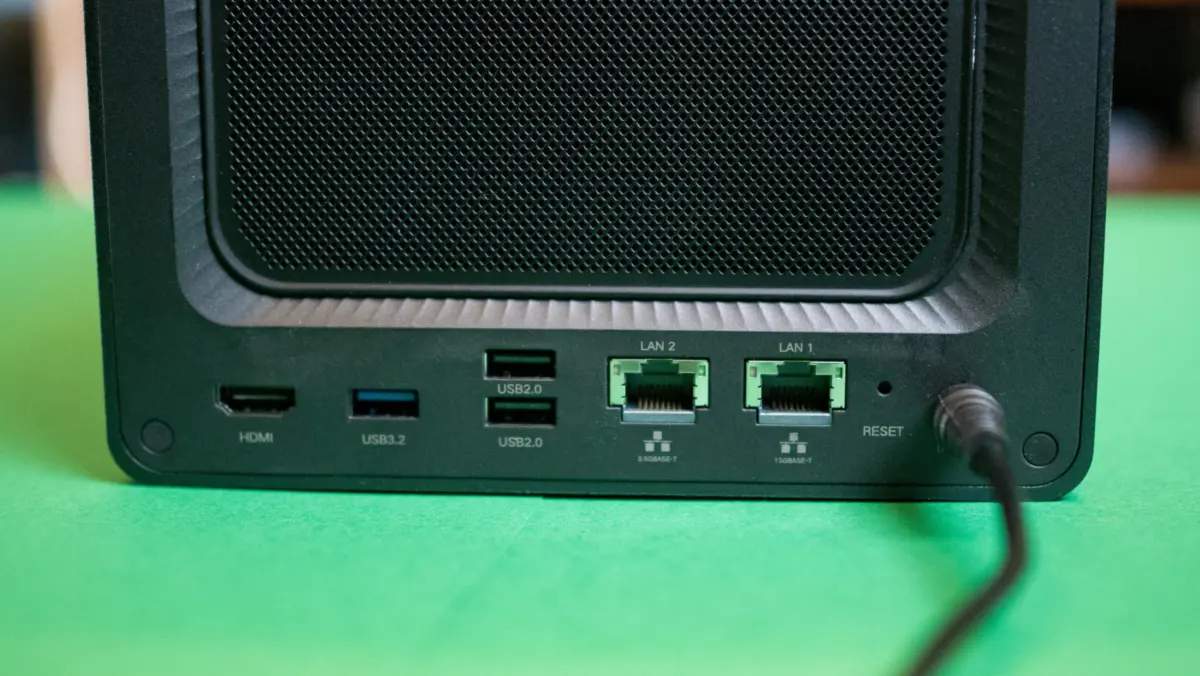
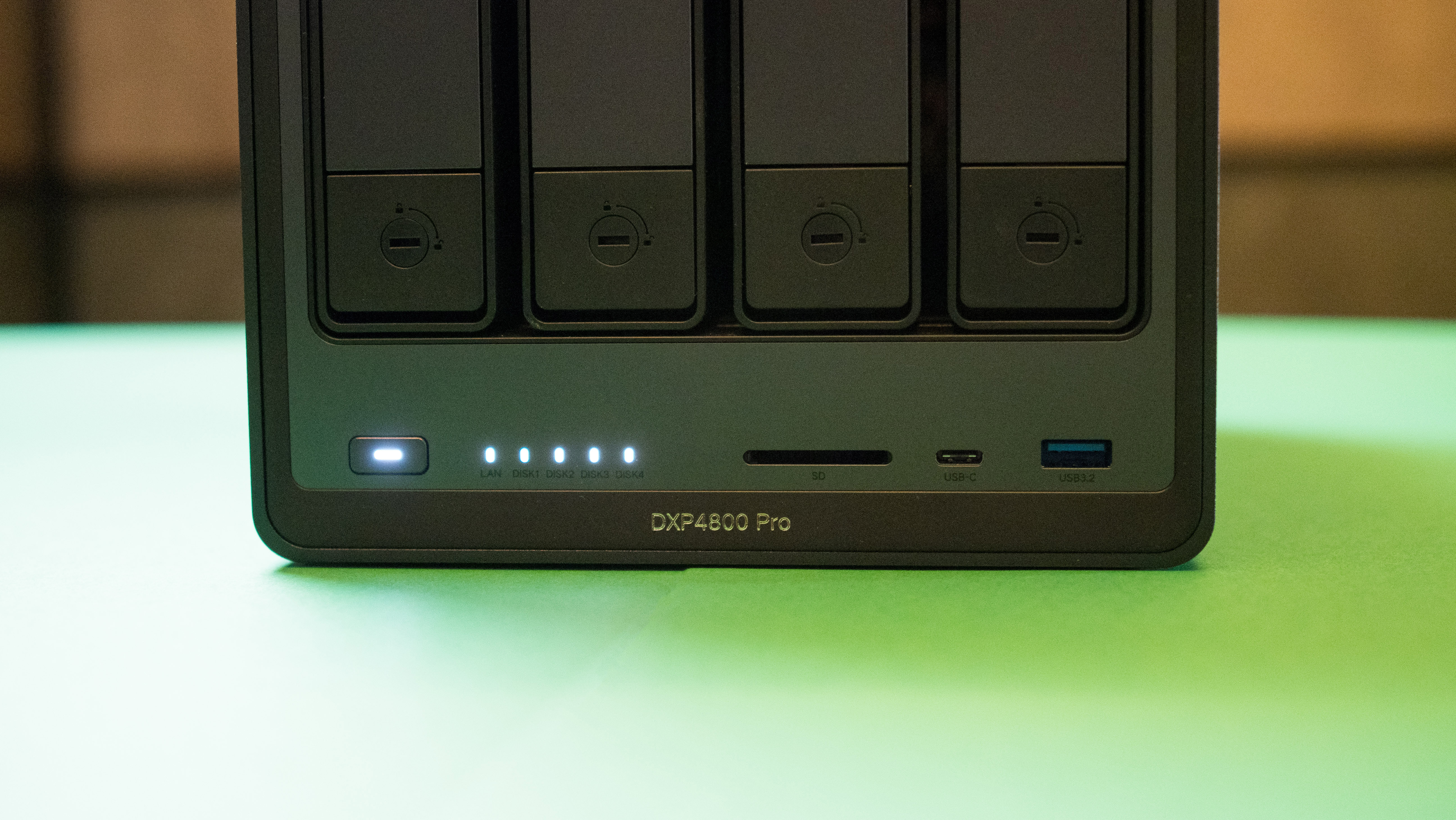
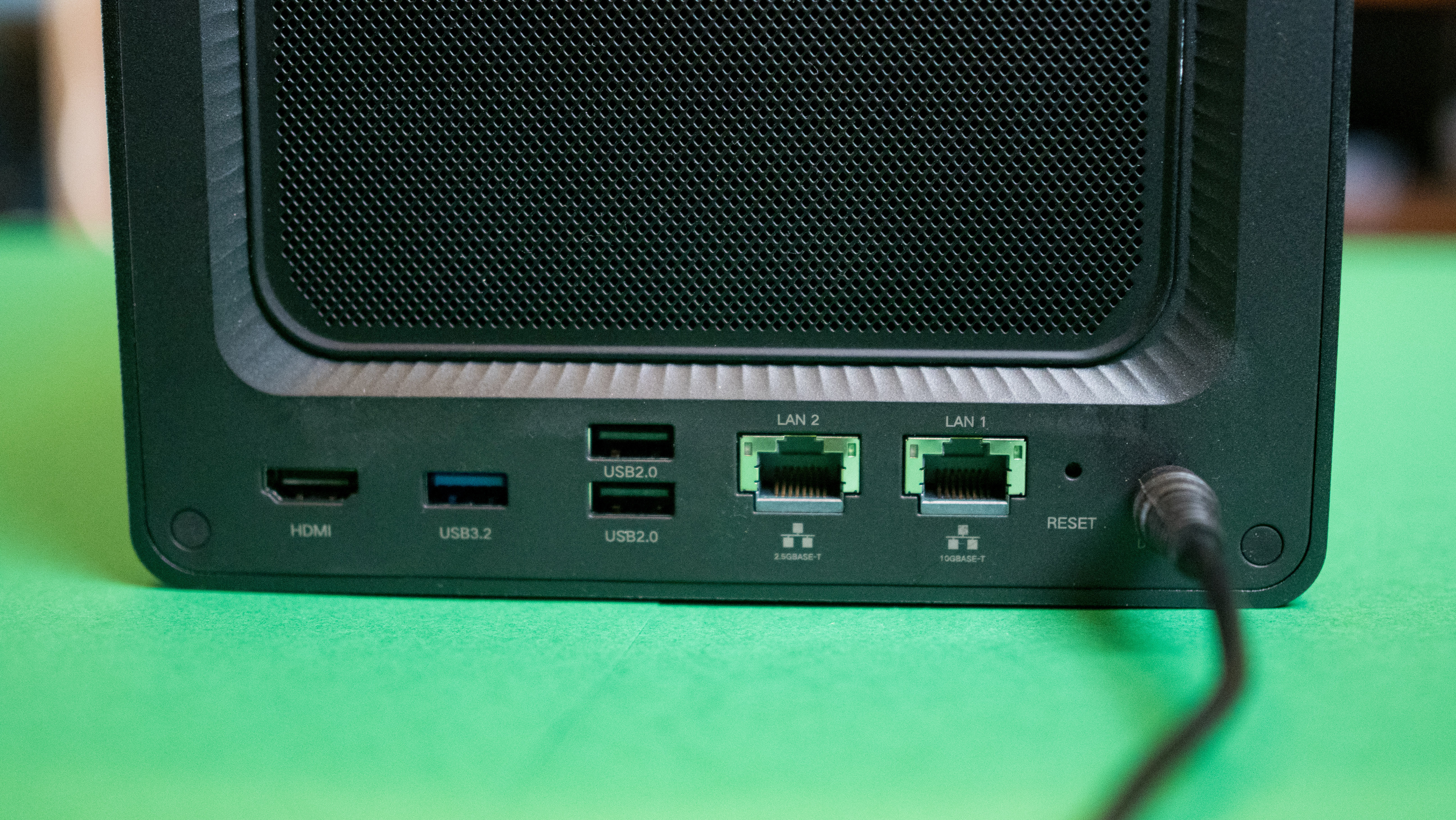
Complementing the CPU is 8GB of pre-installed DDR memory, a built-in 128GB system SSD for snappy response times, and dual NVMe M.2 SSD slots for caching or high-speed storage pools. Networking flexibility is equally impressive, featuring a lightning-fast 10 Gigabit Ethernet (10GbE) port paired alongside a traditional 2.5GbE connection.
To push the hardware to its absolute limits, the testing methodology incorporated a heavy-duty mix of high-capacity storage drives. Two massive 24TB Seagate Exos X24 enterprise drives were paired with two 22TB Seagate IronWolf Pro NAS HDDs.
Initial setup commenced with the initialization of UGOS Pro, UGREEN’s proprietary web-based operating system. Over the preceding 12 months, UGREEN has iterated rapidly on UGOS Pro, transforming it from a rudimentary interface into a fully featured operating environment that rivals established legacy platforms. While a mirrored configuration (such as RAID 1 or RAID 10) is universally recommended for production environments to ensure fault tolerance, the testing rig utilized a JBOD configuration. This choice was deliberate, as the data being migrated already existed across redundant, mirrored offline backups elsewhere in the reviewer’s master homelab infrastructure.
Phase 2: Containerization, Docker, and Memory Scalability
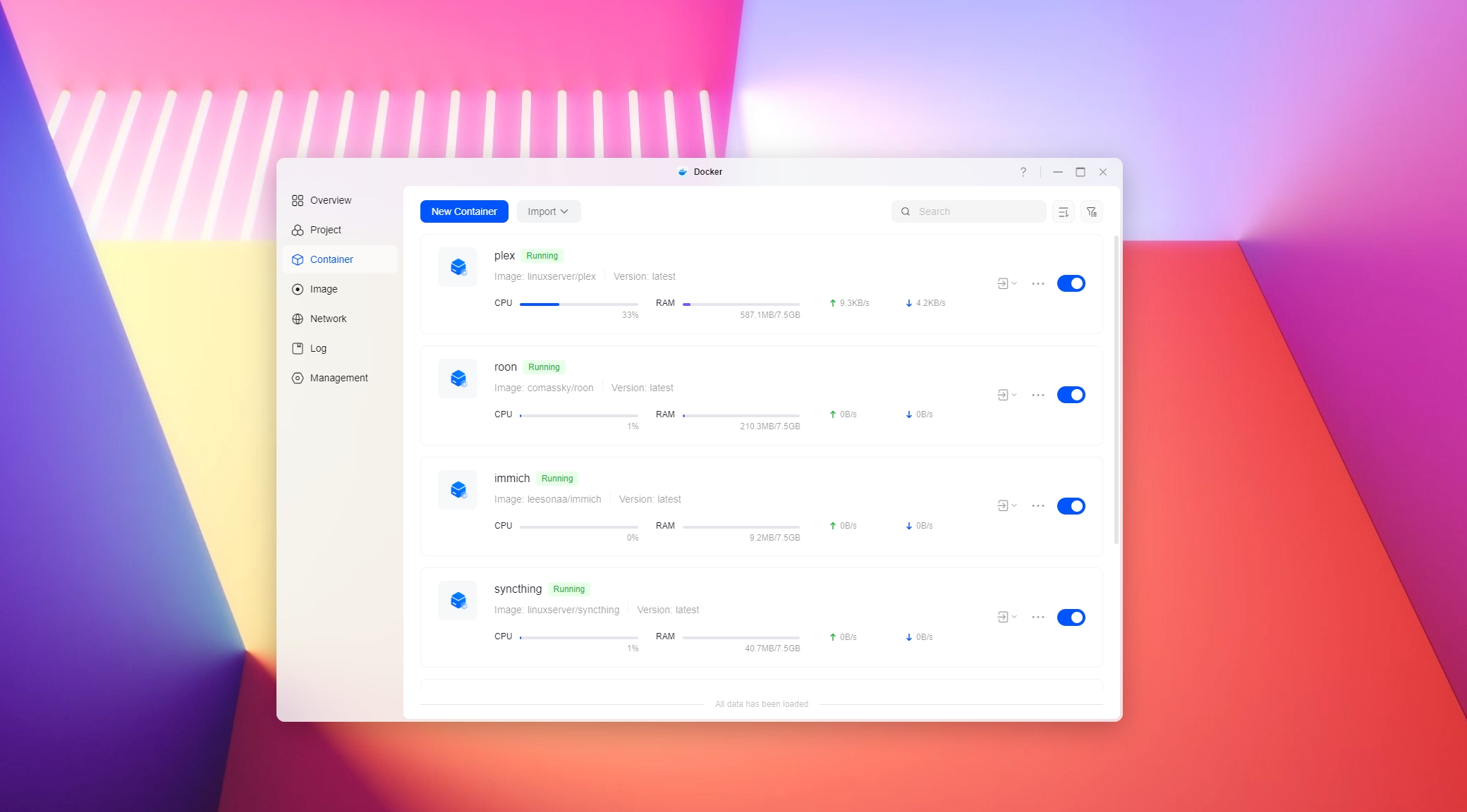
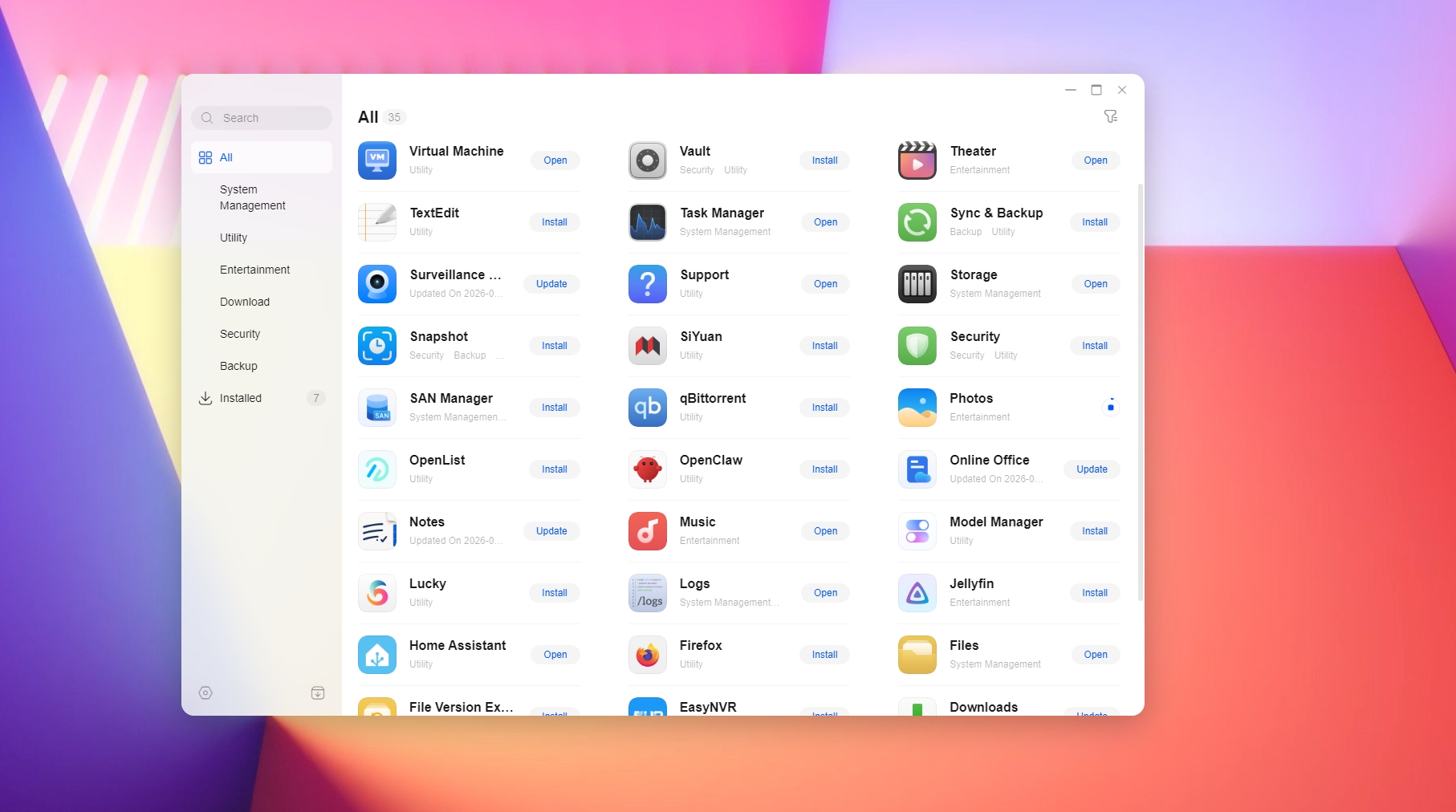
Rather than relying purely on native, packaged apps from the manufacturer’s app store, the deployment phase favored containerization. Running applications via Docker ensures greater system stability, finer isolation, and granular visibility into hardware resource consumption.
The testing profile demanded the simultaneous, 24/7 execution of several heavy-duty self-hosted services:
- Plex Media Server & Jellyfin: Core media streaming and library management.
- Roon: High-resolution audio management for dedicated music listening rooms.
- Immich: Self-hosted photo and video backup ecosystem (a privacy-focused Google Photos alternative).
- Tailscale: Secure, zero-config mesh VPN for seamless remote access outside the local network footprint.
Even with eight separate containerized instances operating concurrently around the clock, the system’s pre-installed 8GB RAM footprint proved surprisingly resilient, leaving roughly 3.2GB of usable memory in reserve. This left ample headroom to provision and test full virtual machines (VMs) by allocating 2GB chunks dynamically.
However, to unlock the true potential of the enterprise homelab environment, a 16GB DRAM upgrade module was subsequently slotted into the chassis, elevating the total memory ceiling to a generous 24GB. While this level of expansion is entirely optional for casual users, it highlights the immense scalability of the DXP4800 Pro; the baseline 8GB configuration is more than sufficient for 95% of enthusiast hobbyist projects right out of the box.
Phase 3: The 54TB Data Migration Marathon
Transferring a staggering 54 terabytes of data required a methodical approach. To avoid bottlenecks and potential corruption during a monolithic data dump, migration was executed over a strict ten-day window using the command-line utility rsync. Data was categorized and ported sequentially: massive photo archives, lossless FLAC music libraries, critical documentation, and dense media repositories.
Of note was the inclusion of an expansive music production library, packed with heavy virtual studio technology (VST) instruments and multi-gigabyte sample packs.
To evaluate peak throughput, the DXP4800 Pro was hardwired directly to an existing 10GbE-capable server (the DiskStation DS1823xs+) via a dedicated 10GbE managed switch. The results were staggering. The system easily saturated the mechanical bandwidth limits of the Seagate Exos X24 and IronWolf Pro drives, sustaining transfer rates close to their theoretical maximums of 280 MB/s per drive. Under aggregate multi-stream file transfers, speeds peaked at an impressive 580 MB/s when moving large movie files. Smaller documents and image files naturally tapered down to a modest yet respectable average of 120 MB/s.
Supporting Context & Metrics: Performance, Thermal Dynamics, and Power Draw
Thermal Performance and Acoustic Management
Sustained file transfers and continuous read/write cycles present a formidable thermal challenge for compact 4-bay chassis designs. Fortunately, the UGREEN DXP4800 Pro manages internal heat dissipation exceptionally well.
The chassis employs a large, intelligent 140mm cooling fan capable of exhausting heat away from the CPU and dense drive bays efficiently. Throughout heavy multi-day data transfers and simultaneous 4K video transcoding sessions, the hard disk drives never exceeded a safe operating threshold of 48 degrees Celsius.
Furthermore, the integration of Seagate’s IronWolf Pro and Exos enterprise drives brought crucial vibration-resistance sensors to the table. In multi-bay environments, rotational vibration (RV) can severely degrade drive performance and shorten mechanical lifespans. The combination of UGREEN’s vibration-dampening chassis design and Seagate’s firmware-level RV mitigation ensured buttery-smooth, silent operations even under maximum duress. While the test drives accumulated just under 3,000 hours of continuous runtime during this evaluation, legacy IronWolf Pro drives deployed by the reviewer in past installations have reliably cleared over 50,000 hours of continuous zero-failure runtime.
Media Transcoding Stress Test
The ultimate stress test for any media server lies in its ability to transcode high-bitrate 4K HDR content on the fly. Utilizing Plex as the primary testing matrix, the DXP4800 Pro was subjected to simultaneous streams across a dozen different client devices throughout the household.
Powered by Intel Quick Sync (available to Plex Pass subscribers), the Intel Core i3-1315U processor handled three concurrent high-bitrate 4K transcodes simultaneously—a remarkable feat for a mid-tier 4-bay enclosure.
In real-world deployment, modern client devices (such as modern Apple TVs, Nvidia Shields, and current-generation smart TVs) natively support direct play for almost all modern video codecs (H.264, HEVC/H.265, and AV1), bypassing the need for CPU-intensive transcoding entirely. However, legacy client hardware (such as older generation tablets or budget streaming sticks) still occasionally triggers transcoding loops. When forced to convert dense H.265 streams down to compatible formats on the fly, the DXP4800 Pro executed these conversions invisibly and instantaneously without stutter or buffering artifacts.
Power Consumption Analysis
Energy efficiency remains a vital metric for always-on home servers. Power telemetry data gathered over the three-month testing period revealed the following operational metrics:
- Idle State: 24W to 28W (drives spinning down/sleeping when inactive).
- Active State (Standard Operations): ~60W during routine file indexing and background container execution.
- Peak Load: Exceeding 85W under maximum CPU strain, concurrent 4K transcoding, and simultaneous multi-drive data writing.
While these figures lean slightly higher than entry-level ARM-based NAS options, they are entirely justified by the inclusion of a powerful desktop-class Intel Core i3 processor and enterprise networking chips. The unit ships with a generous 150W external power brick, ensuring the internal power delivery circuit never encounters starvation under full hardware loads. Averaged out over a monthly utility billing cycle, the energy footprint remains a minor trade-off for the immense compute power delivered.
Future Outlook and Market Positioning
As the digital landscape marches deeper into the latter half of the decade, consumer expectations for self-hosted infrastructure are shifting. With public cloud subscription fees climbing and growing anxieties surrounding data privacy, the "homelab" movement has transitioned from a niche hobby for IT professionals into a mainstream lifestyle choice for tech-savvy households.
Manufacturers like UGREEN are actively disrupting a market segment that has historically been dominated by legacy gatekeepers such as Synology and QNAP. By undercutting established competitors on hardware specs while aggressively iterating on software stability (UGOS Pro), UGREEN has established a compelling value proposition.
The DXP4800 Pro proves that buyers no longer need to compromise between raw processing power and user-friendly software interfaces. Its future-proof networking capabilities—namely the inclusion of native 10GbE connectivity—ensure that as home internet providers roll out symmetrical multi-gigabit fiber connections, the local storage infrastructure will not become a network bottleneck.
The Verdict
After enduring over 2,500 hours of continuous operational stress, multi-terabyte data migrations, simultaneous high-bitrate 4K media streaming streams across a dozen disparate household screens, and heavy containerized homelab deployments, the verdict is unequivocally clear.
The UGREEN DXP4800 Pro is the finest all-around 4-bay media server and network-attached storage system available on the market today. Its potent combination of enterprise-grade Intel Core i3 processing architecture, hardware-accelerated transcoding capabilities, expandable memory potential, and robust 10GbE networking gives it a decisive edge over rival platforms.
For home theater enthusiasts, media hoarders, privacy advocates, and smart home architects seeking a reliable, high-performance command center for their digital lives, the UGREEN DXP4800 Pro earns an unreserved, highest-tier recommendation.