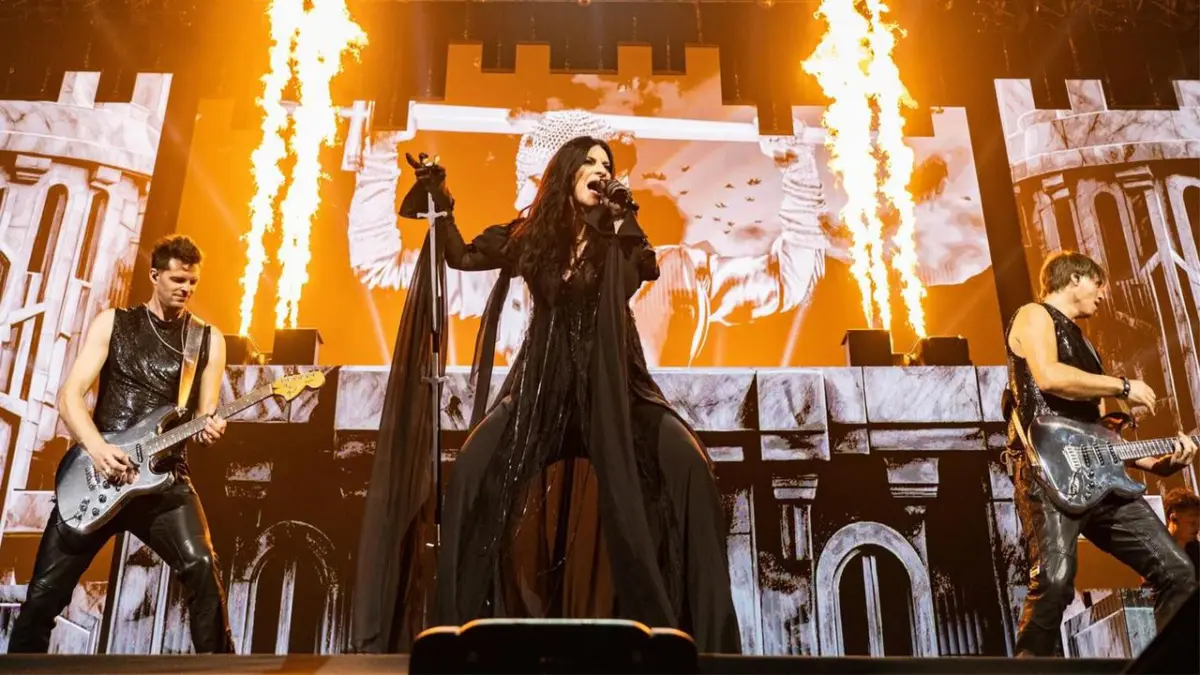
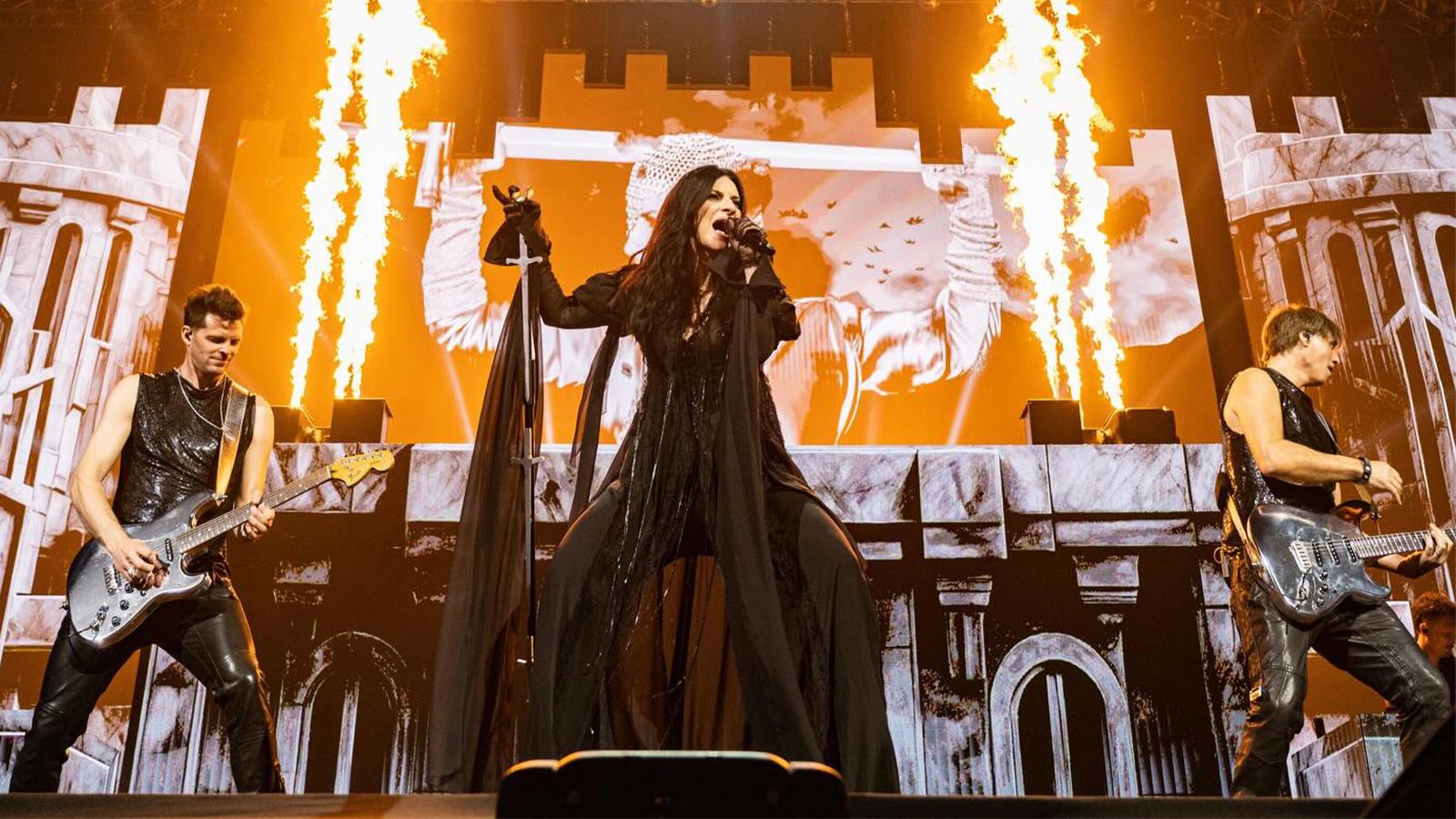
In the high-stakes world of contemporary arena touring, live visuals have evolved far beyond simple background loops or static projection mapping. Today’s concert experiences require living, breathing visual ecosystems capable of interacting with live music, adapting to wildly varying venue architectures, and maintaining absolute stability night after night in front of tens of thousands of screaming fans. When Italian music icon Laura Pausini embarked on her latest major tour, her creative team envisioned a breathtaking, immersive medieval fantasy world anchored by a massive, custom-built LED castle center stage.
Bringing this ambitious concept to life required an elite coalition of technical artists and live production specialists. At the helm of the visual design was Senior Designer Lorenzo Venturini and his team at GATE1 Studio, working alongside Lead Disguise Operator Carlo Barbero, Programmer Stefano Petroni, Media Server Operator Yoshi Lehouck, and Pausini’s co-creative director Luca Tommassini.
By leveraging an advanced digital pipeline comprising Blender, Notch, Disguise Designer, and GX 3+ media servers, the creative collective successfully engineered an interactive, multi-layered castle structure. This comprehensive behind-the-scenes breakdown examines how the team translated a pencil sketch and a moodboard into a real-time technological marvel, redefining what is possible in live-concert scenography.
Detailed Chronology: From Concept to Arena Load-In
The realization of Laura Pausini’s touring castle was not an overnight miracle; it was the product of a rigorous, multi-phase production workflow that spanned weeks of conceptualization, modeling, simulation, and on-site calibration.
Phase 1: Conceptualization and Thematic Foundation (Weeks 1–3)
Every monumental live production begins with a theme. For Pausini’s tour, the narrative anchor was a rich tapestry of medieval fantasy. This core concept dictated every subsequent creative decision, from the lighting designs to the textural quality of the stage architecture.
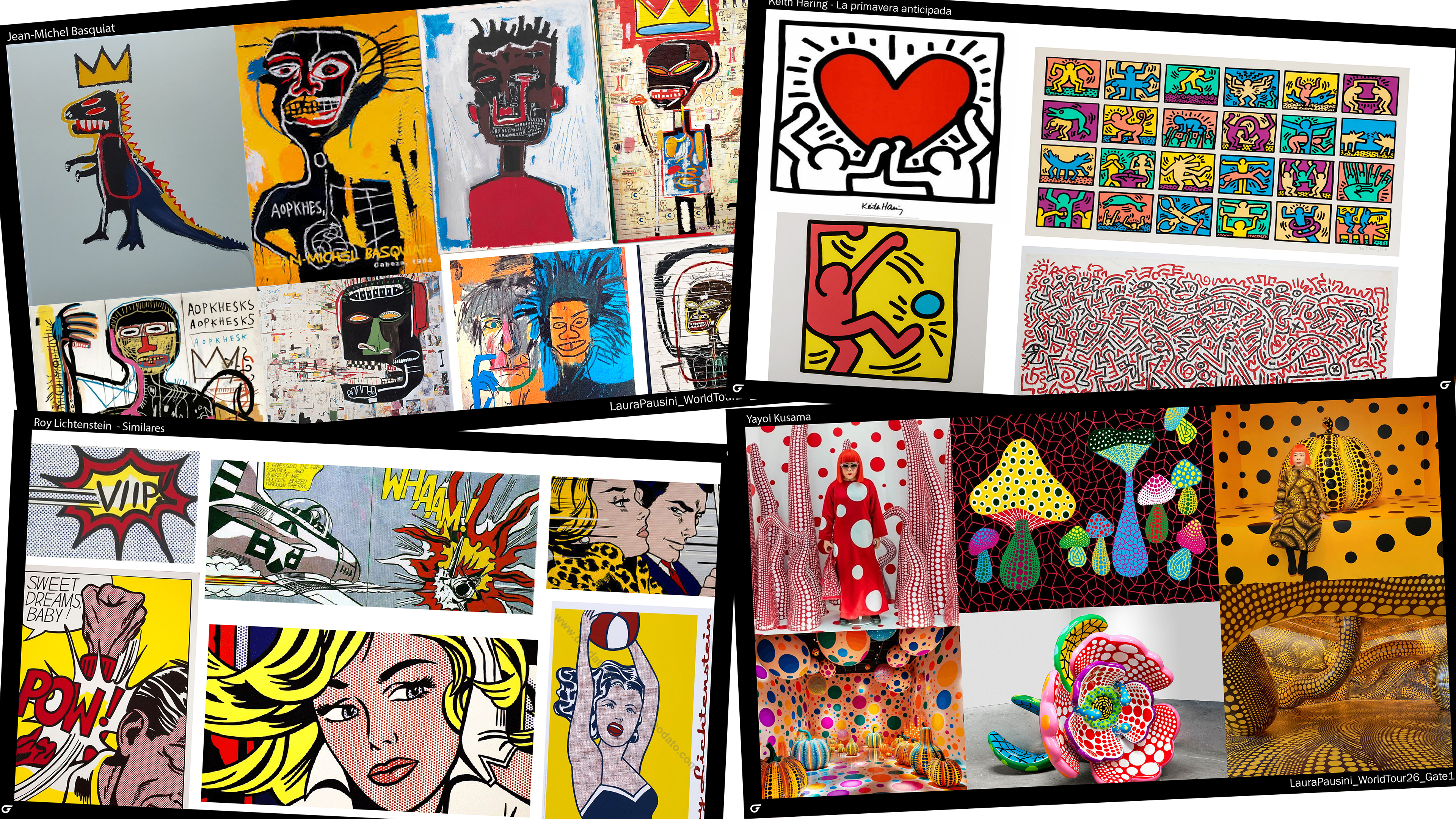
During the initial pre-production window—which lasted approximately three weeks—Venturini, Pausini, and Tommassini collaborated closely, compiling moodboards sourced from historical references, folklore, architectural schematics, and digital concept art found on platforms like Pinterest. It was during this brainstorming phase that the central narrative device solidified: a towering medieval castle structure that would not merely serve as a backdrop, but act as an active performance space from which Pausini could enter, exit, and interact with the audience.
Phase 2: 3D Modeling and Architectural Optimization
Once the visual language and basic structural requirements were approved, the production moved into digital sculpting. Using Blender, the team undertook the complex task of modeling a functional 3D castle tailored specifically to the physical constraints of the touring stage layout.
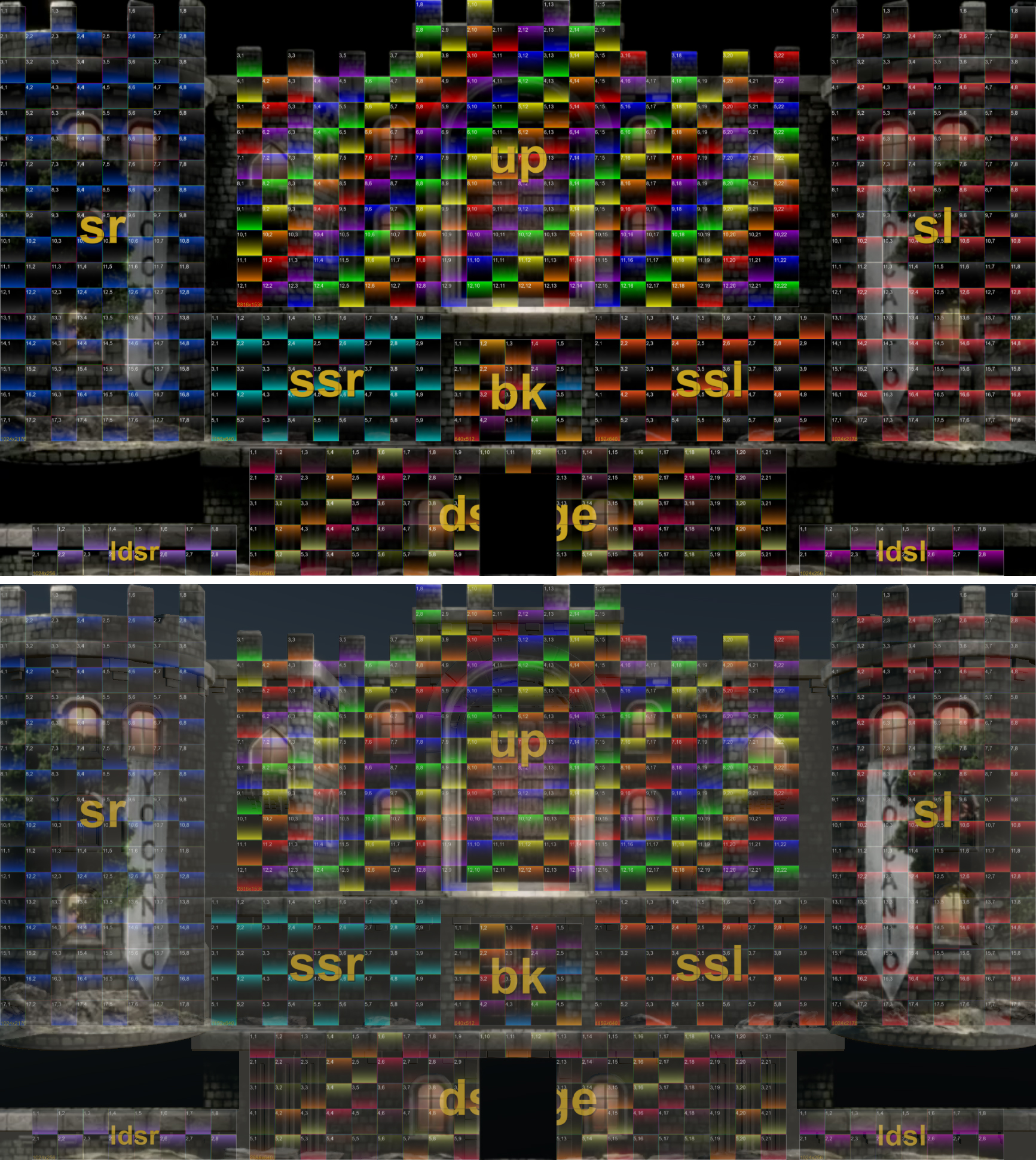
Poly Modeling & Booleans: The main towers and structural curtain walls were constructed using standard polygonal modeling techniques. Boolean operations were meticulously carved into the mesh to create authentic windows, soaring stone arches, and the central grand entrance utilized for the artist’s entrances and exits.
Retopology & Optimization: To ensure the mesh remained lightweight enough to render in real time without bottlenecking the media servers, a clean retopology pass was executed.
UV Unwrapping & Texture Baking: The model was carefully unwrapped with the physical LED screen architecture in mind. Normal maps and Ambient Occlusion (AO) maps were baked directly into the assets, ensuring that every texture and real-time effect built later in Notch would align flawlessly with the physical LED panels on stage.
Phase 3: Real-Time Effect Generation and Node-Based Compositing
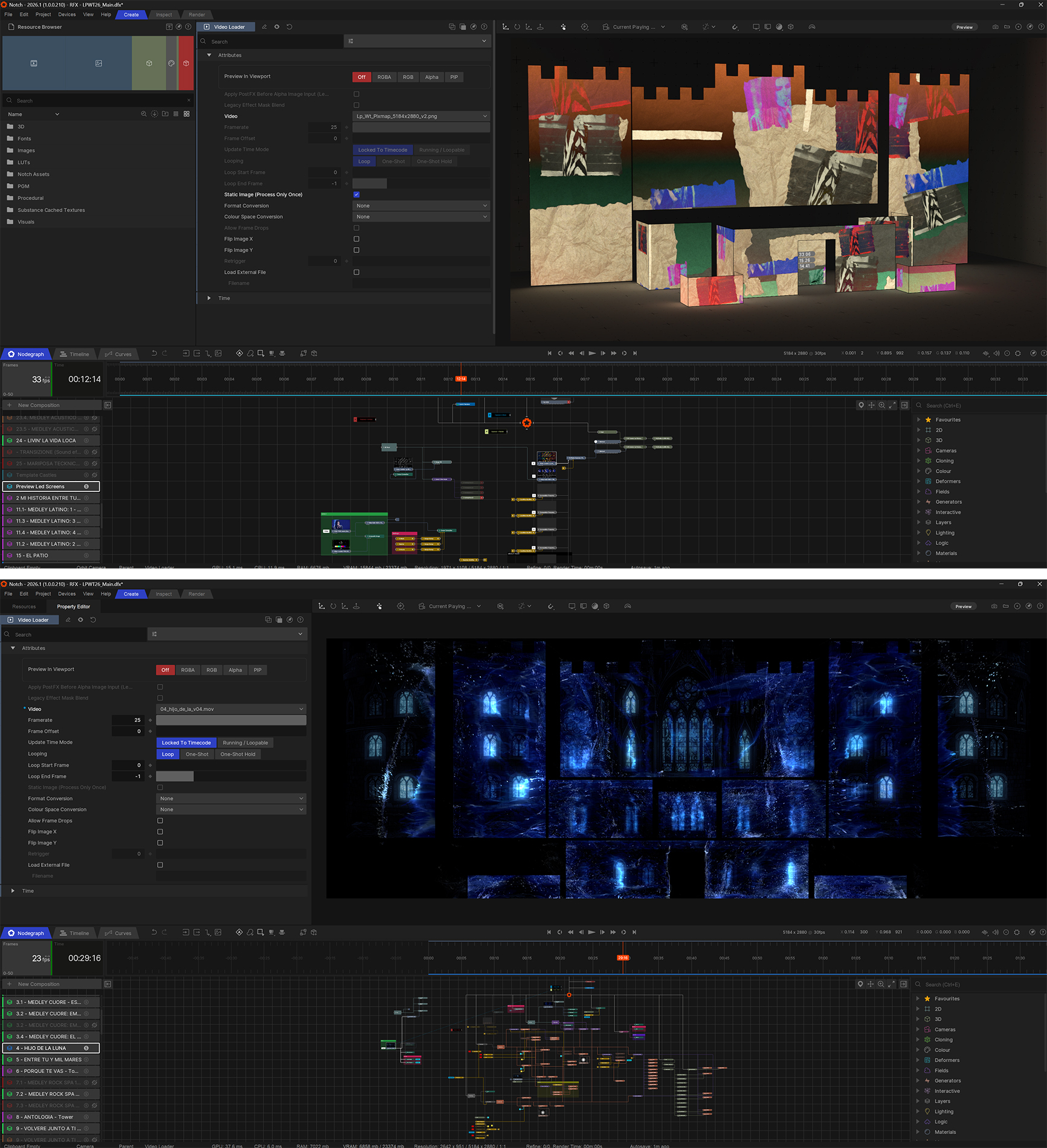
With the asset successfully imported into Notch as an FBX file, the team began developing the bespoke visual effects mapped across the castle’s LED surfaces. The design philosophy demanded that visuals directly respond to the musical arrangements.
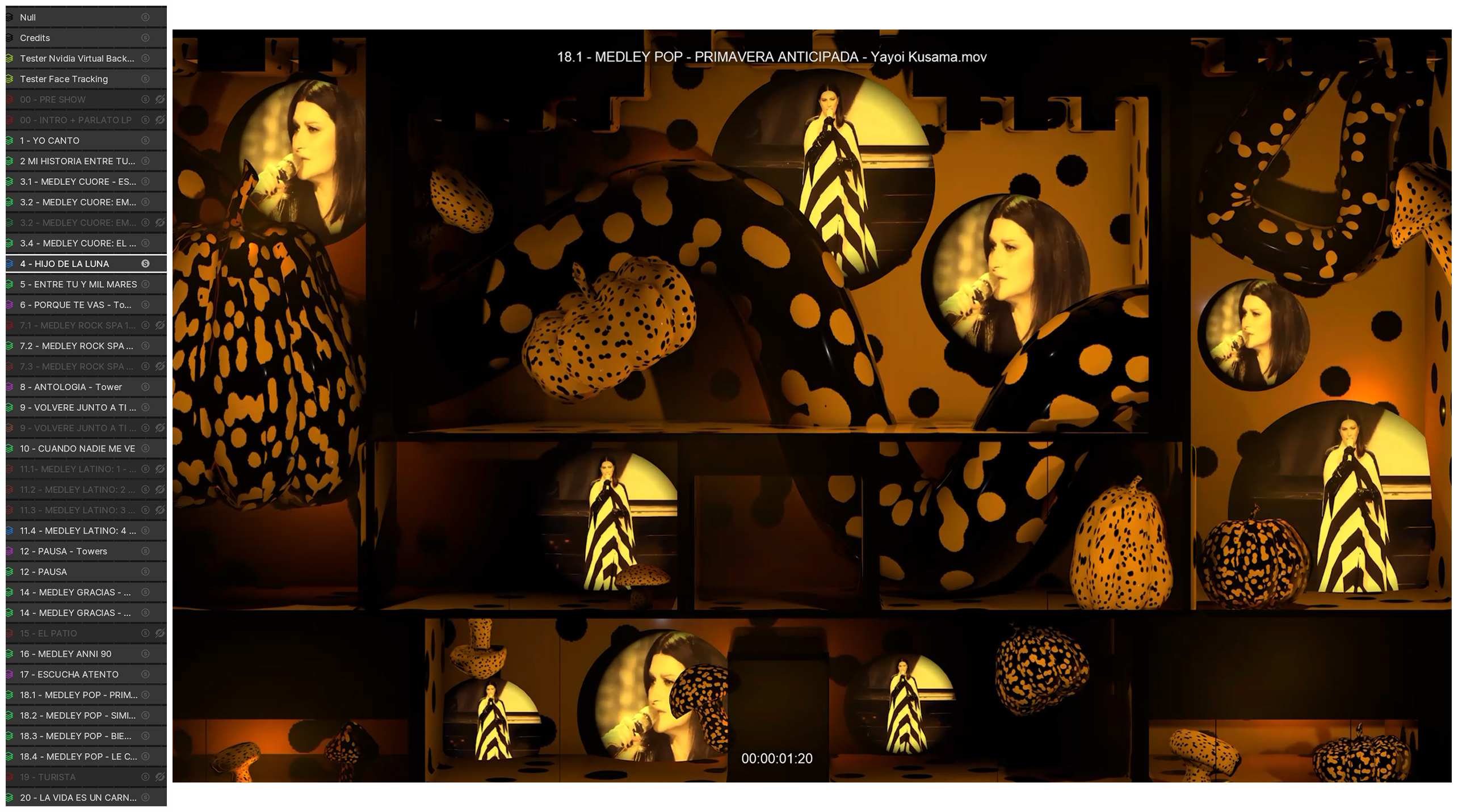
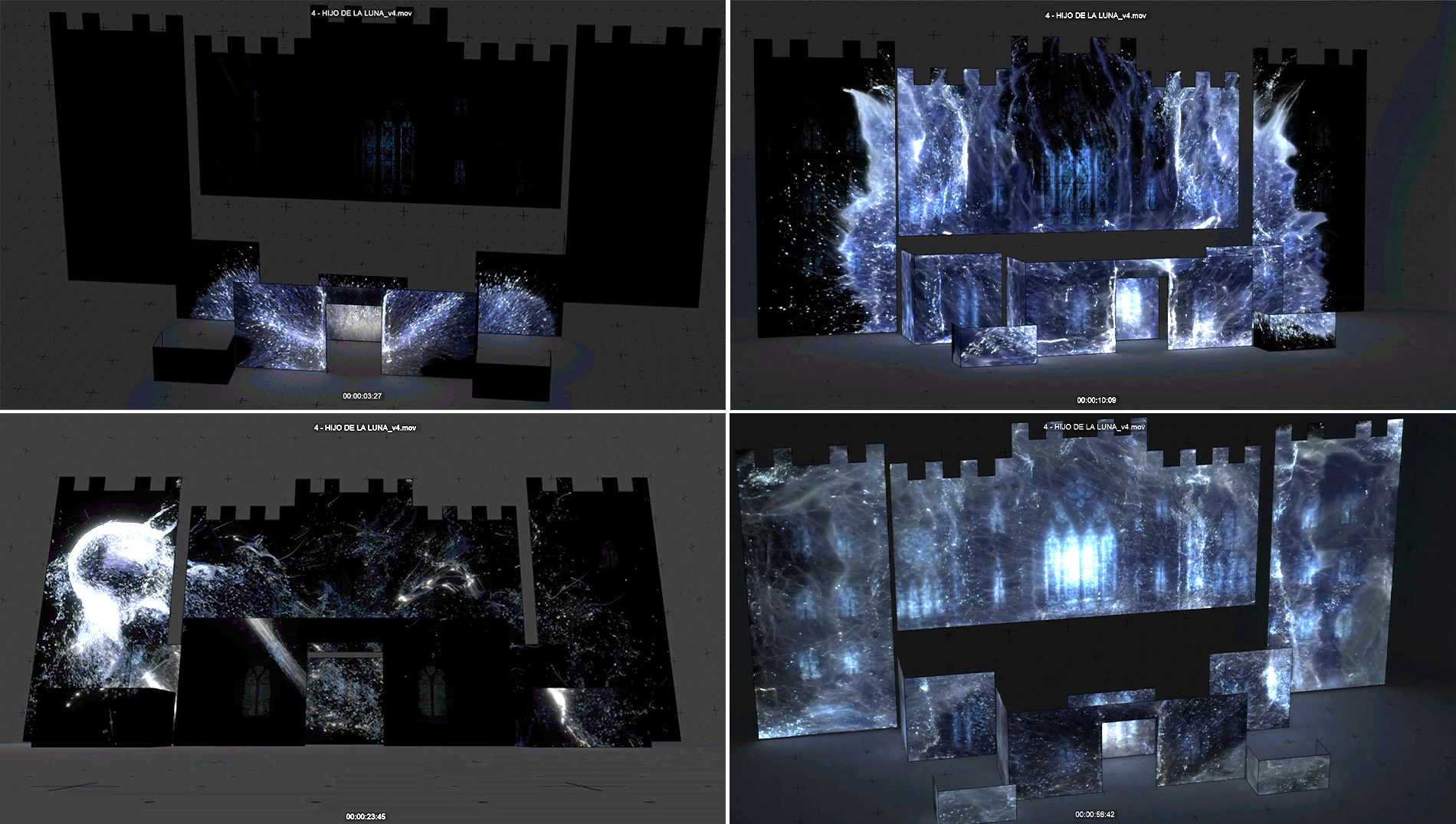
For a retrospective medley celebrating the 1970s, the team generated saturated, high-contrast color grades and halftone-style dot patterns reminiscent of classic pop art. For dramatic ballads like Hijo de la Luna—a haunting track recounting a Romani woman’s pact with the moon—the artists required a more ethereal, organic aesthetic. Utilizing Notch’s advanced material and particle systems alongside custom mesh deformers, the team deployed a GPU-powered particle engine capable of simulating a massive, glowing moon growing out of hundreds of millions of individual points in real time.
Supporting Context & Metrics: The Technical Stack
The sheer computational weight of running high-resolution, real-time 3D environments on tour demands a robust, enterprise-grade hardware and software infrastructure. GATE1 Studio relied on a tightly integrated technical ecosystem to guarantee flawless execution.
+-----------------------------------------------------------------+
                 THE GATE1 STUDIO TECHNICAL PIPELINE
+-----------------------------------------------------------------+
  [ Blender ]          --> 3D Modeling, Retopology, & UV Baking
       |
  [ Notch ]            --> Real-time Node-Based Effects & Particle Sims
       |
  [ Disguise Designer] --> Sequencing, Timecode Sync, & Hybrid Preview
       |
  [ GX 3+ Media Servers] -> Live Show Playback & 8K Video Distribution
+-----------------------------------------------------------------+
Software and Hardware Breakdown
Blender: Utilized for initial asset creation, architectural modeling, and optimization passes.
Notch: The primary real-time node-based motion graphics and VFX software, handling particle simulations, dynamic materials, and heavy compositing layers.
Disguise Designer & GX 3+ Media Servers: The backbone of show control. The team managed approximately 50 active Notch layers running concurrently on Disguise GX 3+ media servers, pushing high-resolution 8K particle simulations, live camera feeds (IMAG), and multi-level projection mapping across the castle columns and central portal.
Disguise X1 (Redundancy System): Touring environments are notoriously unpredictable. To mitigate hardware failure, the team utilized Disguise’s X1 portable backup solution. If a flight case containing primary servers suffered shipping delays, operators could seamlessly transfer the license key to a standard laptop and resume full show operations without missing a beat.
Official Insights: Behind the Design
Lorenzo Venturini, Senior Notch Designer and co-owner of GATE1 Studio, emphasizes that the true art of live concert visuals lies in balancing breathtaking aesthetics with bulletproof technical reliability.
"Creating visuals for a live concert is one of those jobs where the idea might start with a sketch, but it quickly turns into a living, breathing visual system," explains Venturini. "It has to hit the right moment in the music, work across completely different venues, and hold together night after night in front of thousands of people."
A critical component of the tour’s success was the ability to preview and stress-test the entire show well in advance of physical load-in. By utilizing Disguise Designer’s digital twin capabilities, lighting technicians and operators generated accurate 3D simulations of the stage setup for every stop on the tour.
"By adding environmental elements and cameras, and switching to Notch’s Hybrid Renderer, we were able to generate numerous high-quality previews well ahead of load-in," Venturini notes. "This meant Yoshi Lehouck, our touring operator, could guarantee that the Notch effects always looked pristine, even when confronting constantly changing venue conditions, missing LED wall towers, or localized IMAG aspect ratios shifting between 16:9 and 4:3."
Furthermore, the team integrated Disguise’s Expressions feature to grant real-time flexibility during live performances. Rather than relying on a rigid, unyielding timecode timeline, operator Stefano Petroni could dynamically manipulate content and incoming live camera feeds on the fly to match spontaneous audience interactions or unscripted setlist alterations by Pausini.
Future Outlook: The Evolution of Immersive Live Concerts
The success of the Laura Pausini tour highlights a broader paradigm shift within the entertainment industry. As tools like Blender, Notch, and Disguise continue to mature, the boundary between cinematic CGI and real-time live performance grows increasingly porous.
For aspiring 3D artists and technical directors looking to enter the realm of live event production, the workflow pioneered by GATE1 Studio offers a clear blueprint. Mastery of node-based real-time engines, rigorous optimization practices, and a deep understanding of hardware synchronization are no longer niche specializations—they are the baseline requirements for modern stage design.
As concert tours grow increasingly ambitious, incorporating augmented reality, interactive AI-driven particle systems, and modular LED architecture, studios like GATE1 are proving that the future of live music belongs to those who can seamlessly fuse raw artistic vision with uncompromising technical engineering.