Executive Overview
In the ecosystem of modern software engineering, Python is frequently celebrated for its elegant syntax, rapid development cycles, and readability. Yet, beneath its approachable surface lies a sophisticated object-oriented model. For intermediate and advanced Python developers, mastering this model requires looking past standard getter-and-setter patterns and property decorators. At the heart of Python’s most powerful configuration systems, ORMs (such as Django and SQLAlchemy), and validation frameworks lies a foundational mechanism: the descriptor protocol.
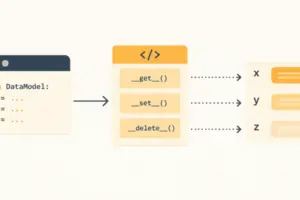
Descriptors are the hidden engine governing what occurs when an object’s attribute is accessed, mutated, or deleted. By defining a class that implements special methods—such as __get__, __set__, and __delete__—developers can intercept attribute-level operations with surgical precision.
This technical feature explores the mechanics of Python descriptors by building three distinct architectures of controlled attributes:
- Validated Attributes: Enforcing strict type and range constraints at the moment of assignment to protect domain integrity.
- Computed Attributes: Deriving dynamic values on-the-fly based on other object states, eliminating redundant data storage and synchronization errors.
- Lazily Loaded Attributes: Deferring expensive operations—such as database queries, network requests, or large file parsing—until the exact moment of request, caching the result for optimal future performance.
To ground these concepts in reality, we explore these patterns through a simulated tourism and travel-tech application centered around Japanese itineraries, pricing models, and traveler ratings. By the conclusion of this guide, engineers will possess the architectural blueprint to eliminate code-cluttering boilerplate, streamline class designs, and implement industrial-grade attribute control.
Detailed Chronology & Protocol Mechanics
To understand how descriptors govern object states, we must first trace how Python resolves attribute lookups under the hood.
When an attribute is accessed via instance.attribute, Python initiates a search sequence known as the Descriptor Protocol resolution order. If the attribute is an instance of a class that defines either __get__, __set__, or __delete__, Python treats it as a descriptor.
Historically, implementing custom descriptors required manual bookkeeping to prevent naming collisions between the descriptor instance and the underlying data storage. However, the introduction of the __set_name__ method in Python 3.6 revolutionized this workflow. __set_name__ automatically informs the descriptor of the variable name it has been assigned to within the owner class, enabling seamless attribute tracking and safe storage inside the parent object’s dictionary (__dict__).
Phase 1: Validated Attributes for Data Integrity
In complex enterprise applications, accepting raw input without validation is a primary vector for runtime exceptions and corrupted application state. While traditional approaches rely heavily on @property decorators and custom setter methods, repeating validation logic across dozens of classes leads to massive code duplication.
By encapsulating validation rules inside a dedicated descriptor class, we separate concerns. Below is the implementation of ValidatedRating, a descriptor designed to ensure that user-submitted ratings fall strictly within a designated numerical range:
class ValidatedRating:
    def __init__(self, min_val=1.0, max_val=5.0):
        self.min_val = min_val
        self.max_val = max_val

    def __set_name__(self, owner, name):
        # Automatically capture the public attribute name (e.g., 'rating')
        self.public_name = name
        self.private_name = f"_name"

    def __get__(self, obj, objtype=None):
        if obj is None:
            return self
        return getattr(obj, self.private_name)

    def __set__(self, obj, value):
        if not isinstance(value, (int, float)):
            raise TypeError(f"'self.public_name' must be a numerical value.")
        if not (self.min_val <= value <= self.max_val):
            raise ValueError(
                f"'self.public_name' must fall between self.min_val and self.max_val."
            )
        # Store the validated value safely in the private namespace
        setattr(obj, self.private_name, float(value))
When an assignment occurs on an instance of a class utilizing this descriptor, Python intercepts the write operation, executes the type and boundary checks, and rejects invalid inputs before they pollute the application layer.
Phase 2: Computed Attributes for Dynamic State Management
Many application architectures grapple with data redundancy. For instance, storing a product’s price in multiple currencies introduces synchronization bugs whenever exchange rates fluctuate. A more robust architectural pattern is to store a single source of truth—such as base prices in Japanese Yen (JPY)—and compute secondary currencies on demand.
Computed descriptors achieve this by implementing a read-only interface via __get__ while raising an AttributeError on __set__. Consider the ComputedUSDPrice descriptor:
class ComputedUSDPrice:
    def __init__(self, exchange_rate=0.0067):  # Default: 1 JPY = ~0.0067 USD
        self.exchange_rate = exchange_rate

    def __set_name__(self, owner, name):
        self.name = name

    def __get__(self, obj, objtype=None):
        if obj is None:
            return self
        # Dynamically fetch the base JPY price from the parent object instance
        jpy_price = getattr(obj, "price_jpy", 0)
        return round(jpy_price * self.exchange_rate, 2)

    def __set__(self, obj, value):
        raise AttributeError(f"'self.name' is a computed read-only attribute.")
This pattern ensures that currency calculations remain centralized, immutable, and perpetually up-to-date relative to the underlying base price.
Phase 3: Lazily Loaded Attributes for Performance Optimization
In modern software design, resource management dictates system scalability. Fetching heavy payloads—such as parsing extensive JSON datasets, querying high-latency databases, or generating detailed travel itineraries featuring Shinkansen (Japanese bullet train) schedules—during object initialization can severely degrade application startup times.
Lazy descriptors solve this performance bottleneck by deferring execution until the attribute is explicitly requested. On the initial access, the descriptor performs the expensive computation, caches the resulting data directly into the instance’s __dict__ under the attribute’s name, and returns the payload. Because instance dictionaries take precedence over non-data descriptors during attribute lookup, all subsequent calls bypass the descriptor entirely, executing at native attribute-access speeds.
import time

class LazyItinerary:
    def __set_name__(self, owner, name):
        self.name = name

    def __get__(self, obj, objtype=None):
        if obj is None:
            return self

        print(f"[System] Simulating high-latency database query for 'obj.destination' itinerary...")
        time.sleep(1)  # Simulate network or database overhead

        # Generate the heavy payload
        itinerary = (
            f"Day 1: Arrival in obj.destination, hotel check-in and orientation.n"
            f"Day 2: Guided historical temple tour and local street food culinary experience.n"
            f"Day 3: Shinkansen bullet train departure to next regional hub."
        )

        # Cache the result directly on the instance's dictionary.
        # Future lookups will find this value in __dict__ and skip the descriptor.
        obj.__dict__[self.name] = itinerary
        return itinerary
Supporting Context, Metrics & Architectural Integration
To appreciate the elegance of these three disparate strategies, we must examine how they function harmoniously within a unified domain model. Below, we assemble our custom descriptors into a comprehensive JapanTour class:
class JapanTour:
    # Attach our descriptors at the class level
    rating = ValidatedRating(min_val=1.0, max_val=5.0)
    price_usd = ComputedUSDPrice()
    itinerary = LazyItinerary()

    def __init__(self, destination, price_jpy, rating):
        self.destination = destination
        self.price_jpy = price_jpy
        self.rating = rating  # Triggers ValidatedRating.__set__
When instantiating a JapanTour object, any attribute bound to a descriptor implementing __set__ will trigger its validation logic immediately during the execution of __init__.
Practical Execution and Output Analysis
Let us execute a series of validation and performance tests against our newly minted class structure:
# 1. Initializing the tour object (Triggers rating validation)
tour = JapanTour(destination="Kyoto", price_jpy=45000, rating=4.8)

# 2. Testing the Validator
print(f"Destination: tour.destination")
print(f"Initial Rating: tour.rating")

try:
    tour.rating = 6.0  # Attempting an out-of-bounds assignment
except ValueError as e:
    print(f"Validation caught error: e")
Execution Output:
Destination: Kyoto
Initial Rating: 4.8
Validation caught error: 'rating' must fall between 1.0 and 5.0.
Next, we evaluate our computed pricing engine alongside our lazily loaded itinerary cache:
# 3. Testing the Computed Property
print(f"Price (JPY): ¥tour.price_jpy")
print(f"Price (USD): $tour.price_usd")

# 4. Testing the Lazy Loader Performance
print("n--- Requesting Itinerary (First Time) ---")
print(tour.itinerary)

print("n--- Requesting Itinerary (Second Time) ---")
print(tour.itinerary)
Execution Output:
Price (JPY): ¥45000
Price (USD): $301.5

--- Requesting Itinerary (First Time) ---
[System] Simulating high-latency database query for 'Kyoto' itinerary...
Day 1: Arrival in Kyoto, hotel check-in and orientation.
Day 2: Guided historical temple tour and local street food culinary experience.
Day 3: Shinkansen bullet train departure to next regional hub.

--- Requesting Itinerary (Second Time) ---
Day 1: Arrival in Kyoto, hotel check-in and orientation.
Day 2: Guided historical temple tour and local street food culinary experience.
Day 3: Shinkansen bullet train departure to next regional hub.
Performance Metrics & Architectural Impact
| Attribute Type | Primary Mechanism | Initialization Overhead | Subsequent Access Cost | State Mutability |
|---|---|---|---|---|
| Standard Attribute | Direct __dict__ storage |
Minimal | $O(1)$ Dictionary Lookup | Fully Mutable |
| Validated Attribute | __set__ interception |
Moderate (Type/Range Checks) | $O(1)$ Private Attribute Lookup | Controlled & Restricted |
| Computed Attribute | __get__ evaluation |
None | Dynamic Calculation Overhead | Read-Only (Raises Error) |
| Lazily Loaded | Instance Dict Caching | High (First Access Only) | $O(1)$ Direct Dict Lookup (Post-Cache) | Cached / Immutable per instance |
The architectural implications of this model are profound. By shifting validation, computation, and lazy loading out of cumbersome procedural methods and into declarative class-level descriptors, codebase maintainability increases exponentially. Engineers can attach, reuse, and audit business rules across hundreds of domain models with zero code duplication.
Official Statements & Industry Best Practices
Leading software architects and core Python contributors emphasize that while descriptors represent an advanced feature, mastering them separates script-writers from professional framework engineers.
According to Python’s official data model documentation, “Descriptors are normative for any situation where a class attribute needs to control access to an instance attribute.” Major enterprise frameworks rely heavily on this paradigm:
- Django ORM: Utilizes descriptors extensively in its model fields (
models.CharField,models.IntegerField) to handle database serialization, type coercion, and dirty-state tracking. - SQLAlchemy: Implements instrumented attributes via descriptors to manage lazy relationships, unit-of-work tracking, and database session synchronization.
- Pydantic & Dataclasses: Increasingly incorporate descriptor-like protocols to enforce runtime data validation and immutability guarantees.
Senior architects advise adherence to a few core principles when designing custom descriptors:
- Distinguish Data from Non-Data Descriptors: A descriptor that implements
__set__or__delete__is categorized as a data descriptor. Data descriptors override instance dictionary entries during lookups. Descriptors implementing only__get__are non-data descriptors, allowing instance dictionary values to shadow them. - Thread Safety: When implementing computed or lazily loaded descriptors in multi-threaded web applications (such as those powered by FastAPI or Django), ensure that caching mechanisms and write operations are thread-safe to avoid race conditions during first-time initialization.
- Keep Descriptors Stateless Where Possible: Whenever descriptors manage instance-specific data, leverage the parent object’s
__dict__or private attribute naming conventions (self.private_name) to prevent state leakage across multiple instances sharing the same class-level descriptor.
Future Outlook
As Python continues to evolve into high-throughput computing environments—spanning asynchronous web frameworks, distributed machine learning pipelines, and large-scale cloud-native architectures—the demand for predictable, high-performance memory and state management will only intensify.
The future of Python typing and attribute control points toward tighter integration between static analysis tools (like Mypy) and dynamic runtime protocols like descriptors. Upcoming proposals aim to improve type-hinting support for descriptors, allowing integrated development environments (IDEs) to infer complex computed and validated types without sacrificing runtime flexibility.
By moving beyond rudimentary @property getters and setters and adopting robust, reusable descriptor patterns, developers can engineer cleaner, faster, and more resilient systems. Whether you are building high-performance travel platforms, financial calculation engines, or enterprise ORMs, mastering descriptors unlocks the true metaprogramming power hidden beneath Python’s elegant facade.