Executive Overview
In a significant push toward integrating advanced artificial intelligence into consumer wellness and clinical guidance, Apple has announced the launch of a comprehensive research initiative dubbed the Health AI Usage Study. Developed in close partnership with OpenEvidence—a recognized clinical AI platform utilized extensively by medical professionals and powered by trusted data sources such as The New England Journal of Medicine—the initiative seeks to understand how everyday users interact with artificial intelligence when seeking medical answers.
At the center of this initiative is a newly released research application, now available for download on the App Store. Apple aims to enroll up to 200,000 participants across the United States to test, evaluate, and rate AI-generated health responses. By combining real-world user queries with optional biometric and health telemetry from the Apple HealthKit ecosystem, the Cupertino-based tech giant hopes to bridge the persistent gap between complex clinical data and actionable, consumer-friendly insights.
Crucially, Apple has drawn a distinct boundary between this standalone research project and its broader commercial ecosystem. The experimental research app operates entirely independently of Siri and Apple Intelligence, and the company has implemented stringent privacy safeguards, ensuring that participant data remains confidential and will not be utilized to train future commercial AI models. As consumer technology increasingly intersects with personal medicine, this study represents a major milestone in establishing scientific rigor, clinical grounding, and user-centric design at the foundational level of artificial intelligence development.
Detailed Chronology and Study Mechanics
The rollout of the Health AI Usage Study marks the culmination of months of behind-the-scenes development and strategic collaboration within Apple’s health and engineering divisions.
The Application and Onboarding Process
The journey for participants begins on the App Store, where the dedicated research application is now live. To qualify for the study, individuals must meet specific demographic and hardware criteria:
- Age and Location: Participants must be at least 21 years old and reside within the United States.
- Hardware Requirements: Due to the processing demands of modern localized or hybrid clinical tools, users must own an iPhone 15 Pro or a subsequent newer model running modern operating system architecture (iOS 26 and up).
- Ecosystem Integration: Participants are given the agency to decide whether they wish to share contextual data from Apple HealthKit. This optional sharing encompasses a wide array of personal health metrics, including daily activity levels, longitudinal sleep quality, and digitized lab results.
By feeding this contextual data into the research platform, the study aims to evaluate whether AI responses can become more tailored and relevant when informed by a user’s actual physiological baseline.
How the Tool Works in Practice
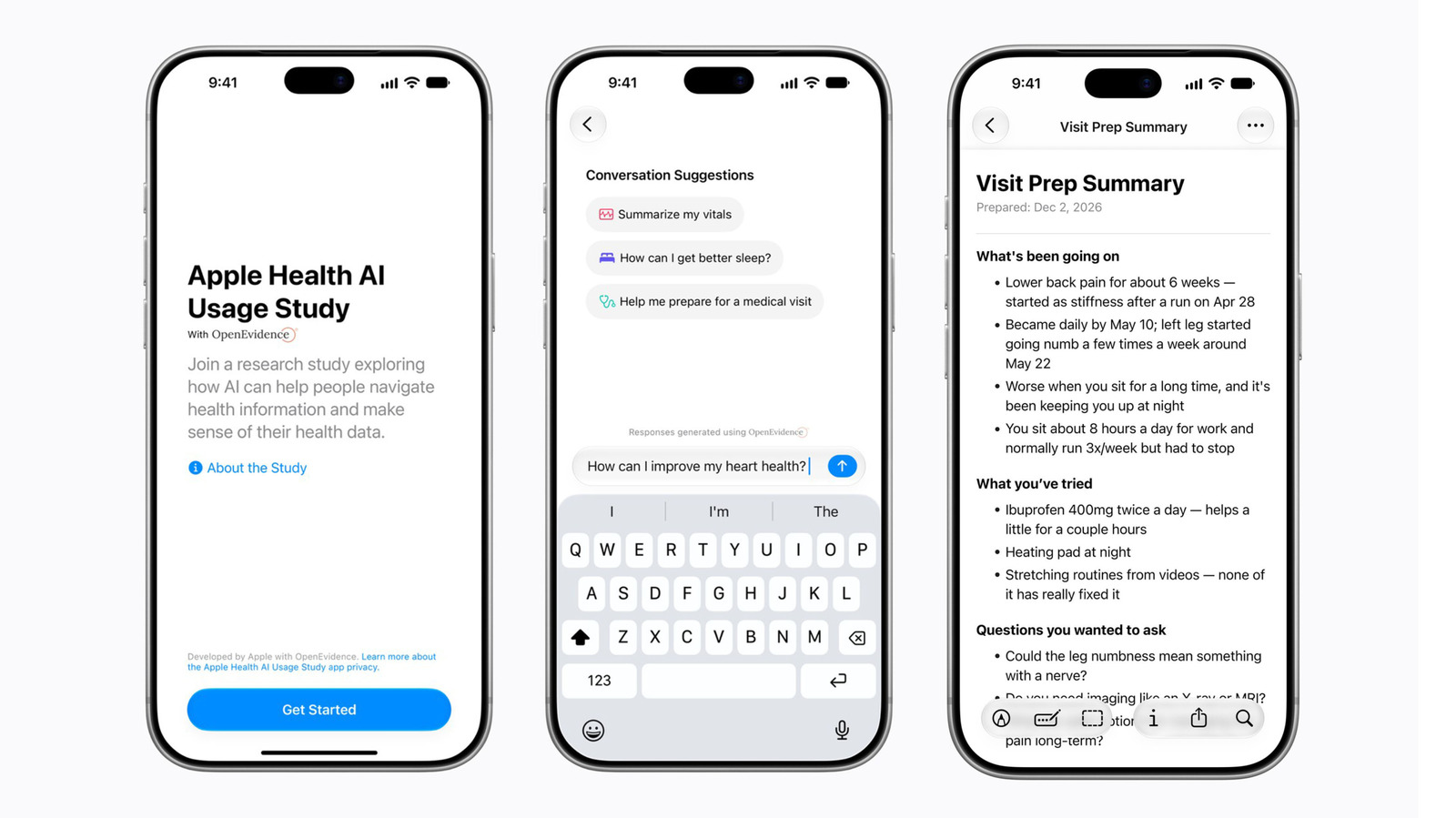
Once onboarded, participants interact with a text-based conversational interface. Screen shots from the application demonstrate typical user prompts, such as inquiries regarding cardiovascular wellness ("How can I improve my heart health?").
Upon submitting a query, the system—backed by OpenEvidence’s robust medical database—generates a response designed to strip away dense medical jargon while retaining absolute clinical accuracy. Crucially, every response is accompanied by direct links to peer-reviewed clinical sources, allowing users to verify the information and trace the algorithmic output back to legitimate medical literature.
Participants are then tasked with rating these responses, providing vital feedback on clarity, perceived helpfulness, tone, and accuracy. This iterative feedback loop is designed to provide Apple and its clinical partners with unprecedented qualitative data regarding how non-medical professionals interpret, trust, and act upon AI-driven health advice.
Supporting Context & Metrics: The Intersection of AI and Consumer Health
The launch of Apple’s Health AI Usage Study arrives at a pivotal moment in the technology and healthcare sectors. For years, the proliferation of "Dr. Google" has presented a double-edged sword: while vast amounts of medical information are freely accessible online, patients frequently struggle to separate peer-reviewed consensus from unverified misinformation or alarmist blog posts.
Bridging the Clinical Gap
Generative artificial intelligence has introduced a new paradigm, offering conversational summaries of complex topics. However, mainstream large language models (LLMs) have historically suffered from hallucinations, a lack of clinical grounding, and an inability to contextualize medical advice within a patient’s unique health history.
By partnering with OpenEvidence, Apple is intentionally bypassing generic consumer AI models in favor of a clinical-grade architecture. OpenEvidence is built specifically for healthcare professionals, drawing data from gold-standard publications like The New England Journal of Medicine, peer-reviewed journals, and clinical trial databases. Bringing this level of rigor into a consumer-accessible format requires rigorous study—which explains the scale of Apple’s new initiative.
Scale and Ambition
- Target Enrollment: 200,000 participants across the United States.
- Data Vectors: Text queries, subjective response ratings, and optional HealthKit integrations (activity, sleep, lab metrics).
- Core Objective: Developing tools that translate high-level clinical research into actionable, non-jargony, and easily digestible guidance for everyday individuals.
The sheer scale of the target demographic—reaching up to 200,000 users—ensures that the resulting dataset will be statistically significant across diverse age groups, activity levels, and health backgrounds.
Official Statements and Privacy Commitments
Given the sensitive nature of health data, Apple has taken proactive steps to address privacy concerns and articulate its broader philosophy regarding digital health innovation.
The Philosophy of Responsible Innovation
Sumbul Desai, MD, Apple’s Vice President of Health and Fitness, emphasized the company’s commitment to clinical validation in an official statement released alongside the study:
“[We] believe responsible innovation starts with scientific rigor and clinical grounding. Insights from this study will help advance the broader scientific conversation and ensure that as technology evolves, we continue building trusted tools that genuinely support people wherever they are on their health journey.”
Dr. Desai’s remarks underscore a growing industry realization: consumer trust in health-tech cannot be won through flash features alone. It requires deep collaboration with the medical community and a transparent commitment to safety and efficacy.
Strict Privacy Safeguards
To alleviate fears regarding data monetization or unauthorized surveillance, Apple has explicitly outlined the boundaries governing the study:
- No Siri or Apple Intelligence Integration: The research app operates in a siloed environment and is not tied to the consumer-facing Siri assistant or the broader Apple Intelligence suite currently deployed across iOS devices.
- Confidentiality: Participant data submitted during the study is kept strictly confidential.
- No Model Training: Apple has explicitly pledged that data gathered through this study will not be used to train commercial AI models.
These firewalls are designed to protect participants and ensure that the project remains purely scientific and exploratory in nature.
Future Outlook: What This Means for the Future of Wellness
The launch of the Health AI Usage Study is much more than a localized research project; it is a clear indicator of where consumer health technology is heading over the next decade.
The Evolution of Personalized Medicine
As artificial intelligence matures, the holy grail of digital health is hyper-personalized, clinically sound preventative care. By learning how users interact with medical literature through this study, Apple and its peers are laying the groundwork for future tools that could help individuals manage chronic conditions, optimize physical fitness, and prepare more effectively for clinical consultations with their human doctors.
Rather than replacing primary care physicians, the trajectory of these tools points toward empowerment and education. By making peer-reviewed medical data accessible and comprehensible, technology companies hope to foster a more health-literate public capable of engaging in more productive, informed dialogues with their healthcare providers.
Long-Term Industry Impact
The findings generated by up to 200,000 American participants will likely influence not only Apple’s future product roadmap but also the broader regulatory and ethical standards governing AI in medicine. As researchers analyze how everyday users rate clarity, safety, and utility, the insights will contribute valuable peer-reviewed data to the global scientific community.
Ultimately, Apple’s latest endeavor signals a maturing approach to artificial intelligence in health—one that prioritizes clinical grounding, respects strict user privacy, and places human well-being at the absolute center of technological progress.