Executive Overview
When Tesla first unveiled the concept of its next-generation Roadster years ago, it was accompanied by staggering performance claims: 0 to 60 mph in 1.9 seconds, a top speed exceeding 250 miles per hour, and a 620-mile range. To the automotive and tech worlds, these figures already sounded like hyperbole. Yet, true to form, Tesla has consistently pushed the boundaries of what consumers expect from electric vehicles. However, during a recent, highly theatrical launch and demonstration event, Tesla CEO Elon Musk and his engineering teams redefined the concept of automotive performance entirely.
Moving beyond traditional track times and quarter-mile acceleration metrics, Tesla treated spectators to a jaw-dropping live stunt show that blurred the lines between high-end automotive engineering and science fiction. The highlight of the evening involved the redesigned Roadster performing gravity-defying maneuvers, executing vertical hangs, clearing lines of parked vehicles, and utilizing rocket-inspired propulsion technology borrowed directly from SpaceX.
What began as an unveiling of a production-intent prototype quickly evolved into a masterclass in experiential marketing and technological flex. By integrating cold-gas thruster systems—similar to those used on SpaceX Falcon rockets—into a street-legal (or at least track-capable) automobile, Tesla has signaled that the future of personal transport is not merely electric, but fundamentally aerospace-adjacent. This comprehensive report explores the chronology of the stunt show, examines the engineering and financial metrics behind the vehicle’s tiers, evaluates official statements, and analyzes what this unprecedented machine means for the future of the high-performance automotive industry.
Detailed Chronology of the Stunt Show
The demonstration event was meticulously choreographed to showcase the unprecedented agility and aerodynamic capabilities of the redesigned Roadster. Attendees and livestream viewers alike were treated to a sequence of spectacles that seemed to defy the fundamental laws of physics.
The C-Shaped Ramp and the Upside-Down Hang
The performance commenced with the Roadster positioned at the base of an imposing, custom-built C-shaped ramp. As the vehicle surged forward, it ascended the steep curve with blistering velocity—not once, but twice.
On both attempts, the car reached the absolute apex of the structure, coming to a dead stop perpendicular to the ground. In a move that left audiences gasping, the Roadster hung completely upside-down at the vertical zenith of the ramp. Rather than succumbing to gravity, the vehicle maintained its bizarre orientation through a combination of precision weight distribution and localized downward force.
Following the second vertical pause, the Roadster executed a controlled, dynamic leap off the ramp. As it sailed through the air, it performed a graceful roll before safely hovering down to the ground. This breathtaking maneuver was made possible by the vehicle’s integrated cold-gas thrusters—a direct technological transfer from SpaceX’s aerospace engineering division.
Clearing the Fleet and the Stationary Flip
Following the ramp sequence, the Roadster was driven onto the main exhibition floor, where a fleet of Tesla’s production vehicles had been parked side-by-side to create a formidable obstacle. With calculated precision, the Roadster accelerated down a short runway and leaped effortlessly over the entire line of vehicles, demonstrating remarkable suspension travel, balanced weight distribution, and controlled aerodynamic lift.
The grand finale of the presentation pushed the boundaries of automotive theatrics even further. Positioned at a complete standstill from a zero-velocity start, the Roadster initiated a sudden, violent, yet controlled flip. The car rotated entirely in mid-air before utilizing its onboard thruster system to brake its descent, hovering gently back down to touch the tarmac with surgical precision.
The live audience erupted as the driver stepped out of the vehicle, cementing the demonstration as one of the most daring and technologically advanced vehicle showcases in automotive history.
Supporting Context & Metrics: Engineering, Pricing, and Availability
Beneath the theatrical flair of the stunt show lies a deeply complex matrix of automotive engineering, tiered pricing structures, and exclusive availability requirements that separate casual reservation holders from aerospace-grade enthusiasts.
The SpaceX Thruster Package Integration
The inclusion of cold-gas thrusters on a consumer-accessible automobile is a watershed moment in vehicle design. Traditionally, downforce and stability are managed via passive aerodynamic elements—such as wings, splitters, and diffusers—coupled with active mechanical suspension systems. Tesla, however, has leveraged compressed air thrusters (historically used for attitude control on spacecraft) to actively manipulate the Roadster’s trajectory, stability, and braking capacity.
Operating at extreme pressures, these thrusters provide instantaneous thrust vectoring. This allows the vehicle to effectively "push" itself into the pavement for enhanced cornering grip, arrest momentum during emergency braking scenarios, and provide the stabilization required to execute low-altitude hovering and flipping maneuvers safely.
Financial Commitments and Reservation Tiers
Tesla has structured the purchasing and reservation process for the next-gen Roadster into distinct tiers, catering to everyone from traditional luxury car buyers to elite collectors willing to pay top dollar for bleeding-edge aerospace tech.
-
The Base Reservation Tier:
For enthusiasts looking to secure a standard version of the redesigned Roadster, the entry barrier is relatively straightforward. The initial reservation requires a fully refundable deposit of $5,000. Within 10 days of placing this initial hold, buyers must remit an additional $45,000, bringing the base vehicle reservation commitment to $50,000. While the final MSRP of the base Roadster has yet to be officially locked in by Tesla, this substantial down payment reflects the high manufacturing costs associated with the vehicle’s projected performance specs.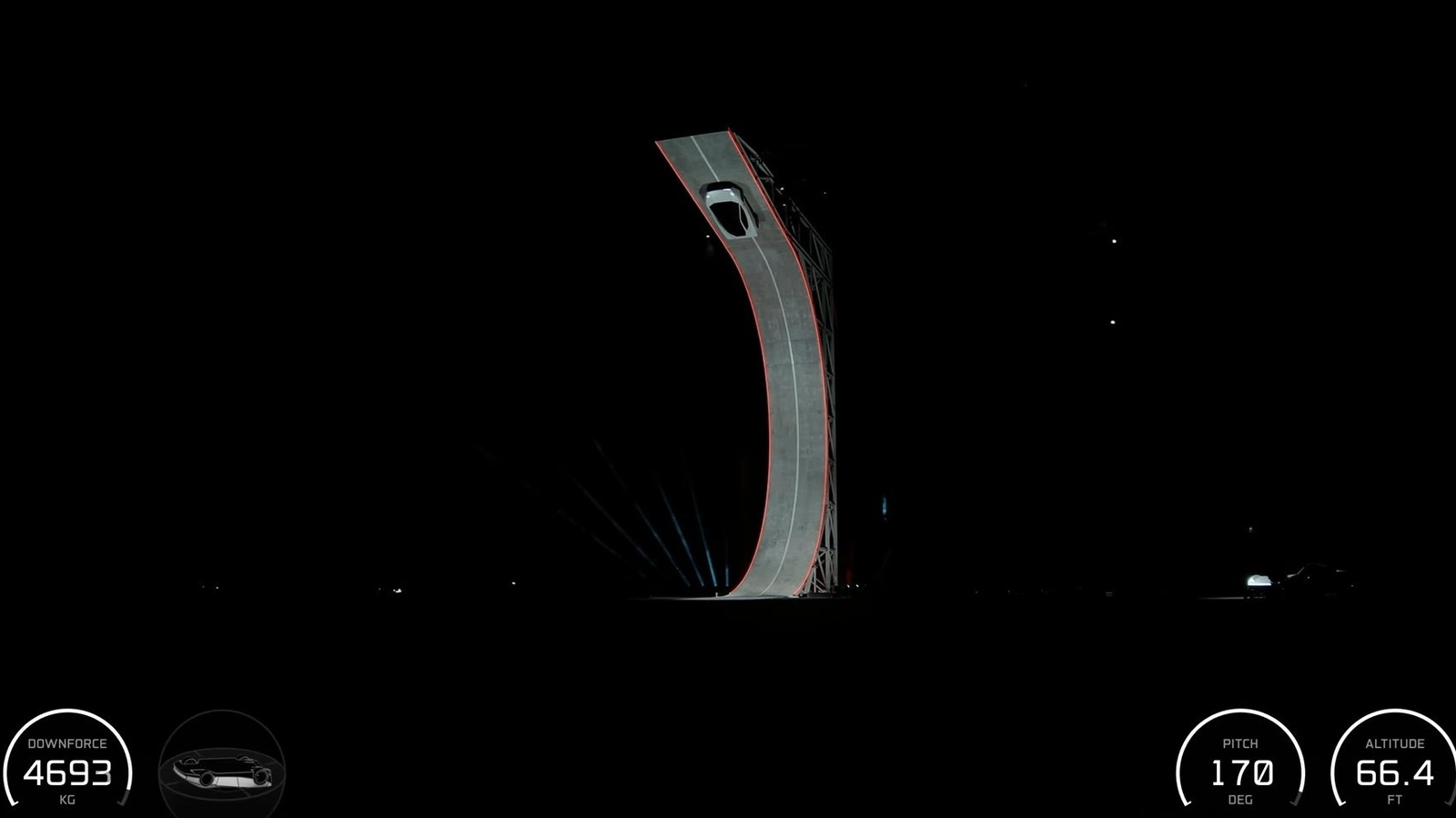
-
The Suction and Accelerator Thruster Package:
For buyers who want the full, physics-defying experience—including the suction technology that allowed the vehicle to adhere to the upside-down C-ramp and the accelerator thrusters demonstrated during the show—the financial investment scales dramatically. Securing this variant requires a staggering reservation cost of $250,000. This package bridges the gap between terrestrial sports cars and high-performance experimental craft, incorporating heavy-duty composite materials, specialized air-tank infrastructure, and advanced software integration. -
The Hover-Capable Elite Tier:
The absolute pinnacle of the Roadster lineup—the version capable of executing the gravity-defying jumps and hovering maneuvers witnessed at the live event—operates under an entirely different paradigm. This model will not be available through open-market reservations. Instead, access is strictly invite-only, reserved for a select cohort of elite customers, brand loyalists, and high-net-worth automotive collectors. Tesla has kept details regarding the final cost and production volume of this specific variant heavily guarded.
Official Statements and Industry Reactions
The automotive and aerospace communities have responded to Tesla’s Roadster stunt show with a mixture of awe, skepticism, and intense analytical scrutiny.
Tesla’s Vision of Integrated Technology
In official post-event communications, Tesla representatives emphasized that the integration of SpaceX technology into the Roadster is not merely a promotional gimmick, but a proof-of-concept for the future of transportation physics.
"Real life, baby," Tesla posted on its official social media channels alongside footage of the vehicle’s vertical hang, encapsulating the company’s ethos of turning science fiction into tangible reality.
Company engineers noted that the algorithms governing the cold-gas thrusters require millisecond-level precision. The onboard computer constantly calculates pitch, yaw, roll, and gravitational pull, firing compressed air nozzles to counteract destabilizing forces in real-time. This software architecture shares more DNA with reusable orbital-class rocket boosters than it does with traditional electronic stability control (ESC) systems found in modern sedans and SUVs.
Industry Skepticism and Regulatory Hurdles
Despite the excitement generated by the event, industry analysts have raised critical questions regarding the commercial viability and regulatory approval of a rocket-propelled automobile.
Automotive safety regulators, including the National Highway Traffic Safety Administration (NHTSA) and international counterparts, have yet to issue official guidelines regarding compressed-gas thrusters mounted on passenger vehicles. Critics point out several glaring challenges:
- Pedestrian Safety: High-pressure gas thrusters operating at vehicle level pose severe safety hazards to pedestrians, cyclists, and nearby motorists in the event of an accidental discharge or system malfunction.
- Homologation and Street Legality: It remains highly improbable that a vehicle equipped with active flight-style thrusters and suction systems will be granted legal status for public roadways in regions like the European Union or North America without significant modifications.
- Maintenance and Refueling: The logistics of servicing a vehicle that requires high-pressure gas replenishment alongside traditional battery re-charging introduce a complex service paradigm that current Tesla Service Centers are not equipped to handle.
Nevertheless, supporters argue that even if certain extreme features—such as full hovering capabilities—are restricted to closed tracks or remain exclusive to the invite-only tier, the trickle-down effect of this research and development will fundamentally alter vehicle dynamics, safety systems, and aerodynamic efficiency for decades to come.
Future Outlook: What Lies Ahead for the Roadster and Tesla
As the dust settles on the high-octane launch event, the eyes of the global automotive market turn toward production execution. Tesla has historically faced well-documented challenges regarding production timelines, supply chain bottlenecks, and the scaling of next-generation vehicle architectures (as witnessed during the rollouts of the Model X and the Cybertruck).
Production Timelines and Manufacturing Hurdles
Bringing a vehicle with the complexity of the next-gen Roadster to market requires overcoming unprecedented manufacturing hurdles. The integration of lightweight carbon-fiber composite chassis elements, high-density battery packs capable of sustaining a 620-mile range while discharging massive bursts of energy for acceleration and thruster activation, and aerospace-grade pneumatic systems demands a completely overhauled production line.
Industry insiders suggest that while the prototype showcased at the event successfully demonstrated the physical feasibility of the design, transitioning these stunt-capable systems into a reliable, warrantied consumer product will require years of rigorous track and flight testing.
Redefining the Performance Benchmark
Regardless of when the first production models officially roll off the assembly line, Tesla has successfully shifted the paradigm of what consumers anticipate from an electric vehicle. For over a decade, the EV narrative was dominated by range anxiety, charging infrastructure, and straight-line acceleration metrics.
By introducing rocket thrusters, vertical positioning, and hovering dynamics, Tesla has transformed the conversation into one of sheer experiential wonder. The Roadster is no longer just competing against traditional internal combustion supercars like Ferrari, Lamborghini, or Bugatti; it is carving out an entirely new category of terrestrial performance vehicles that borrow directly from the playbook of space exploration.
As reservation holders lock in their $50,000 base commitments or vie for coveted invitations to the elite hover-capable tier, the automotive world waits with bated breath. Whether the production Roadster will routinely perform mid-air flips on public highways remains doubtful, but the message delivered by Elon Musk and the Tesla engineering team is unmistakably clear: the boundaries of physics are merely suggestions, and the future of mobility is bound only by imagination.