Executive Overview
The landscape of artificial intelligence development has shifted dramatically. The engineering challenge of today is no longer just about optimizing raw model intelligence or scaling parameter counts; it is about building reliable, long-running agentic systems that can function autonomously across months of deployment without degradation, amnesia, or catastrophic failure.
At the heart of this challenge lies a fundamental architectural hurdle: Large Language Models (LLMs) are stateless by design. Every inference call initiates a fresh slate, devoid of native memory regarding what transpired previously. Early agent developers attempted to bypass this limitation through brute force—dumping entire conversation histories directly into expansive context windows and hoping for optimal retention.
Production data has definitively exposed the flaws in this approach. As context windows fill up, latency spikes exponentially, and the model’s ability to reason over its inputs degrades. Critical facts become buried beneath layers of noise, and conflicting statements in the prompt window frequently lead to unpredictable hallucination rather than logical synthesis. While prompt caching has successfully mitigated token costs for stable prompt prefixes, throwing hardware at the problem via oversized context windows is a false economy.
True production-grade reliability requires treating memory and state as deliberate, decoupled architectural decisions rather than afterthoughts. This report provides an authoritative exploration of the five core patterns required to master persistent memory and state in AI agents, detailing how to engineer systems that securely learn, adapt, and scale over extended lifecycles.
Detailed Chronology & Conceptual Foundations: State vs. Memory
Before diving into architectural patterns, enterprise engineers must draw a razor-sharp distinction between two terms that are frequently conflated: State and Memory. Conflating these two layers introduces systemic failure modes that compromise both application uptime and enterprise data security.
[Memory Layer] (Semantic & Episodic)
      │
      ▼  (Initialization / Reads)
[Working State] (In-Context Scratchpad)
      │
      ▼  (Execution / Writes)
[Persistent Storage] (PostgreSQL / Vector DBs)
Defining the Core Pillars
- State (The Whiteboard): State is a snapshot of everything an agent currently knows about an active task. It tracks variables such as the current workflow step, the raw output of the last tool execution, and intermediate variables. State is dynamic, updating constantly as execution progresses. Crucially, when an active session terminates, traditional session state evaporates unless explicitly persisted.
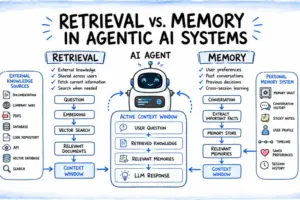
- Memory (The Cross-Boundary Mechanism): Memory is the mechanism that carries information across temporal and operational boundaries—spanning the next conversational turn, a subsequent session days later, or an entirely distinct agent operating downstream. Working memory represents the shortest temporal horizon, while semantic and episodic memory span weeks, months, or years.
The Lifecycle Interaction Cycle
These two components exist in a continuous feedback loop:
- Initialization: At the commencement of a task, an agent queries long-term memory to seed its initial state, retrieving domain-specific rules, behavioral constraints, and historical failure logs.
- Execution: During task execution, the agent continuously mutates its state while interacting with external APIs and data structures.
- Persisting: Upon task completion or interruption, selective insights from the runtime state are written back to long-term memory stores.
When state architecture fails, an agent loses track of its immediate objective mid-task. When memory architecture fails, an agent loses the capacity to learn, resulting in institutional amnesia where every user interaction resets the baseline.
The Five Architectural Patterns for Production Agents
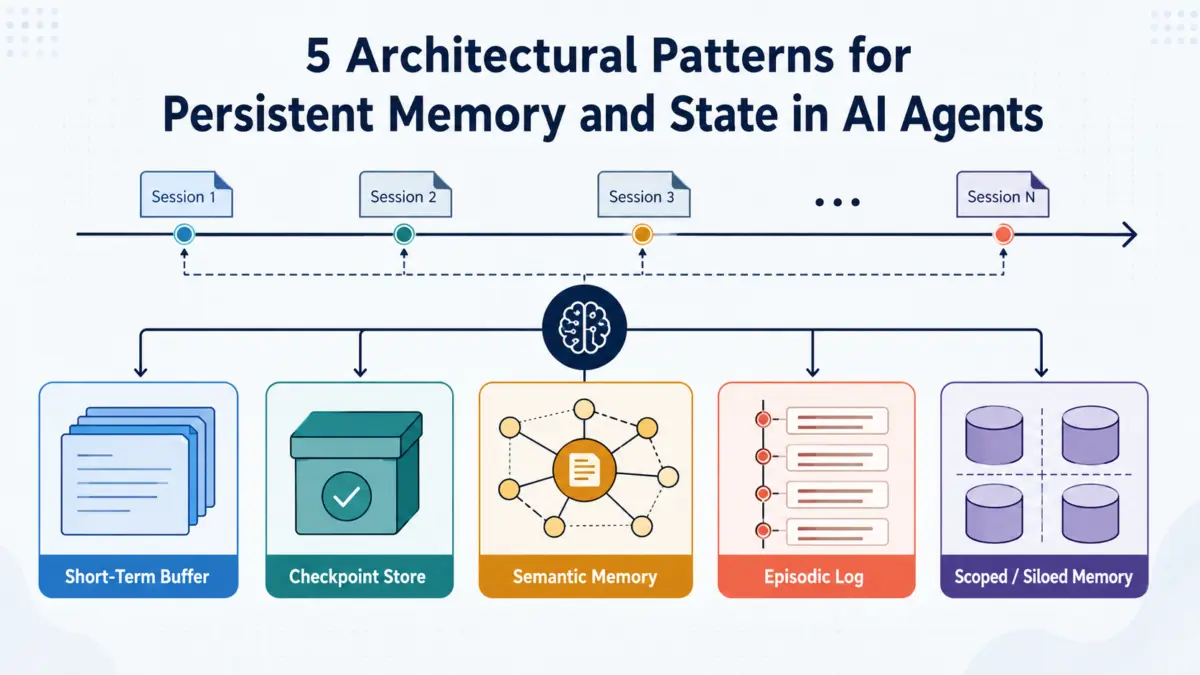
To construct robust autonomous systems, engineers must implement five specialized architectural patterns designed to handle runtime state, cross-session persistence, historical reflection, and strict tenant segregation.
┌─────────────────────────────────────────────────────────────┐
│                 5 Architectural Patterns                    │
├──────────────────────┬──────────────────────────────────────┤
│ 1. Working Buffer    │ Ephemeral execution scratchpad       │
│ 2. Checkpointing     │ Fault-tolerant durability (State)    │
│ 3. Semantic Memory   │ Cross-session facts & preferences    │
│ 4. Episodic Logs     │ Historical traces & failure learning │
│ 5. Multi-Scope       │ Enterprise-grade data isolation      │
└──────────────────────┴──────────────────────────────────────┘
Pattern 1: The In-Context Working Buffer (Short-Term Execution)
The Concept
Working memory manages the ephemeral state of the active session: live prompts, immediate conversational turns, and active tool execution outputs. Functioning as a high-speed scratchpad, it is designed for rapid read-and-write operations that are discarded once the session concludes.
Architectural Mechanics
Rather than allowing message arrays to expand without bound—which triggers quadratic compute penalties in standard attention mechanisms—the working buffer operates as a managed sliding window. The agent writes intermediary reasoning steps to a dedicated scratchpad.
As the buffer approaches its token limit, a background compression process synthesizes older conversational turns into a dense executive summary, preserving logical conclusions while stripping away verbose tool outputs.
- The Engineering Tradeoff: Mid-conversation summarization inherently modifies the prompt prefix. This mutation invalidates the Key-Value (KV) cache, triggering noticeable latency spikes on the subsequent inference call. System architects must explicitly design around this caching penalty.
When to Use It
Every production agent requires an in-context working buffer. It serves as the baseline requirement for orchestrating multi-step reasoning loops within a unified session boundary.
Pattern 2: Execution Checkpointing (Fault Tolerance & Pausing)
The Concept
While working buffers manage in-session memory, execution checkpointing addresses external interruptions. Long-running enterprise workflows routinely encounter network timeouts, API rate limits, or mandatory human-in-the-loop approval pauses. Checkpointing serializes workflow state to a durable database, allowing execution to resume precisely where it halted without re-running completed computations.
Architectural Mechanics
Graph-based agent frameworks model workflows as directed acyclic graphs (DAGs) composed of nodes and edges. Following the execution of each node, the framework serializes the workflow state—including environment variables, execution history, and current graph position—to a robust relational database such as PostgreSQL or SQLite.
[Agent Node] ──> [State Checkpoint] ──> [Durable DB (PostgreSQL/SQLite)]
      │
└── (Crash/Pause) ──> [Reload Checkpoint] ──> [Resume Execution]- Critical Engineering Pitfall: Resumption does not inherently grant exactly-once semantics. If a node partially executes before crashing (for instance, transmitting an external email or committing a partial database transaction), resuming the workflow can trigger duplicate side effects. Consequently, all side-effecting agent nodes must be engineered for idempotency. Furthermore, open file handles, active socket connections, and runtime client objects cannot be serialized, dictating strict constraints on what data structures may reside within state definitions.
When to Use It
Checkpointing is non-negotiable for human-in-the-loop compliance systems, financial authorization workflows, and long-horizon agents vulnerable to infrastructure instability.
Pattern 3: Semantic Memory (Cross-Session Knowledge)
The Concept
While checkpointing ensures intra-task continuity, semantic memory governs cross-session intelligence. It represents what the agent knows—persistent facts, explicit user preferences, and foundational domain expertise that must survive across completely independent client sessions.
Architectural Mechanics
Incoming facts are asynchronously extracted and ingested into external storage layers, typically combining vector databases equipped with metadata filtering alongside knowledge graphs to manage complex entity relationships. When a user issues a query, the system retrieves relevant facts and injects them directly into the prompt context prior to model evaluation.
- The Staleness Dilemma: Information evolves. If a user declares "We use PostgreSQL" in March and transitions to Snowflake in July, both assertions reside within the retrieval store. Without recency weighting, supersession logic, or Time-To-Live (TTL) expiration rules, the system will inevitably surface outdated facts.
- The Credentials Trap: API keys, access tokens, and administrative secrets must never be ingested into semantic memory. Storing raw credentials invites catastrophic prompt injection attacks or over-eager retrieval routines that inadvertently emit secrets in plain text. Secrets belong strictly inside enterprise secrets managers, exposing only opaque credential handles to the agent runtime.
- Provenance Tracking: Ingesting unverified external content—such as scraped web pages, untrusted user inputs, or arbitrary tool outputs—directly into semantic memory as established "facts" compromises system integrity. Because LLMs lack a native structural separation between direct instructions and parameterized content, engineers must implement strict provenance tagging to track data origins and dynamically scope trust levels.
When to Use It
Tailored for personalized assistants, enterprise coding copilots, and vertical automation systems that must retain architectural conventions, user preferences, and schema definitions across independent operational cycles.
Pattern 4: Episodic Event Logs (Historical Reflection)
The Concept
Where semantic memory records what an agent knows, episodic memory records what an agent did. It functions as a chronological, retrospective ledger capturing the complete trajectory of historical tasks: Goal, Plan, Tool Invocations, and Final Outcomes.
Architectural Mechanics
Upon the completion of a workflow, a background telemetry process flushes the complete execution trajectory into a historical log. Before tackling a novel task, the agent queries this repository. If historical logs indicate that a specific database schema generated syntax errors during past attempts, episodic memory surfaces that warning, preventing the agent from repeating historical mistakes.
- Advisory vs. Constraining: Retrieved failure traces function as advisory context rather than immutable constraints; the underlying model retains the autonomy to ignore them. Additionally, engineers must guard against failure poisoning: if an agent workflow fails due to a transient network outage rather than a logical flaw, logging that failure as a strategic error teaches the agent an incorrect lesson.
When to Use It
Autonomous software engineering agents, automated data pipelines, and advanced planning systems that require continuous self-correction and iterative learning without direct human oversight.
Pattern 5: Multi-Scope Segregation (Enterprise Privacy)
The Concept
As memory persists across sessions, data multi-tenancy becomes an immediate compliance requirement. The moment an agent architecture serves multiple users or distinct corporate tenants, memory segmentation is mandatory. A fact acquired while assisting User A must never cross boundaries to inform responses for User B.
Architectural Mechanics
Every memory write operation must be cryptographically tagged with explicit identity scopes: user_id, session_id, and org_id. Retrieval queries must enforce strict authorization filtering aligned with active authentication tokens.
[Incoming Query + Auth Token]
          │
          ▼
[Storage-Layer Tenant Isolation (RLS / Namespaces)]
          │
          ▼
[Filtered Memory Retrieval (Fail-Closed Architecture)]- Storage-Layer Enforcement: Security boundaries should ideally be enforced directly at the storage layer via database row-level security (RLS) or dedicated per-tenant namespaces, rather than relying exclusively on application-layer query filters. An omitted
WHEREclause at the application layer fails open; storage-layer isolation fails closed. Furthermore, true enterprise compliance extends beyond data ingestion to encompass verifiable deletion mechanics: when a user exercises their regulatory right to erasure, systems must purge raw logs alongside all associated embeddings, extracted summaries, and derived semantic facts.
When to Use It
Mandatory for all Software-as-a-Service (SaaS) products, multi-tenant enterprise tools, and deployments operating within regulated sectors (e.g., healthcare, finance, defense).
Supporting Context, Metrics, and Operational Overhead
Managing memory at scale introduces significant operational overhead that must be measured and budgeted. As enterprise deployments extend past the six-month mark, semantic and episodic repositories naturally accumulate duplicate entries, obsolete assertions, and environmental noise.
| Memory Pattern | Primary Storage Medium | Key Failure Mode | Mitigation Strategy |
|---|---|---|---|
| 1. Working Buffer | In-Memory / KV Cache | KV cache invalidation latency spikes | Asynchronous compaction balancing |
| 2. Checkpointing | PostgreSQL / SQLite | Partial node execution side effects | Idempotent node design |
| 3. Semantic Memory | Vector DB / Graph DB | Stale facts & credential leakage | TTL rules, recency weighting, secrets managers |
| 4. Episodic Logs | Chronological Ledger | Failure poisoning & misdirection | Provenance tagging & transient filtering |
| 5. Multi-Scope | Tenant-Namespaced DB | Cross-tenant data leakage | Storage-layer RLS and strict identity tagging |
Without proactive hygiene protocols—such as TTL pruning policies, automated consolidation jobs, and continuous deduplication pipelines—retrieval quality degrades proportionally with data volume, while token overhead scales upward. Operationalizing memory requires treating vector stores and event ledgers with the same rigorous lifecycle management applied to traditional enterprise data warehouses.
Future Outlook: The Horizon of Autonomous Agent Architecture
The evolution of agentic memory is rapidly transitioning from static retrieval-augmented generation (RAG) paradigms toward dynamic, self-optimizing memory networks. Looking ahead, we can anticipate several defining trends in the engineering of persistent AI systems:
- Native Differentiable Memory: Future foundation models will increasingly incorporate differentiable memory architectures (such as advanced neural memory augmentations) directly into their pre-training objectives, blurring the line between parametric weights and external vector stores.
- Automated Provenance and Truth Engines: As multi-agent swarms interact across untrusted enterprise networks, automated provenance verification will become standard, utilizing cryptographic ledgers to trace every generated fact back to its verifiable root origin.
- Self-Pruning Memory Graphs: Autonomous maintenance routines will supersede manual TTL scripts. Background agent swarms will continuously audit semantic stores, executing localized graph pruning and fact-merging operations to ensure optimal retrieval latency and absolute compliance with data privacy mandates.
Summary
The context window is not a database. Treating it as one invites system instability, inflated latency, and catastrophic data leakage. By consciously decoupling memory into specialized architectural components—ephemeral working buffers for real-time execution, chronological logs for experiential reflection, and scoped semantic stores for persistent facts—enterprise engineers can construct resilient AI agents that operate reliably, respect rigorous data boundaries, and maintain production-grade performance over extended operational lifecycles.