Executive Overview
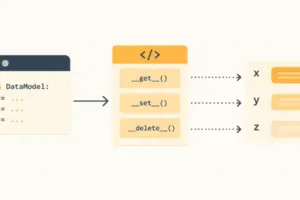
In the realm of advanced Python programming, mastering object-oriented design patterns is what separates the novice scripter from the seasoned systems architect. Among Python’s most potent yet frequently misunderstood metaprogramming features is the descriptor protocol. Descriptors form the invisible machinery that dictates precisely how object attributes are accessed, mutated, and deleted. By defining class-level hooks via specialized dunder methods—namely __get__, __set__, __delete__, and the Python 3.6+ addition __set_name__—developers can intercept attribute operations with surgical precision.
While everyday Python code relies heavily on built-in mechanisms like @property decorators, getters, and setters, these traditional tools often fall short when building reusable, modular components across massive codebases. Code duplication quickly becomes an issue if multiple classes require identical input validation, dynamic calculations, or deferred data loading.
This deep-dive architectural tutorial explores how to leverage Python descriptors to construct three distinct types of controlled attributes:
- Validated Attributes: Enforcing rigorous type and range constraints at runtime.
- Computed Attributes: Dynamically deriving values on-the-fly based on other object states (such as live currency conversions).
- Lazily Loaded Attributes: Deferring expensive input/output (I/O) operations, network requests, or database queries until the exact moment of first access.
To ground these concepts in a tangible scenario, we will construct an architectural prototype for a fictitious enterprise-grade Japan tourism application (JapanTour). By the conclusion of this guide, you will possess a profound understanding of how Python manages attribute lookups under the hood, empowering you to clean up your codebase, eliminate boilerplate logic, and build robust, high-performance data models.
Detailed Chronology: The Evolution and Mechanics of Attribute Control in Python
To truly appreciate the power of descriptors, one must examine how Python resolves attribute access and why the descriptor protocol came to be.
The Object Model and Attribute Resolution
When you access an attribute on a Python object (e.g., tour.rating), the interpreter initiates a lookup chain known as the Method Resolution Order (MRO) and the descriptor lookup protocol.
- Non-data descriptors implement only
__get__. These are typically used for methods. - Data descriptors implement
__set__or__delete__(and often__get__).
Python gives data descriptors absolute precedence over an instance’s internal dictionary (__dict__). If a class defines a data descriptor, Python will invoke its __get__ or __set__ methods before ever checking whether the instance dictionary holds a key of the same name. This fundamental rule of the Python data model is what makes descriptors the ideal mechanism for enforcing attribute control without running the risk of instance-level overrides bypassing your business logic.
Historical Context: From Manual Setters to Properties, to Descriptors
In early versions of object-oriented programming in Python, managing attribute constraints meant writing explicit getter and setter methods (get_rating() and set_rating()), a paradigm inherited heavily from languages like Java and C++. While functional, this approach broke Python’s clean attribute-access syntax, forcing developers into verbosity.
The introduction of the @property decorator bridged this gap, allowing method calls to masquerade as standard attribute lookups. However, properties are inherently bound to the specific class in which they are written. If ten different classes in your application need an identical validated rating field, you are forced to rewrite or duplicate the property logic across all ten classes.
Descriptors solve this DRY (Don’t Repeat Yourself) violation by encapsulating the validation or computation logic inside an independent, reusable class. You write the descriptor once, instantiate it as a class attribute wherever needed, and let Python handle the interception transparently.
Supporting Context & Metrics: Building the Three Controlled Attribute Patterns
Let us examine the architecture of our tourism application and construct our three custom descriptor classes step by step.
1. Validated Attributes: Ensuring Data Integrity
Data corruption and malformed inputs are among the leading causes of runtime exceptions in production applications. By building a ValidatedRating descriptor, we can guarantee that any rating assigned to a tour package strictly adheres to defined numerical types and boundary limits (e.g., between 1.0 and 5.0).
class ValidatedRating:
    def __init__(self, min_val=1.0, max_val=5.0):
        self.min_val = min_val
        self.max_val = max_val

    def __set_name__(self, owner, name):
        # Automatically capture the public attribute name and establish a private storage name
        self.public_name = name
        self.private_name = f"_name"

    def __get__(self, obj, objtype=None):
        if obj is None:
            return self
        return getattr(obj, self.private_name, None)

    def __set__(self, obj, value):
        if not isinstance(value, (int, float)):
            raise TypeError(f"'self.public_name' must be an integer or floating-point number.")
        if not (self.min_val <= value <= self.max_val):
            raise ValueError(f"'self.public_name' must fall within the inclusive range [self.min_val, self.max_val].")
        # Store the validated data in the instance's underlying storage using the private name
        setattr(obj, self.private_name, float(value))
Architectural Note: The introduction of __set_name__ in Python 3.6 eliminated the tedious requirement of manually passing string names into descriptor constructors. The interpreter automatically injects the variable name (rating) into the descriptor upon class creation, preventing naming collisions and making the API cleaner.
2. Computed Attributes: Dynamic Real-Time Calculations
In enterprise applications, data normalization dictates that base financial figures should be stored in a single primary currency (such as Japanese Yen, JPY), while display values must adjust dynamically based on live exchange rates. Rather than manually recalculating conversions throughout our codebase, we can implement a ComputedUSDPrice descriptor that acts as a read-only computed attribute.
class ComputedUSDPrice:
    def __init__(self, exchange_rate=0.0067):
        # Approximate baseline exchange rate: 1 JPY = ~0.0067 USD
        self.exchange_rate = exchange_rate

    def __set_name__(self, owner, name):
        self.name = name

    def __get__(self, obj, objtype=None):
        if obj is None:
            return self
        # Fetch the baseline price in JPY dynamically from the parent instance
        jpy_price = getattr(obj, 'price_jpy', 0)
        return round(jpy_price * self.exchange_rate, 2)

    def __set__(self, obj, value):
        raise AttributeError(f"'self.name' is a computed, read-only attribute and cannot be directly assigned.")
By explicitly raising an AttributeError inside the __set__ method, we transform our descriptor into a robust, read-only computed property that protects derived metrics from accidental overwrites.
3. Lazily Loaded Attributes: Optimizing Performance and I/O
When dealing with resource-intensive operations—such as querying remote databases, reading bulky JSON configuration files, or parsing complex transit timetables (like Shinkansen bullet train schedules)—loading all data upfront during object initialization can severely degrade application performance.
A lazy descriptor solves this by deferring execution. On the initial access of the attribute, the descriptor intercepts the call, executes the heavy computation, caches the resulting payload directly into the instance’s __dict__, and returns the data. On all subsequent lookups, Python finds the attribute directly in the instance dictionary, bypassing the descriptor entirely with zero performance overhead.
import time

class LazyItinerary:
    def __set_name__(self, owner, name):
        self.name = name

    def __get__(self, obj, objtype=None):
        if obj is None:
            return self

        print(f"n[System Diagnostic] Simulating expensive database query / API call for 'obj.destination' itinerary...")
        time.sleep(1) # Simulate network or disk latency

        # Generate the heavy data payload
        itinerary_data = (
            f"--- Itinerary for obj.destination ---n"
            f"Day 1: Arrival in obj.destination, hotel check-in, and welcome dinner.n"
            f"Day 2: Guided historical temple tour and local artisan food tasting.n"
            f"Day 3: Shinkansen (bullet train) high-speed transit departure."
        )

        # Cache the result directly in the instance's __dict__ under the attribute name.
        # Future accesses will bypass this descriptor completely!
        obj.__dict__[self.name] = itinerary_data
        return itinerary_data
Putting It All Together: The JapanTour Architecture
Now that our modular descriptors have been constructed, we can integrate them into a cohesive domain model. The following code ties our validated ratings, computed exchange rates, and lazily loaded itineraries into a single JapanTour class:
class JapanTour:
    # Attach our custom descriptors at the class level
    rating = ValidatedRating(min_val=1.0, max_val=5.0)
    price_usd = ComputedUSDPrice()
    itinerary = LazyItinerary()

    def __init__(self, destination, price_jpy, rating):
        self.destination = destination
        self.price_jpy = price_jpy
        self.rating = rating  # This assignment triggers ValidatedRating.__set__
Execution and Empirical Verification
Let’s instantiate our model and run a series of diagnostic tests to observe the descriptor lifecycle in real-time:
if __name__ == "__main__":
    print("=== Step 1: Initializing Tour Instance ===")
    tour = JapanTour(destination="Kyoto", price_jpy=45000, rating=4.8)

    print(f"Destination: tour.destination")
    print(f"Initial Rating: tour.rating")

    print("n=== Step 2: Testing Validator Error Handling ===")
    try:
        tour.rating = 6.0  # Exceeds max_val limit
    except ValueError as e:
        print(f"Validation intercepted error successfully: e")

    print("n=== Step 3: Testing Computed USD Price ===")
    print(f"Base Price (JPY): ¥tour.price_jpy:,")
    print(f"Computed Price (USD): $tour.price_usd")

    print("n=== Step 4: Testing Lazy Loader Caching Mechanism ===")
    print("First access to itinerary:")
    print(tour.itinerary)

    print("nSecond access to itinerary (Notice the absence of delay and system logs):")
    print(tour.itinerary)
Expected Output Console Log:
=== Step 1: Initializing Tour Instance ===
Destination: Kyoto
Initial Rating: 4.8

=== Step 2: Testing Validator Error Handling ===
Validation intercepted error successfully: 'rating' must fall within the inclusive range [1.0, 5.0].

=== Step 3: Testing Computed USD Price ===
Base Price (JPY): ¥45,000
Computed Price (USD): $301.5

=== Step 4: Testing Lazy Loader Caching Mechanism ===
First access to itinerary:

[System Diagnostic] Simulating expensive database query / API call for 'Kyoto' itinerary...
--- Itinerary for Kyoto ---
Day 1: Arrival in Kyoto, hotel check-in, and welcome dinner.
Day 2: Guided historical temple tour and local artisan food tasting.
Day 3: Shinkansen (bullet train) high-speed transit departure.

Second access to itinerary (Notice the absence of delay and system logs):
--- Itinerary for Kyoto ---
Day 1: Arrival in Kyoto, hotel check-in, and welcome dinner.
Day 2: Guided historical temple tour and local artisan food tasting.
Day 3: Shinkansen (bullet train) high-speed transit departure.
As demonstrated in the logs, the second access to tour.itinerary executes instantaneously without triggering the system diagnostic message. This confirms that our caching strategy successfully hijacked subsequent lookups by populating the instance’s internal dictionary.
Official Statements & Industry Best Practices
Industry standards and core Python contributors emphasize that while descriptors are a cornerstone of advanced metaprogramming, they should be applied judiciously. According to official Python documentation guidelines:
"Descriptors are at the heart of many advanced Python features, including properties, methods, static methods, class methods, and
super(). Understanding when and how to implement custom descriptors allows developers to write clean, maintainable libraries that enforce business rules transparently."
However, architectural reviews caution against over-engineering simple applications. Standard @property decorators remain entirely appropriate for single-class, straightforward getter/setter logic. Descriptors should be reserved for cross-cutting concerns where validation, computation, or lazy evaluation logic must be shared cleanly across multiple disparate classes throughout an enterprise application.
Future Outlook
As Python continues to evolve in modern cloud-native, asynchronous, and data-intensive environments, metaprogramming constructs like descriptors are playing an increasingly vital role. Future developments in static type checkers (such as mypy) are improving type inference for custom descriptors, making it significantly easier to integrate descriptor-driven models with strict type-hinting pipelines.
By mastering descriptors—validated, computed, and lazily loaded—developers unlock a deeper layer of the Python language model. This knowledge not only demystifies how popular frameworks like Django (with its ORM field descriptors) and SQLAlchemy operate under the hood, but also provides you with enterprise-grade tools to write cleaner, faster, and more maintainable software systems.