Executive Overview
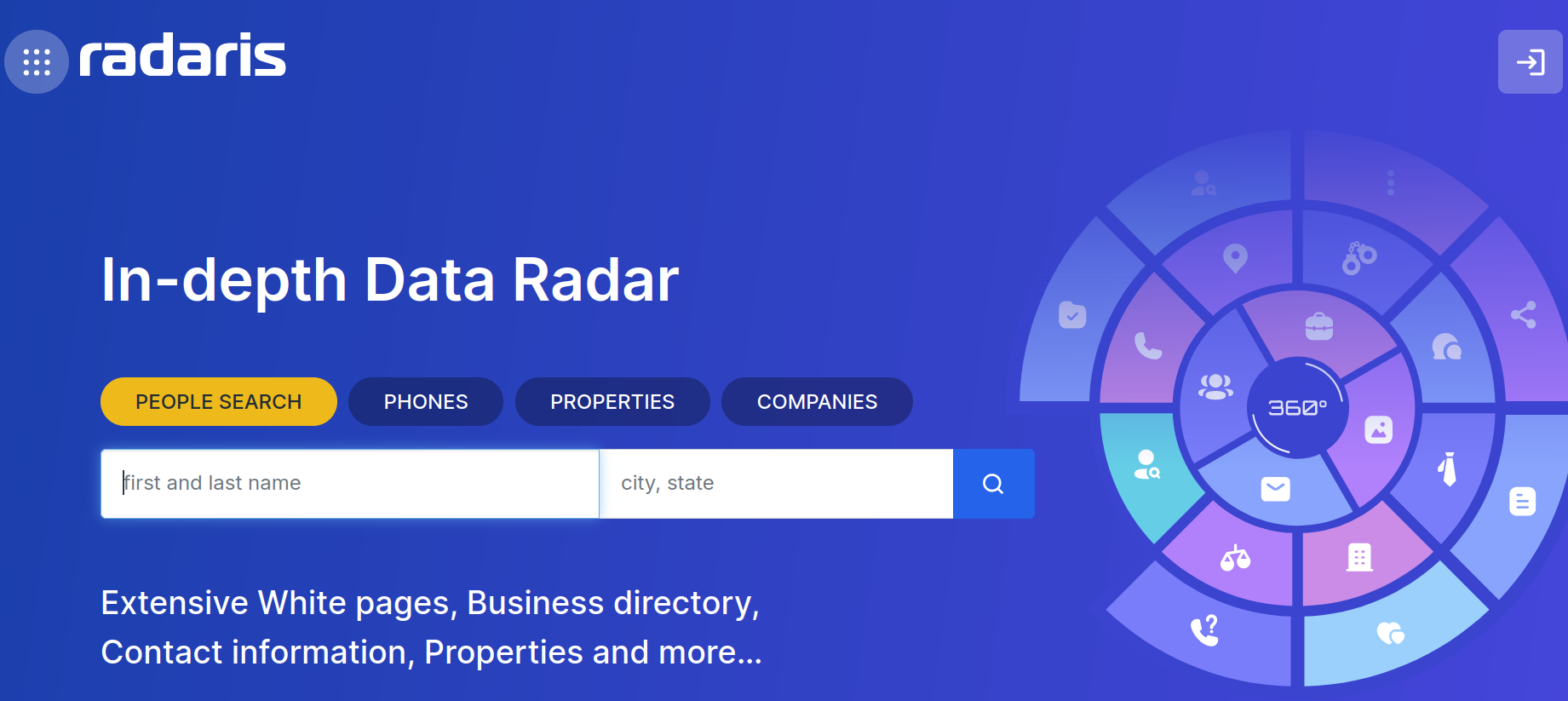
For over a decade, consumer data broker Radaris.com operated with apparent impunity. Specializing in the lucrative and often invasive people-search industry, the platform consistently ignored or stonewalled individual requests to remove personal information from its vast online databases. That era of unhindered operation, however, has come to a dramatic and definitive end.
In a landmark legal victory that sent shockwaves through the surveillance economy, a New Jersey court ordered the transfer of Radaris.com and more than a dozen associated data broker domains to the plaintiffs in a high-stakes privacy lawsuit. The legal onslaught was spearheaded by Atlas Data Privacy Corp, a firm aggressively targeting companies alleged to have violated Daniel’s Law. Named in honor of a fallen family member of a state jurist, the New Jersey statute provides for punitive fines of $1,000 per violation against commercial data brokers that publish the personal information of state law enforcement officials, judges, and government personnel.
The court-mandated transfer of Radaris.com—which now redirects visitors to an informational notice rather than selling detailed personal dossiers—marks a watershed moment in the accountability of data brokers. Backed by a massive corpus of internal emails and financial documents unsealed during litigation, this case not only dismantles a major player in the people-search ecosystem but also exposes the intricate web of offshore shell companies, fictitious executives, and cross-industry partnerships that sustain the modern data-broker industrial complex.
Detailed Chronology: From Subterfuge to Surrender
The Legal Catalyst and Initial Showdown
The legal reckoning for Radaris began in February 2024, when Atlas Data Privacy Corp filed a lawsuit alleging that the platform systematically violated Daniel’s Law. Less than a month later, investigative reporting by KrebsOnSecurity published a deep dive into the elusive masterminds behind the platform: Igor and Dmitry Lubarsky (also known as Lybarsky), Russian-born brothers residing in Massachusetts.
Rather than engaging transparently with the legal system or the press, the Lubarsky brothers and their legal representation—spearheaded by Val Gurvits of the Boston Law Group—responded with aggressive pushback. They threatened defamation lawsuits, asserted that the reporting was entirely inaccurate, and claimed that the true owners of Radaris were, in fact, Ukrainians residing in Ukraine.
Subsequent investigative reporting unraveled this defense, demonstrating that the operators had constructed a sprawling portfolio of data broker entities using a fictitious CEO named “Gary Norden.” Radaris attorneys later admitted in court that the persona was entirely fabricated, though the company had previously issued press releases quoting the fake executive to secure venture capital and investor funding.
The Shell Game and "Island-Hopping"
As the legal pressure intensified, Atlas re-filed and expanded its lawsuit in June 2025, capturing a wider array of Radaris-affiliated entities. According to Matt Adkisson, president and CEO of Atlas, Radaris relied on a well-practiced playbook of procedural delays and transnational shell games.
"We refer to this period as their island-hopping phase," Adkisson noted. "Privacy policies changed constantly, and new entities kept appearing from places like the Marshall Islands, the British Virgin Islands, and Seychelles."
Adkisson detailed how the defendants frequently shifted corporate ownership on paper. When terms of service were updated to claim that Radaris was managed by a newly minted Marshall Islands entity, Atlas hired local investigators, only to discover that the named management company did not legally exist.
This strategy of administrative attrition had historically served the network well. Similar tactics had been deployed in a 2017 class-action lawsuit (Huebner v. Radaris, LLC), where Radaris initially defaulted, prompting a court to order the transfer of the domain via Verisign. At that time, Radaris lawyers appealed, arguing that the true owner—a Cyprus-registered company called Bitseller Expert Limited—had been denied due process because it wasn’t explicitly named. The court halted the transfer, and the operational control quickly shifted to a Marshall Islands entity named Andtop Company in October 2020.
The Final Reckoning
Unlike previous plaintiffs who eventually grew fatigued by endless procedural roadblocks, Atlas committed the necessary time and resources to see the litigation through. Raj Parikh, a partner at PEM Law in New Jersey representing Atlas, noted that while financial recovery from foreign actors is notoriously difficult, safeguarding law enforcement officers and public officials remained the paramount objective.
On August 26, the presiding judge ruled that the defendants had repeatedly failed to appear and defend against the claims despite multiple opportunities. Consequently, the court ordered the transfer of Radaris.com and 13 sister domains to Atlas.

Legal defense strategy shifted following the ruling. Mr. Gurvits stepped aside, leaving the case to attorney Victor Worms, who argued that the default judgment was fundamentally void.
"We have made a motion to vacate that default judgment on the grounds that it is void since a non-entity has no legal capacity to sue or be sued," Worms stated, adding that the defense intends to pursue appeals against what they characterize as an unconstitutional forfeiture.
Supporting Context & Metrics: Inside the Radaris Empire
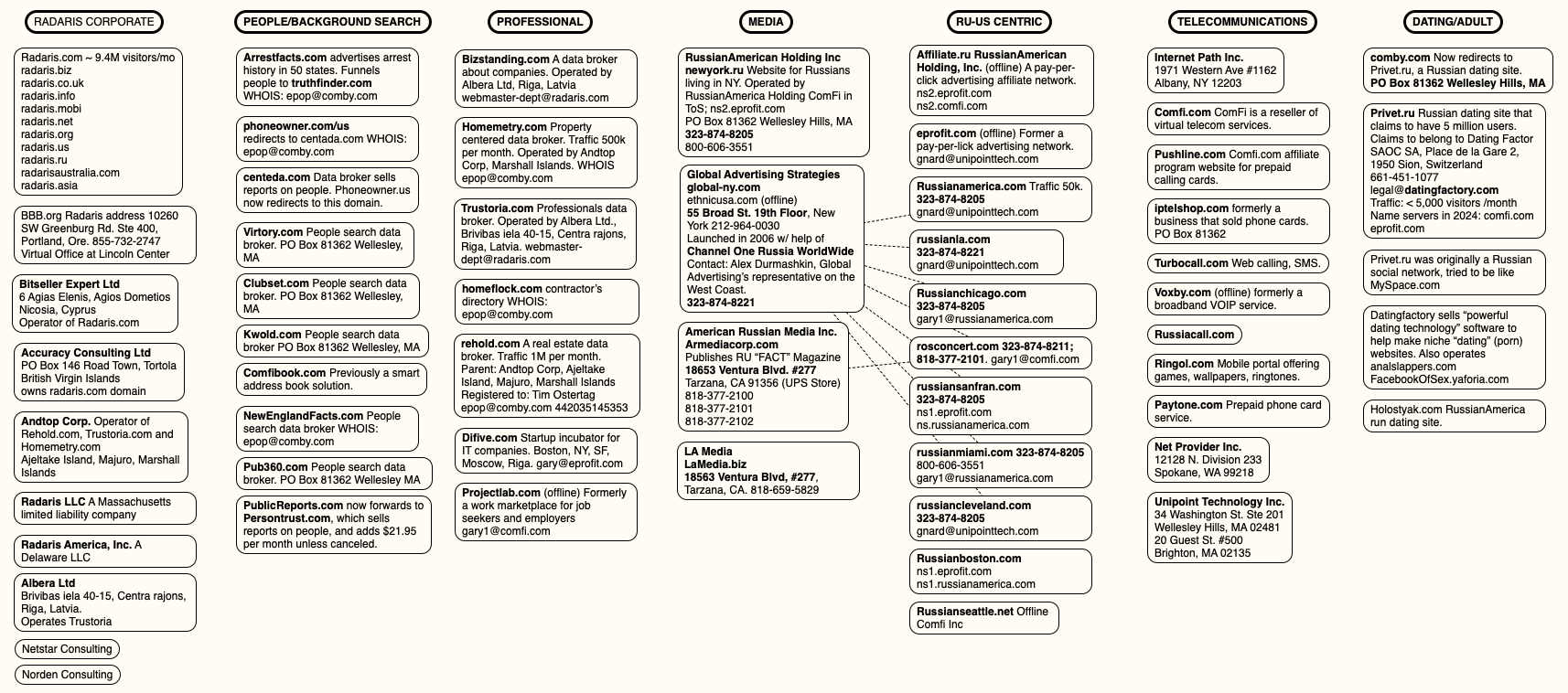
The breadth of the Radaris operation only became fully apparent through the discovery process. Atlas reported acquiring more than 10,000 internal emails and operational documents over the course of the litigation. This documentary evidence conclusively linked nominal corporate vehicles—including Radaris America, Inc., Bitseller Expert Limited, Digital Orbit Corp, Core Solutions Group Inc, Lucky Solutions Inc, Virtura Corp, Veripages Inc., Nuform Solutions Inc., Growth Data Advisors Inc., and Property Experts, Inc—to a single centralized administration.
Operational Metrics and Infrastructure
- Centralized Administration: Financial transactions, payment processing, domain registrations, and software-as-a-service vendor accounts were funneled through a tight-knit Boston-area group using administrative domains such as
difive.com,centerex.com,scienteco.com,eprofit.com,realmo.com, andpub360.com. - Lucrative Revenue Streams: Internal emails uncovered by Atlas revealed that Radaris.com generated approximately $42,000 per month, while sister site Veripages.com pulled in roughly $45,000 monthly.
- Industry Partnerships: A significant portion of this revenue was fueled by commercial partnerships with mainstream marketing and advertising entities, such as the Lifetime Value Company (operator of PeopleLooker, PeopleSmart, NumberGuru, and Bumper).
- The "Spreading the Disease and Selling the Cure" Loop: Documents exposed that the Radaris ecosystem earned up to $25,000 monthly through partnerships with Onerep, a company ostensibly marketed as a privacy service to help individuals remove personal data from people-search directories. Investigations have repeatedly shown deep ties between privacy removal startups and the founders of data-broker empires.
Official Statements and Industry Impact
The fall of Radaris.com serves as a profound stress test for state-level privacy initiatives like Daniel’s Law. While the New Jersey court successfully executed domain transfers and established a powerful precedent, the broader legal landscape remains deeply contested.
The data broker industry has mobilized aggressively against Daniel’s Law. Approximately 70 separate lawsuits filed by Atlas have been removed to federal court by data broker firms challenging the statute as unconstitutionally broad and a violation of First Amendment protections. The U.S. Court of Appeals for the Third Circuit is currently reviewing these challenges, with industry observers anticipating that the ultimate resolution will reach the U.S. Supreme Court.
State-level momentum, however, continues to build. At least 14 other states have enacted statutes modeled after Daniel’s Law. Conversely, pushback remains fierce; in August 2025, a federal district court ruled West Virginia’s iteration of Daniel’s Law to be facially unconstitutional under the First Amendment.
Future Outlook: The Need for Comprehensive Federal Reform
Privacy experts argue that piecemeal state laws—while vital for protecting vulnerable public officials—cannot adequately address the systemic privacy crisis plaguing the United States.
Justin Sherman, a privacy expert and author of the forthcoming book The Middlemen, which explores the mechanics of the data broker industry, points out that the technology and surveillance lobbies continue to thwart federal legislative efforts.
"These days at the federal level, add in the intense amount of lobbying against these laws from social media companies, big tech, cryptocurrency firms, and now AI proponents in the mix who claim that limiting their data scraping is somehow going to collapse the whole U.S. economy under Chinese rule," Sherman observed.
Sherman emphasizes that people-search platforms will continue to proliferate unless Congress enacts robust federal data protection standards. Current state privacy frameworks routinely exempt records categorized as "public" or "government" documents—including voting registries, property deeds, marriage licenses, motor vehicle records, criminal histories, and professional licenses. This structural loophole allows data brokers to legally harvest and monetize information that ordinary citizens have no practical way of concealing.
Recent high-profile breaches, such as the exposure of 153 million driver’s licenses via identity service provider IDScan.net, underscore the escalating dangers of unregulated data accumulation and scraping. Without baseline federal controls limiting how scraped or collected personal data can be stored, shared, and monetized, isolated legal victories like the seizure of Radaris.com represent crucial battles won in a much larger, ongoing war for digital privacy.
"The average person can look at Daniel’s Law and have a perfectly normal reaction, which is that everyone should be covered, not just police and judges," Sherman concluded. "But we don’t need more wake-up calls. We’ve had eight million wake-up calls already on the need for better privacy laws. The lack of comprehensive federal privacy law is not for a lack of knowledge, and anyone claiming otherwise is either not reading the news or kidding themselves."